
Psyche Spacecraft
- 11 May 2026
In News:
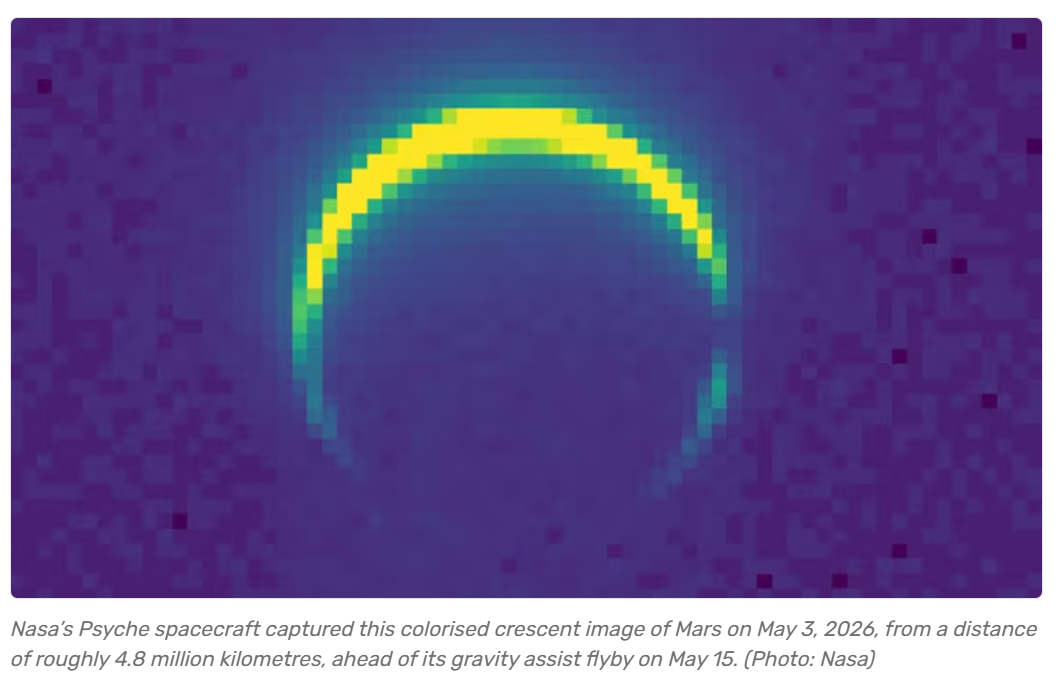
In a significant milestone for deep-space exploration, NASA’s Psyche spacecraft recently captured a rare and striking crescent view of Mars from a distance of approximately 5 million kilometers. This imaging feat occurred during a critical gravity-assist maneuver, where the spacecraft utilized the Red Planet's gravitational pull to slingshot itself toward its ultimate destination: the metal-rich asteroid, 16 Psyche.
Mission Overview and Timeline
Launched on October 13, 2023, the Psyche mission represents NASA’s first endeavor to explore a world that is not made of rock or ice, but largely of metal.
- Journey to the Belt: The spacecraft is currently navigating toward the outer main asteroid belt between Mars and Jupiter.
- Arrival and Orbit: The gravity of Asteroid Psyche is expected to capture the spacecraft in late July 2029.
- Scientific Operations: The primary mission is slated to begin in August 2029. The spacecraft will spend roughly two years in orbit, performing comprehensive mapping, surface photography, and composition analysis.
The Target: Asteroid 16 Psyche
Scientists believe that Asteroid Psyche might be the exposed nickel-iron core of an early planet—a "planetesimal"—that lost its rocky outer layers due to violent collisions billions of years ago. By studying it, researchers hope to gain a "look inside" the cores of terrestrial planets like Earth, which are otherwise unreachable due to extreme heat and pressure.
Spacecraft Features and Propulsion
The Psyche spacecraft, roughly the size of a small van, incorporates cutting-edge deep-space technology:
- Solar-Electric Propulsion: Unlike traditional chemical rockets, Psyche utilizes Xenon gas as propellant. This system uses electricity from solar arrays to accelerate xenon ions, creating a gentle but consistent thrust that allows the craft to gain immense speed over time.
- Efficiency: This propulsion method is highly efficient for long-duration missions, allowing for greater payload capacity and more precise orbital maneuvering.
Scientific Payload: The Instruments of Discovery
To decode the history of the asteroid, the spacecraft carries a suite of high-precision instruments:
- Magnetometer: Designed to detect if the asteroid possesses a remnant magnetic field. Finding such a field would strongly indicate that the asteroid was once the core of a molten planet.
- Gamma-Ray and Neutron Spectrometer: This instrument allows scientists to identify the specific chemical elements (such as iron, nickel, and silicon) that comprise the asteroid's surface material by measuring the energy of particles rebounding from it.
- Multispectral Imager: Comprising a pair of identical cameras with telescopic lenses, this tool will photograph the surface in various wavelengths of light to reveal its topography and geological features.
Strategic Significance for Space Science
The Psyche mission is a prime example of "Discovery Class" missions aimed at fundamental questions of planetary origin. It highlights:
- Origin of Life and Earth: Understanding how planetary cores form is essential to understanding why Earth developed a magnetic field, which shields us from lethal solar radiation.
- Innovation in Interplanetary Navigation: The successful imaging of Mars during the gravity assist demonstrates the precision of modern deep-space navigation and the utility of planetary flybys to save fuel and increase mission longevity.
India–Vietnam Strategic Partnership

- 11 May 2026
In News:
In May 2026, the bilateral relationship between India and Vietnam reached a historic milestone as both nations elevated their ties to an Enhanced Comprehensive Strategic Partnership during the state visit of Vietnamese President Tô Lâm to India. This elevation reflects a deep-seated convergence of interests regarding Indo-Pacific stability, maritime security, and the pursuit of strategic autonomy in an increasingly multipolar world.
The Strategic Backbone: Defence and Maritime Security
Defence cooperation has transitioned from mere buyer-seller interactions to a robust strategic pillar. The partnership is defined by a mutual commitment to a "free, open, and rules-based Indo-Pacific."
- Capacity Building: India continues to provide advanced training assistance and defence financing to Vietnam.
- Asset Transfers: The transfer of military assets, such as the INS Kirpan, serves as a symbol of India’s commitment to enhancing Vietnam’s maritime patrol capabilities.
- Maritime Domain Awareness (MDA): Both nations have intensified cooperation in maritime security to counter common challenges in the South China Sea, ensuring the protection of Sea Lines of Communication (SLOCs).
Economic Resilience and Trade Expansion
Economic engagement is being leveraged as a tool for strategic resilience. As both nations seek to de-risk their supply chains, trade has become a primary vehicle for integration.
- Trade Volume: Bilateral trade has officially surpassed the $16 billion mark.
- Vision 2030: A roadmap has been established to scale this trade to $25 billion by 2030, focusing on diversifying the basket of goods and services.
- Critical Sectors: New avenues for cooperation have opened in critical minerals, green energy, and the development of a resilient economic architecture to withstand global market volatility.
Vietnam’s Role in India’s ‘Act East’ Policy
Vietnam stands as a central pillar of India’s Act East Policy and its broader Indo-Pacific Oceans Initiative (IPOI).
- ASEAN Linkage: As one of the most vibrant economies in Southeast Asia, Vietnam acts as a gateway for India’s deeper engagement with the ASEAN bloc.
- Strategic Balancing: The partnership contributes to regional balancing alongside powers like Japan, Australia, and the US. Notably, both India and Vietnam maintain strategic autonomy, choosing to collaborate based on shared principles rather than joining formal military alliance systems.
Emerging Technology and Connectivity
The "Enhanced" nature of the partnership in 2026 emphasizes the transition into high-technology domains:
- Emerging Tech: Joint ventures in semiconductors, AI, and telecommunications are being prioritized.
- Connectivity: Improving physical and digital connectivity remains a priority to facilitate smoother movement of goods and people between the two regions.
- Space Cooperation: Collaborative efforts in satellite tracking and remote sensing for disaster management and resource mapping.
Solid Waste Management (SWM) Rules, 2026
- 11 May 2026
In News:
The Solid Waste Management (SWM) Rules, 2026, which came into effect on April 1, 2026, were intended to be a watershed moment for India’s environmental governance. However, the framework has sparked a nationwide debate regarding the "Centralisation Reflex" of the Union government. While the rules aim for uniformity, critics argue they overlook the principles of subsidiarity and federalism, potentially prioritizing bureaucratic compliance over actual ecological restoration.
The Scale of India’s Ecological Emergency
India is currently grappling with a waste crisis that has evolved into a multi-dimensional ecological emergency. Centralized management has often failed to address the granular realities of this crisis:
- Fiscal Inefficiency: Currently, 40%–50% of municipal budgets are drained by secondary transport (moving waste to distant landfills) rather than processing it at the source.
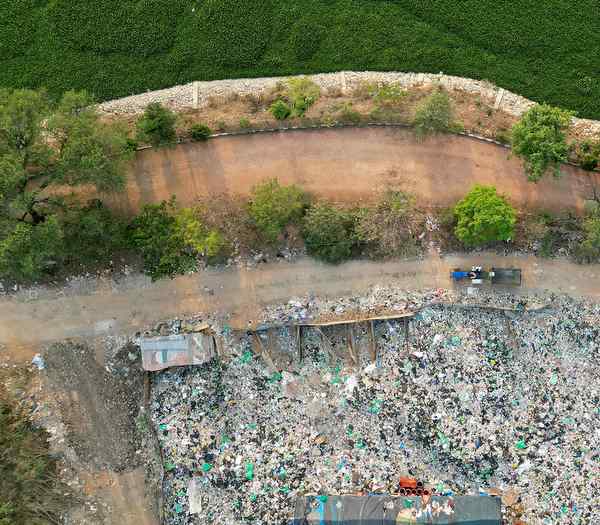
- The Landfill Menace: Urban centers are ringed by "mountains of methane." The 2024 fires in Kochi and Delhi underscored the catastrophic air pollution and greenhouse gas emissions stemming from these legacy dumpsites.
- Urban and Rural Clogging: In cities like Bengaluru and Mumbai, plastic-clogged drains were identified as the primary driver of the 2025 monsoon floods. Meanwhile, rural India is facing a new crisis: a surge in e-waste and hazardous pesticide containers without any localized collection mechanisms.
- Water Contamination: Toxic leachate from landfills adjacent to water bodies—visible in the hyacinth-choked lakes of Bengaluru—is leading to irreversible nutrient loading and groundwater poisoning.
The Centralisation Reflex: Why Top-Down Models Persist
The 2026 Rules lean heavily toward a "one-size-fits-all" technocratic vision. This centralization is driven by several institutional beliefs:
- The Incapacity Argument: A prevailing assumption that Gram Panchayats and Urban Local Bodies (ULBs) lack the technical competence to manage waste, leading the Centre to design a single operational blueprint for both a metropolis like Mumbai and a remote Himalayan village.
- Trust Deficit: The mandate for a centralized online portal managed by the Central Pollution Control Board (CPCB) forces local bodies to act as mere "data suppliers" rather than autonomous governors.
- Judicialised Administration: To meet court-mandated timelines and avoid litigation, the Centre creates rigid, uniform standards that are easier to defend legally but difficult to implement administratively at the grassroots level.
- Atrophy of Local Expertise: By shifting decision-making to New Delhi, local bodies lose the opportunity to "learn by doing," becoming dependent on central instructions rather than developing indigenous composting or recycling models.
Implications for Governance and Federalism
The shift toward centralized control carries significant risks for India’s democratic and administrative fabric:
- Blurred Accountability: When a village fails to manage waste based on a design made in Delhi, officials often engage in a "blame game"—local bodies cite a lack of funds, while the Centre alleges poor implementation.
- Erosion of the State List: Sanitation and public health are State subjects under the Seventh Schedule. The 2026 Rules effectively reduce States to mere implementing agencies, stifling their ability to act as "policy laboratories."
- Unproductive Compliance: The current system prioritizes "paper-based compliance." Sanitation workers are frequently diverted from street-level waste management to perform data entry for central dashboards.
- Fiscal Stress: New mandates often arrive without formula-based financing, forcing small local bodies to purchase expensive equipment they cannot maintain, leading to the quiet evasion of the rules.
A Decentralised Way Forward: The Path to Subsidiarity
To transform the SWM Rules, 2026, from a technocratic exercise into a successful ecological tool, the following reforms are essential:
- Embrace Subsidiarity: Authority must shift to the lowest level of governance—the Ward and Gram Sabha. Decisions should be made by those closest to the waste generation, utilizing local knowledge and informal worker networks.
- State-Led Policy Laboratories: States should be allowed to frame their own rules for a five-year period to test novel solutions, such as Kerala’s model of Self-Help Group-led composting.
- Phased and Tiered Rollout: Strict, high-tech compliance should be prioritized for megacities (population >1 crore), while rural hamlets should be allowed to adopt simplified, nature-based processing models.
- Shared Federal Data Platforms: The CPCB portal should evolve from a "monitoring tool" into a "service platform" where local bodies can customize dashboards for their own specific governance needs.
- Predictable Financing: Every new obligation mandated by the Rules must be backed by statutory, formula-based financial transfers to ensure local bodies are not set up for failure.
Cyrtodactylus varadgirii

- 11 May 2026
In News:
In a significant boost to urban biodiversity records, wildlife enthusiasts and researchers recently spotted the relatively uncommon gecko species, Cyrtodactylus varadgirii, within the Aarey forest of Mumbai. Commonly known as Giri’s Geckoella, this elusive reptile has long been considered a "disappearing resident" of the city's green lungs. Its recent sighting underscores the critical role that urban forests play as refugia for endemic wildlife amidst rapid metropolitan expansion.
Taxonomy and Discovery
The species belongs to the Gekkonidae family and was formally described in 2016. It is named in honor of the renowned Indian herpetologist Dr. Varad Giri, acknowledging his extensive contributions to the study of Indian reptiles. While it was once grouped with other similar geckos, detailed morphological and genetic analysis established it as a distinct species.
Biological and Behavioral Characteristics
Cyrtodactylus varadgirii is a specialized ground-dwelling reptile with distinct life-history traits:
- Nocturnal and Terrestrial: Unlike common house geckos that climb walls, this species is terrestrial. It is primarily active at night, navigating the forest floor.
- Diet and Habitat: It is strictly insectivorous, playing a vital role in controlling insect populations. It resides primarily in dense leaf litter, which provides both camouflage and hunting grounds.
- Adaptability: One of its most unusual features is its presence in both pristine natural habitats and human-modified landscapes. It has been recorded in urban green spaces and open areas, marking a departure from many of its close relatives who are restricted to deep forests.
Geographical Distribution
Giri’s Geckoella is endemic to India, with a distribution range covering parts of:
- Western India: Primarily Maharashtra (including Mumbai and the northern Western Ghats) and Gujarat.
- Central India: Recorded in parts of Madhya Pradesh.
Despite this relatively wide distribution across three states, the species remains "poorly known" due to a lack of long-term ecological studies. Most sightings are recorded during the monsoon season, when increased moisture levels likely drive activity or visibility.
Conservation Significance and Challenges
The rediscovery of the gecko in Aarey Forest is particularly relevant for environmental governance and conservation biology:
- Urban Biodiversity: Its survival in a city like Mumbai highlights the resilience of certain endemic species, provided their micro-habitats (like leaf litter and soil quality) remain undisturbed.
- Data Deficiency: There is a significant gap in the "natural history" of the species. Beyond occurrence records, little is known about its breeding cycles, population density, or specific threats.
- Habitat Fragmentation: As a terrestrial gecko dwelling in leaf litter, it is highly vulnerable to forest fires, land clearing, and the "beautification" of parks which involves removing natural debris.
Orbital Data Centres and the Pathfinder Mission
- 11 May 2026
In News:
In a landmark collaboration that signals a paradigm shift in space-based technology, Bengaluru-based satellite startup Pixxel and Indian AI firm Sarvam AI have partnered to develop Pathfinder. Scheduled for launch by the final quarter of 2026, Pathfinder is set to be India’s first “orbital data centre” satellite. This mission represents a move toward decentralized, space-based computing, aimed at overcoming the physical and economic constraints of terrestrial AI infrastructure.
What is an Orbital Data Centre?
Traditionally, satellites function as data collectors; they capture high-resolution imagery or signals and transmit these massive raw files to ground stations for processing. This creates a significant "bandwidth bottleneck."
An Orbital Data Centre utilizes edge computing, placing high-performance hardware—specifically data-centre-grade Graphics Processing Units (GPUs)—directly into Low Earth Orbit (LEO). Instead of sending raw data back to Earth, the satellite processes the information in space, transmitting only "actionable insights" or finished analysis to the ground.
The Strategic Significance of Space-Based Computing
The shift from Earth to orbit is driven by several critical factors:
- Overcoming Terrestrial Constraints: Ground-based data centres are increasingly burdened by high land costs and the massive water requirements for cooling. Furthermore, the energy consumption of generative AI is hitting the limits of local power grids.
- Continuous Energy Supply: In specific orbits, solar power is effectively continuous. This provides a source of "free" electricity, making space an economically attractive location for high-intensity computation.
- Solving Data Bottlenecks: Hyperspectral imaging generates enormous datasets. Processing this data in-situ (at the source) eliminates the expensive and slow downlink of high-resolution files.
- Scalability and Commercial Viability: Emerging launch capabilities, such as high-payload rockets and the potential for large constellations (100–500 satellites), suggest that space-based computing could eventually rival terrestrial cloud infrastructure.
The Pathfinder Mission: India’s Technology Demonstrator
Pathfinder is a 200-kg class satellite designed to validate the technical feasibility of in-orbit data processing.
Key Components & Objectives:
- Datacentre-grade GPUs: It will carry high-performance GPUs similar to those used in Earth-based AI clusters.
- Hyperspectral Payloads: The satellite will feature Pixxel’s flagship hyperspectral camera, providing high-fidelity Earth observation data.
- Sovereign AI Backbone: Sarvam AI will integrate full-stack language models and an AI inference platform. This allows for AI training and inference to occur entirely within the satellite’s systems.
- Manufacturing: The craft is being built at Gigapixxel, Pixxel’s advanced facility designed for large-scale satellite production.
Note: While this is an Indian mission, the name "Pathfinder" also references NASA’s 1997 Mars Pathfinder mission, which deployed the Sojourner rover.
Formidable Challenges: The Harsh Reality of Space
Despite the benefits, computing in a vacuum presents unique engineering hurdles:
- Thermal Management: On Earth, fans and water systems use convection to cool hardware. In the vacuum of space, heat must be dissipated through radiative cooling using complex heat-transfer loops and radiating panels.
- Radiation Exposure: Cosmic radiation can cause “bit flips” (random changes in computer code) and degrade semiconductors. Hardware must be shielded or made "radiation-hardened," which adds weight and cost.
- Redundancy and Repair: Unlike a server room on Earth, a satellite cannot be easily repaired. High levels of redundancy are required to manage "eclipse periods" (when the satellite is in Earth's shadow) and potential hardware failures.
- Miniaturization: Scaling down power-hungry GPUs into a compact 200-kg payload requires extraordinary breakthroughs in power management and engineering.