
Index of Services Production (ISP)

- 26 Jun 2026
In News:
The Ministry of Statistics and Programme Implementation (MoSPI) is set to launch the Index of Services Production (ISP) in July 2026. The new index is expected to become India's first high-frequency indicator for measuring the performance of the services sector, similar to the Index of Industrial Production (IIP) for industry.
About the Index of Services Production (ISP)
The Index of Services Production (ISP) is a short-term economic indicator that measures changes in the real output of service-producing industries over time relative to a specified base year. It is being developed with 2024–25 as the proposed base year and will primarily use Goods and Services Tax (GST) data to capture economic activity in the formal services sector.
The objective of the ISP is to provide timely information on the growth and performance of India's services sector, which contributes the largest share to the country's Gross Value Added (GVA). The index is expected to improve short-term economic assessment and strengthen evidence-based policymaking.
Data Sources
The ISP will draw information from multiple administrative and statistical databases to ensure comprehensive coverage of service-sector activities.
Its principal data sources include:
- Administrative data for sectors such as air transport, railways, banking, and insurance.
- GST data for wholesale and retail trade, hospitality, road and water transport, warehousing, telecommunications, real estate, information technology services, professional services, and entertainment.
- Annual Survey of Incorporated Services Sector Enterprises (ASISSE) data for health and education services, which will be incorporated in subsequent phases.
Since the index is largely based on GST-registered enterprises, it will primarily reflect the performance of the formal services sector.
Key Features
- Base Year: 2024–25.
- Developed by the Ministry of Statistics and Programme Implementation (MoSPI).
- Measures changes in the volume of output rather than price changes.
- Sectoral weights are assigned based on each sector's contribution to Gross Value Added (GVA) as reported in the National Accounts Statistics (NAS).
- Designed to complement existing indicators such as the Index of Industrial Production (IIP) and national income estimates.
Doctrine of Constructive Res Judicata

- 26 Jun 2026
In News:
The Supreme Court has recently reiterated that the doctrine of constructive res judicata, embodied in Explanation IV to Section 11 of the Code of Civil Procedure (CPC), 1908, is intended to prevent parties from litigating disputes in a piecemeal manner and to ensure finality in judicial proceedings.
What is Res Judicata?
The doctrine of Res Judicata is a well-established legal principle that originated in the English Common Law system. The Latin term res judicata literally means "a matter already judged." It is also referred to as the doctrine of claim preclusion.
The principle provides that once a competent court has finally decided a dispute between the same parties, the same matter cannot be litigated again before the same or another court. This prevents repeated lawsuits on identical issues and ensures certainty and finality in the administration of justice.
In India, the doctrine is codified under Section 11 of the Code of Civil Procedure (CPC), 1908, and is applicable to both civil and criminal proceedings, though its operation differs according to the nature of the proceedings.
What is Constructive Res Judicata?
- Constructive Res Judicata is an extension of the doctrine of res judicata. It bars not only issues that were actually decided in an earlier suit but also issues that could and ought to have been raised during the earlier proceedings but were deliberately or negligently omitted.
- Thus, a party cannot file a fresh suit based on the same cause of action by raising new grounds that were available at the time of the earlier litigation. The law treats such omitted issues as if they had already been adjudicated.
- The doctrine derives its statutory basis from Order II Rule 2 read with Section 11 of the CPC, particularly Explanation IV to Section 11.
Explanation IV of Section 11
Explanation IV states:
"Any matter which might or ought to have been made a ground of defence or attack in a former suit shall be deemed to have been a matter directly and substantially in issue in such suit."
This legal fiction ensures that parties present their entire case in one proceeding rather than splitting their claims across multiple suits.
Essential Conditions
The doctrine of constructive res judicata applies when the following conditions are satisfied:
- The parties in both proceedings are the same or claim under the same parties.
- The subject matter of both proceedings is substantially identical.
- The issue raised in the subsequent suit could and ought to have been raised in the earlier proceeding.
- The earlier case was decided by a court of competent jurisdiction.
- The earlier decision attained finality and was decided on its merits.
Objectives
The doctrine seeks to:
- Prevent multiplicity of litigation.
- Ensure finality of judicial decisions.
- Avoid abuse of the judicial process.
- Promote judicial economy and efficient use of court resources.
- Protect parties from repeated litigation over the same dispute.
Pradhan Mantri Rashtriya Bal Puraskar (PMRBP)

- 26 Jun 2026
In News:
The Ministry of Women and Child Development has invited nominations for the Pradhan Mantri Rashtriya Bal Puraskar (PMRBP), India's highest civilian honour for children, recognising exceptional achievements in various fields.
About Pradhan Mantri Rashtriya Bal Puraskar (PMRBP)
- The Pradhan Mantri Rashtriya Bal Puraskar (PMRBP) is India's premier national award instituted to honourchildren between the ages of 5 and 18 years who have demonstrated exceptional courage, innovation, talent, resilience, leadership, or outstanding service to society.
- Introduced in 2019, the award seeks to recognise young achievers who have made remarkable contributions in diverse fields and inspire other children to pursue excellence and nation-building.
- The award is presented annually by the President of India in New Delhi on 26 December, observed as Veer Bal Diwas.
Veer Bal Diwas
Veer Bal Diwas is observed every year on 26 December to commemorate the supreme sacrifice of Sahibzada Zorawar Singh and Sahibzada Fateh Singh, the younger sons of the tenth Sikh Guru, Guru Gobind Singh, who displayed extraordinary courage and steadfastness in the face of persecution.
Award Categories
The PMRBP recognises outstanding achievements in six categories:
- Bravery
- Social Service
- Environment
- Sports
- Art and Culture
- Science and Technology
Eligibility and Selection
The award is open to children aged between 5 and 18 years who have demonstrated exceptional achievements or acts of courage with a lasting social impact.
Children may be nominated in more than one category, although each achievement is evaluated separately. While the award is generally not conferred posthumously, exceptional cases may be considered.
An Expert Committee evaluates the nominations based on the significance, originality, impact, and excellence of the achievements.
Award Components
The award comprises:
- A Medal
- A Certificate
- A Citation
Approximately 25 children are selected every year for their outstanding accomplishments.
Nodal Ministry
- Ministry of Women and Child Development (MoWCD)
The Ministry administers the award and oversees the nomination and selection process in consultation with the Expert Committee.
Objectives
The Pradhan Mantri Rashtriya Bal Puraskar aims to:
- Recognise exceptional achievements of children across diverse fields.
- Encourage innovation, creativity, courage, and leadership among young citizens.
- Inspire children to contribute positively to society and nation-building.
- Promote a culture of excellence, social responsibility, and public service.
16th-Century Vijayanagara Inions Unearthed in Seshachalam Forest
- 26 Jun 2026
In News:
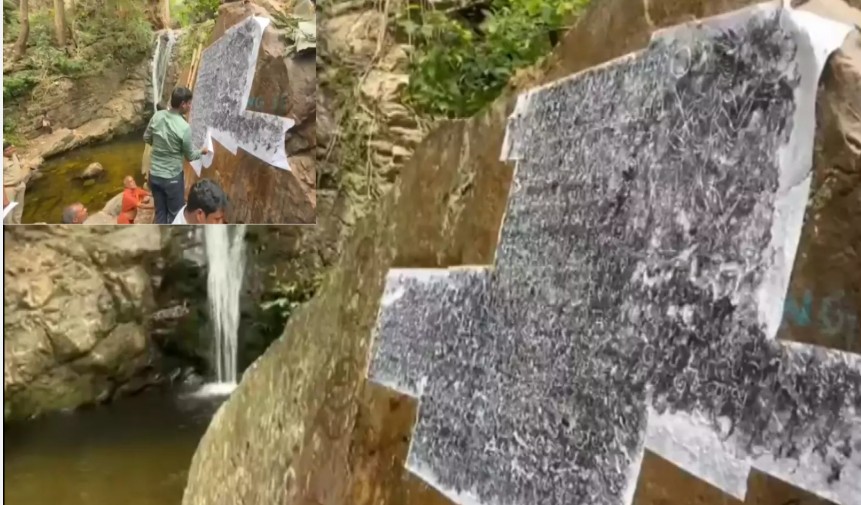
The Archaeological Survey of India (ASI) has discovered three 16th-century inions belonging to Vijayanagara king Sadasivaraya in the Seshachalam Forest of Tirupati district, Andhra Pradesh.
About the Discovery
- The newly discovered inions have been precisely dated to 31 July 1554 CE and are engraved in Telugu, Tamil, and Kannada, reflecting the linguistic diversity and administrative inclusiveness of the Vijayanagara Empire.
- The inions primarily record the religious activities of King Sadasivaraya, who visited Papavinasa on a pilgrimage and commissioned the construction of a Shiva temple and a monastery (Mutt) during his visit.
Key Findings
The inions throw light on several aspects of Vijayanagara administration and religious patronage:
- They record the construction of a Shiva temple and Mutt at Papavinasa under the patronage of King Sadasivaraya.
- They mention the assignment of tax revenues (Kaanika) and land grants from two villages to finance daily worship, food offerings (Naivedya), and temple maintenance at the GudimallamParasurameswara Temple.
- The inions also refer to SadasivaBasavanna Odeya, a disciple of LingannaVodaya of Bendekeri, and Peddayya, son of Chembhaperiya, who served as the composer and temple accountant.
These records provide valuable insights into the financial management and institutional support extended to temples during the Vijayanagara period.
Historical Significance of Gudimallam Temple
The inions reaffirm the importance of the GudimallamParasurameswara Temple, widely regarded as India's oldest surviving Shiva temple, dating back to the 2nd century BCE.
The discovery establishes that the shrine continued to receive direct royal patronage, land grants, and financial support under the Vijayanagara rulers despite the growing prominence of nearby pilgrimage centres such as Tirumala. It highlights the continuity of Shaivite worship and the preservation of ancient sacred sites during the medieval period.
Vijayanagara Empire (1336–1646 CE)
The Vijayanagara Empire was one of the greatest empires of medieval South India. It was founded in 1336 CE by Harihara I and Bukka Raya I of the Sangama Dynasty on the banks of the Tungabhadra River. The empire served as a major political, cultural, and economic power for over three centuries.
The empire was ruled successively by four dynasties:
- Sangama
- Saluva
- Tuluva
- Aravidu
Its golden age was witnessed during the reign of Krishnadevaraya (Tuluva Dynasty), who is remembered for his military successes, efficient administration, literary contributions, and patronage of the Ashtadiggajas, the celebrated group of eight Telugu scholars. He also authored the famous Telugu work Amuktamalyada.
Administration
The Vijayanagara administration was characterised by the Nayankara (Amara-Nayaka) System, under which military chiefs were granted Amaram (land assignments) in return for maintaining troops, collecting revenue, and rendering military service to the king. This decentralised system played a crucial role in maintaining the empire's vast territorial control.
Art and Architecture
The empire marked the culmination of the Dravidian style of temple architecture. Important architectural features included:
- Massive Raya Gopurams
- Ornate monolithic pillars
- Spacious Kalyana Mandapas
- Intricately carved temple complexes
Prominent examples include the Vittalaswamy Temple and the Hazara Rama Temple at Hampi, a UNESCO World Heritage Site.
Foreign Accounts
The prosperity and cosmopolitan nature of the empire have been documented by several foreign travellers and envoys, including:
- Ibn Battuta (Morocco)
- Nicolo de Conti (Italy)
- Abdur Razzak (Persia)
- Domingo Paes (Portugal)
Their accounts describe the empire's flourishing trade, urban planning, military strength, and immense wealth.
Decline
The empire suffered a decisive setback after the Battle of Talikota (Rakshasi-Tangadi) in 1565, where the combined forces of the Deccan Sultanates defeated the Vijayanagara army. Although the empire continued under the Aravidu Dynasty, it gradually declined, bringing an end to one of the most remarkable phases of South Indian history.
Seismic Doublet (Doublet Earthquake)
- 26 Jun 2026
In News:
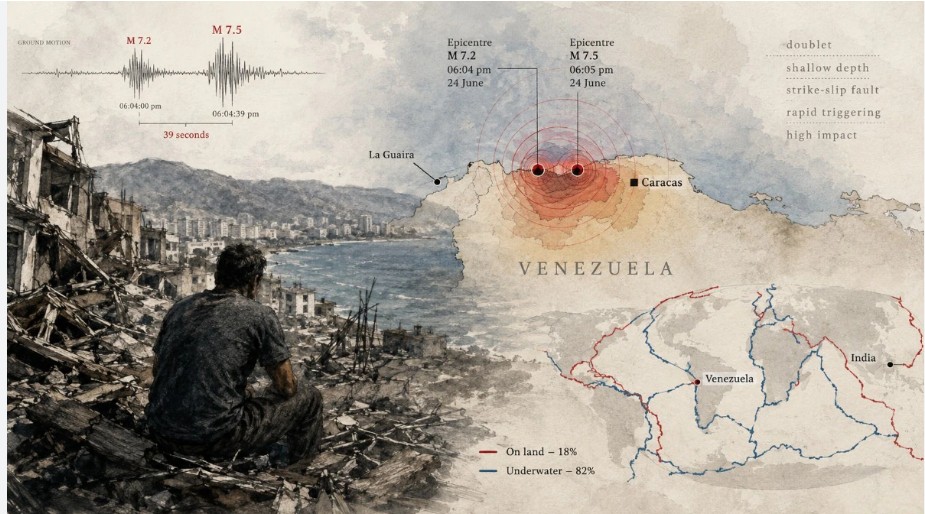
The Government of Venezuela has declared a nationwide State of Emergency after two powerful earthquakes of magnitude 7.2 and 7.5 struck off its north-central coast within a short interval. The rare seismic doublet caused extensive damage to infrastructure and significant loss of life.
What is a Seismic Doublet?
A Seismic Doublet (or Doublet Earthquake) refers to the occurrence of two earthquakes of nearly equal magnitude that strike close together in both time and location.
Unlike a typical mainshock-aftershock sequence, where the aftershocks are significantly weaker than the main earthquake, a seismic doublet involves two major earthquakes of comparable intensity. The second earthquake is not merely an aftershock but an independent large event triggered by stress transferred from the first rupture.
Mechanism
When the first earthquake occurs, it does not completely release the accumulated tectonic stress along a fault. Instead, part of this stress is rapidly transferred to a neighbouringfault segment or an asperity (a strongly locked patch of rock along a fault).
If the adjacent fault is already close to failure, the additional stress may trigger another major rupture within a short period, resulting in a seismic doublet.
Why is Venezuela Highly Earthquake-Prone?
Venezuela is situated along the active boundary between the Caribbean Plate and the South American Plate, making its northern region highly susceptible to earthquakes.
- The Caribbean Plate moves eastward relative to the South American Plate at a rate of approximately 20 mm per year.
- The movement is accommodated through a network of east-west trending strike-slip faults across northern Venezuela.
- These faults periodically accumulate stress due to friction and release it through powerful earthquakes.
Many earthquakes in Venezuela are shallow-focus earthquakes, meaning they originate close to the Earth's surface. As a result, seismic waves lose little energy before reaching the surface, leading to greater destruction.
What is a Strike-Slip Fault?
A strike-slip fault is a type of fault in which blocks of rock move horizontally past one another due to shear stress.
- The movement is predominantly lateral rather than vertical.
- It commonly occurs along transform plate boundaries.
- Sudden movement along these faults generates shallow and often destructive earthquakes.
Relevance to India
India is among the world's most earthquake-prone countries due to the ongoing convergence of the Indian Plate with the Eurasian Plate.
The collision has created the Himalayan mountain system, where enormous tectonic stress continues to accumulate, making the region vulnerable to major earthquakes.
Areas falling under Seismic Zone V (Very High Risk Zone) include:
- Himalayan States
- North-Eastern India
- Parts of Gujarat
- Andaman & Nicobar Islands
Given the presence of highly stressed fault systems, earthquake doublets cannot be ruled out in tectonically active regions, highlighting the importance of continuous seismic monitoring, earthquake-resistant infrastructure, and disaster preparedness.
In News:
The Government of Venezuela has declared a nationwide State of Emergency after two powerful earthquakes of magnitude 7.2 and 7.5 struck off its north-central coast within a short interval. The rare seismic doublet caused extensive damage to infrastructure and significant loss of life.
What is a Seismic Doublet?
A Seismic Doublet (or Doublet Earthquake) refers to the occurrence of two earthquakes of nearly equal magnitude that strike close together in both time and location.
Unlike a typical mainshock-aftershock sequence, where the aftershocks are significantly weaker than the main earthquake, a seismic doublet involves two major earthquakes of comparable intensity. The second earthquake is not merely an aftershock but an independent large event triggered by stress transferred from the first rupture.
Mechanism
When the first earthquake occurs, it does not completely release the accumulated tectonic stress along a fault. Instead, part of this stress is rapidly transferred to a neighbouringfault segment or an asperity (a strongly locked patch of rock along a fault).
If the adjacent fault is already close to failure, the additional stress may trigger another major rupture within a short period, resulting in a seismic doublet.
Why is Venezuela Highly Earthquake-Prone?
Venezuela is situated along the active boundary between the Caribbean Plate and the South American Plate, making its northern region highly susceptible to earthquakes.
- The Caribbean Plate moves eastward relative to the South American Plate at a rate of approximately 20 mm per year.
- The movement is accommodated through a network of east-west trending strike-slip faults across northern Venezuela.
- These faults periodically accumulate stress due to friction and release it through powerful earthquakes.
Many earthquakes in Venezuela are shallow-focus earthquakes, meaning they originate close to the Earth's surface. As a result, seismic waves lose little energy before reaching the surface, leading to greater destruction.
What is a Strike-Slip Fault?
A strike-slip fault is a type of fault in which blocks of rock move horizontally past one another due to shear stress.
- The movement is predominantly lateral rather than vertical.
- It commonly occurs along transform plate boundaries.
- Sudden movement along these faults generates shallow and often destructive earthquakes.
Relevance to India
India is among the world's most earthquake-prone countries due to the ongoing convergence of the Indian Plate with the Eurasian Plate.
The collision has created the Himalayan mountain system, where enormous tectonic stress continues to accumulate, making the region vulnerable to major earthquakes.
Areas falling under Seismic Zone V (Very High Risk Zone) include:
- Himalayan States
- North-Eastern India
- Parts of Gujarat
- Andaman & Nicobar Islands
Given the presence of highly stressed fault systems, earthquake doublets cannot be ruled out in tectonically active regions, highlighting the importance of continuous seismic monitoring, earthquake-resistant infrastructure, and disaster preparedness.