
50th Anniversary of Sikkim’s Integration with India
- 01 May 2026
In News:
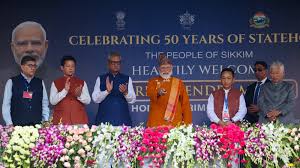
The 50th year of Sikkim’s statehood marks a historic milestone in India’s democratic journey. Celebrating its integration in 1975, the "Land of the Peaks" has transitioned from a protectorate Himalayan kingdom to a national vanguard of ecological sustainability. During the closing ceremony in Gangtok, the Prime Minister emphasized that Sikkim’s organic model now serves as the blueprint for "Viksit Bharat" (Developed India).
Historical Evolution and Integration (1642–1975)
Sikkim’s journey into the Indian Union is a unique chapter in constitutional history, marked by a gradual transition from monarchy to democracy.
- The Chogyal Monarchy: From 1642, Sikkim was ruled by the Namgyal dynasty. During the British era, the Treaty of Tumlong (1861) established it as a British protectorate, while the Calcutta Convention (1890) demarcated its sensitive border with Tibet.
- The Protectorate Era (1947–1974): Upon India's independence, the Indo-Sikkim Treaty of 1950 maintained Sikkim’s autonomy while vesting India with responsibility for its defense, external affairs, and communications.
- The Transition Phases:
- Associate State (1974): Responding to popular democratic fervor, the 35th Constitutional Amendment Act created a unique "Associate State" status, the only instance in Indian history.
- Full Statehood (1975): Following a public referendum where 97.5% voted for integration, the 36th Constitutional Amendment Act officially established Sikkim as the 22nd State of India on May 16, 1975.
Constitutional Safeguards: Article 371F
To preserve the distinct socio-cultural fabric of the region, Article 371F was inserted into the Constitution.
- Legislative Protection: It safeguards "old laws" of Sikkim and restricts land ownership to indigenous residents to prevent demographic shifts.
- Fiscal Autonomy: Under this article and Section 10(26AAA) of the Income Tax Act, native Sikkimese residents are exempt from central income tax on earnings generated within the state, honoring the terms of the 1975 merger.
The "Sikkim Model": Global Pioneer in Organic Farming
In 2016, Sikkim became the world’s first 100% organic state. This transition was not merely agricultural but a holistic shift in governance recognized by the UN FAO Future Policy Gold Award (2018).
Strategic Significance of the Model:
- Ecological Balance: By banning chemical fertilizers, the state has halted groundwater contamination and protected critical pollinators.
- Climate Resilience: Organic soil structures exhibit higher carbon sequestration and water-holding capacity, vital for the fragile Himalayan ecosystem.
- Economic Livelihoods: The "Sikkimese Premium" allows farmers to command higher market prices, while the "100% Organic" tag has catalyzed wellness-based eco-tourism.
Geography and Strategic Biodiversity
Sikkim’s location makes it one of India’s most strategically vital and ecologically dense regions.
- The Teesta River System: Often called the lifeline of Sikkim, the Teesta (a tributary of the Brahmaputra) and the Rangit drain the state. The management of Teesta waters remains a focal point in Indo-Bangladesh hydro-diplomacy.
- Strategic Borders & Passes: Bordered by Nepal, Bhutan, and China (Tibet), it hosts critical passes like Nathu La and Jelep La, which are essential for border trade and national security.
- Kanchenjunga National Park: Inscribed as India's first UNESCO Mixed World Heritage Site (2016), it honors both the natural biodiversity and the cultural sacredness of Mt. Kanchenjunga—India’s highest peak.
- Endemic Fauna: The state is a stronghold for the Red Panda (State Animal), Snow Leopard, and Blue Sheep.
Kavu Nurseries

- 01 May 2026
In News:
The Kerala State Biodiversity Board (KSBB) has initiated a landmark pilot project for the ecological restoration of Sacred Groves (Kavus). This initiative represents a sophisticated model of "Community-Based Conservation," blending traditional ecological knowledge with modern scientific management.
The Decline of the 'Kavu'
Sacred groves are traditionally protected forest patches dedicated to local deities (such as Naga or Bhagavati) and are preserved through social taboos. In Kerala, these Kavus act as "mini-biosphere reserves."
However, recent decades have seen a sharp decline in their health due to:
- Fragmentation: Urbanization and land-use changes.
- Invasive Species: Colonization by non-native flora like Lantana camara.
- Cultural Erosion: Transformation from nature worship to formal temple structures, leading to the "paving over" of forest floors with concrete.
Kavu Nurseries: The Restoration Strategy
The cornerstone of this pilot program is the establishment of Kavu Nurseries—specialized hubs designed to produce high-quality planting material specific to these micro-ecosystems.
Key Operational Features:
- Biodiversity Hubs: Unlike generic nurseries, these focus on over 100 indigenous and threatened species (e.g., Vatica chinensis, Saracaasoca, and Vateria indica).
- Salvo Replantation: The program aims to reintroduce approximately 3,000 saplings into degraded sites to restore canopy density.
- Invasive Species Management: Systemic removal of exotic weeds, replaced by ecologically compatible native vegetation.
- Participatory Governance: Implementation is led by local Biodiversity Management Committees (BMCs), ensuring that conservation efforts have community "buy-in."
Ecological and Cultural Significance
The restoration project yields multi-dimensional benefits that align with India's National Biodiversity Action Plan:
- In-situ Conservation: Acts as a refuge for endemic and medicinal plants that might not survive in larger, unprotected forests.
- Hydrological Services: Sacred groves are often associated with temple ponds (Kulam). They act as natural sponges, recharging groundwater and maintaining soil moisture during dry summers.
- Climate Resilience: By preserving dense green pockets, they regulate local micro-climates and act as carbon sinks in urbanized landscapes.
- Heritage Preservation: It revives the concept of "Social Fencing," where traditional beliefs provide more effective protection than legal barriers.
Pilot Implementation Sites
The project is currently being rolled out across five strategic locations in Kerala:
- Ezhikkara (Ernakulam)
- Pattanchery (Palakkad)
- Villiappally (Kozhikode)
- Iritty (Kannur)
- Uduma (Kasaragod)
Panchayat Advancement Index 2.0
- 01 May 2026
In News:
The release of the Panchayat Advancement Index (PAI) 2.0 Report for the fiscal year 2023–24 marks a pivotal shift toward data-driven governance in India's rural landscape. Prepared by the Union Ministry of Panchayati Raj, this index serves as a comprehensive "report card" for more than 2.5 lakh Gram Panchayats, aligning local performance with global benchmarks through a localized framework.
Conceptual Framework: Localization of SDGs (LSDGs)
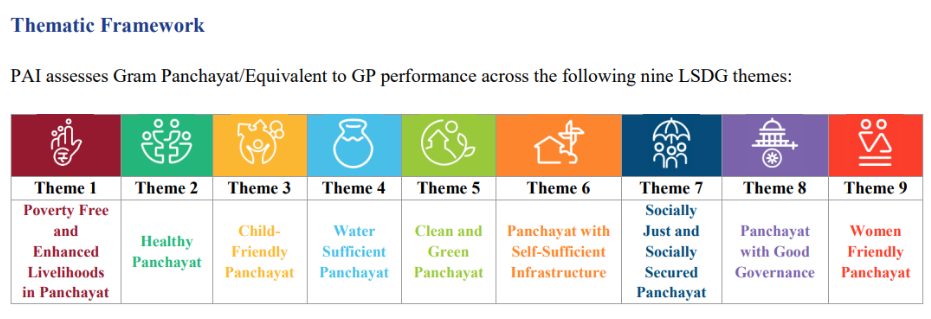
The PAI 2.0 is built on the Localization of Sustainable Development Goals (LSDGs). This strategy condenses the 17 global United Nations SDGs into nine thematic areas tailored for the functional domain of Panchayati Raj Institutions (PRIs). By doing so, the framework translates high-level international targets into actionable local objectives.
The Nine Thematic Pillars:
- Poverty Free and Enhanced Livelihoods
- Healthy Panchayat
- Child-Friendly Panchayat
- Water Sufficient Panchayat
- Clean and Green Panchayat
- Self-Sufficient Infrastructure in Panchayat
- Socially Just and Socially Secured Panchayat
- Panchayat with Good Governance
- Women-Friendly Panchayat
Methodology and Scoring Mechanism
PAI 2.0 employs a rigorous, evidence-based assessment model that utilizes 150 indicators and 230 specific data points. This enables the Ministry to move beyond subjective evaluations to a quantifiable monitoring system.
Performance Classification:
Gram Panchayats are categorized based on their composite PAI scores (0–100):
- Achiever (A ): 90 and above
- Front Runner (A): 75 to below 90
- Performer (B): 60 to below 75
- Aspirant (C): 40 to below 60
- Beginner (D): Below 40
Key Findings of the 2023–24 Report
The PAI 2.0 report highlights a significant surge in institutional engagement and data transparency across the country:
- Exceptional Participation: A record 97.3% of eligible Gram Panchayats (over 2.59 lakh) across 33 States and UTs participated in the exercise. This is a substantial increase from the 80.79% recorded in Version 1.0.
- State-Wise Highlights:
- Chhattisgarh achieved a milestone of 100% participation, with all its 11,643 local bodies submitting validated data.
- Tripura emerged as a leader in high-performance grades, hosting the largest number of "Front Runner" (Grade A) Panchayats.
- The Jugal Kishorenagar Gram Panchayat in Tripura secured the top national rank with a score of 88.44.
- Performance Trends: While participation is nearly universal, the results indicate that a majority of Panchayats currently fall within the Performer (B) and Aspirant (C) categories. No single Panchayat has yet reached the coveted Achiever (A ) status in the composite score, though thousands have achieved A in individual themes like "Poverty Free" and "Healthy Panchayat."
Naval Anti-Ship Missile Short Range

- 01 May 2026
In News:
In a significant milestone for India’s maritime defense, the Defence Research & Development Organisation (DRDO) and the Indian Navy recently conducted the maiden salvo flight trial of the Naval Anti-Ship Missile-Short Range (NASM-SR). The test, carried out from a Sea King 42B helicopter at the Integrated Test Range in Chandipur, Odisha, demonstrated the weapon’s "fire-and-forget" capability. A salvo launch involves firing multiple missiles in quick succession to overwhelm an enemy’s defense systems, a capability essential for modern naval warfare.
Origins and Development
The NASM-SR is India’s first indigenously designed and developed helicopter-launched anti-ship missile.
- Replacement Strategy: It is specifically engineered to replace the aging British-origin Sea Eagle missiles, which have been the mainstay of the Navy’s Sea King fleet for decades.
- Indigenous Partnership: The project was spearheaded by the Research Center Imarat (RCI) in Hyderabad, in collaboration with several other DRDO laboratories and Indian industry partners, aligning with the "Aatmanirbhar Bharat" (Self-Reliant India) initiative.
Technical Specifications and Features
The NASM-SR incorporates several high-end technologies that enhance the precision and lethality of naval air operations:
- Propulsion and Range: The missile is powered by a solid propulsion booster and a long-burn sustainer motor, providing it with an operational range of approximately 55 kilometers.
- Navigation and Guidance: It is equipped with a state-of-the-art seeker and an Imaging Infrared (IIR) system for terminal guidance. Its navigation is supported by a Fiber-Optic Gyroscope-based Inertial Navigation System (INS) and a radio altimeter.
- Control Systems: The missile utilizes Jet-Vane Control (JVC) technology, which allows for extreme maneuverability immediately after launch, and high-bandwidth two-way data links for real-time communication.
- Tactical Advantage: The system supports all-weather, day-and-night operations. It is designed for low-level sea-skimming, a flight profile that allows the missile to fly just above the water's surface to evade enemy radar detection.
- Lethality: The missile is designed for a precise waterline hit, a critical tactical feature intended to cause maximum structural damage and flooding to hostile vessels.
Strategic Significance for the Indian Navy
The induction of the NASM-SR holds several strategic advantages for India's maritime security architecture:
- Self-Reliance in Niche Tech: By developing an indigenous helicopter-launched missile, India reduces its dependence on foreign Original Equipment Manufacturers (OEMs) for critical airborne anti-ship weaponry.
- Enhanced Maritime Domain Awareness: The ability to launch these missiles from helicopters allows the Navy to project power far beyond the visual horizon of its surface fleet, providing a quick-reaction capability against small and medium-sized enemy combatants.
- Modernization of the Air Arm: The successful salvo trials pave the way for the integration of this weapon system onto other platforms, including the Indigenously Developed Dhruv (Advanced Light Helicopter) and the MH-60R Romeo helicopters, thereby modernizing the offensive reach of the Navy’s air wing.
Piprahwa Relics

- 01 May 2026
In News:
Leh recently emerged as a focal point of spiritual and historical significance as it hosted the sacred Piprahwa relics of Gautam Buddha. This landmark event, marked by the arrival of the relics in Ladakh, represents a rare confluence of faith and history. Carried via a special Indian Air Force aircraft and received with state honors, the exposition marks the first time these "AA" category antiquities have been moved from their original place of preservation for domestic exposition within India, following several high-profile international tours to nations like Thailand, Mongolia, and Vietnam.
Historical and Archaeological Context
The Piprahwa Relics are among the most authentic and significant archaeological links to the mortal remains of the Buddha. Their history is rooted in the late 19th century:
- Discovery (1898): The relics were unearthed by William Claxton Peppé, a British colonial engineer, at the Piprahwa Stupa in the Basti district of Uttar Pradesh.
- Identification of Kapilavastu: Archaeological evidence from the site associates Piprahwa with ancient Kapilavastu, the capital of the Shakya kingdom where Siddhartha Gautama spent his formative years before his Great Renunciation (Mahabhinishkramana).
- The Brahmi Inion: A critical find was a sandstone coffer containing crystal caskets. One casket bore an inion in the ancient Brahmi , explicitly linking the contents to the Shakya clan. This epigraphic evidence suggests the remains were enshrined by the Buddha’s own kinsmen around the 3rd century BC.
- Later Excavations (1971–1977): Subsequent excavations by the Archaeological Survey of India (ASI) led by K.M. Srivastava uncovered further steatite caskets containing 22 sacred bone fragments. These are currently preserved at the National Museum in New Delhi.
Legal Status and Repatriation
The trajectory of these relics reflects India’s evolving policy on heritage management and cultural diplomacy:
- The Treasure Trove Act, 1878: Under colonial law, the British Crown claimed Peppé’s original find. While some bones were presented to King Chulalongkorn of Siam (Thailand), a significant portion of the gems and ornaments remained in private hands or were moved to the Indian Museum in Kolkata.
- Antiquity Classification: In modern India, the Piprahwa relics are classified as ‘AA’ antiquities. This legal designation under the Antiquities and Art Treasures Act prohibits their sale and strictly regulates their movement, reflecting their "inestimable" value to national heritage.
- Modern Repatriation (2025-2026): In a significant victory for cultural restitution, a collection of associated gems and artifacts that had remained with the Peppé family for 127 years was repatriated to India. This was achieved through a unique public-private partnership involving the Government of India and the Godrej Industries Group, successfully preempting a planned auction in Hong Kong.
Socio-Cultural and Strategic Significance
The exposition in Ladakh transcends religious ritual, touching upon several key themes relevant to the Indian state:
- Cultural Diplomacy: The movement of these relics to various Buddhist-majority nations serves as a pillar of India’s "Act East" policy, utilizing "Soft Power" to strengthen ties with the Global South and Southeast Asia.
- Regional Integration: The ceremony in Leh, attended by the Lieutenant Governor and senior monastic leaders (including Drukpa Thuksey Rinpoche), underscores the integration of Himalayan Buddhist culture into the broader national narrative.
- The 2569th Buddha Purnima: The timing of the exposition, coinciding with Buddha Purnima, highlights the continuity of the Dhamma in the region, drawing thousands of devotees and global attention to the Dharma Center in Leh and Zanskar.