
Hectocotylus in Octopus Reproduction
- 08 Apr 2026
In News:
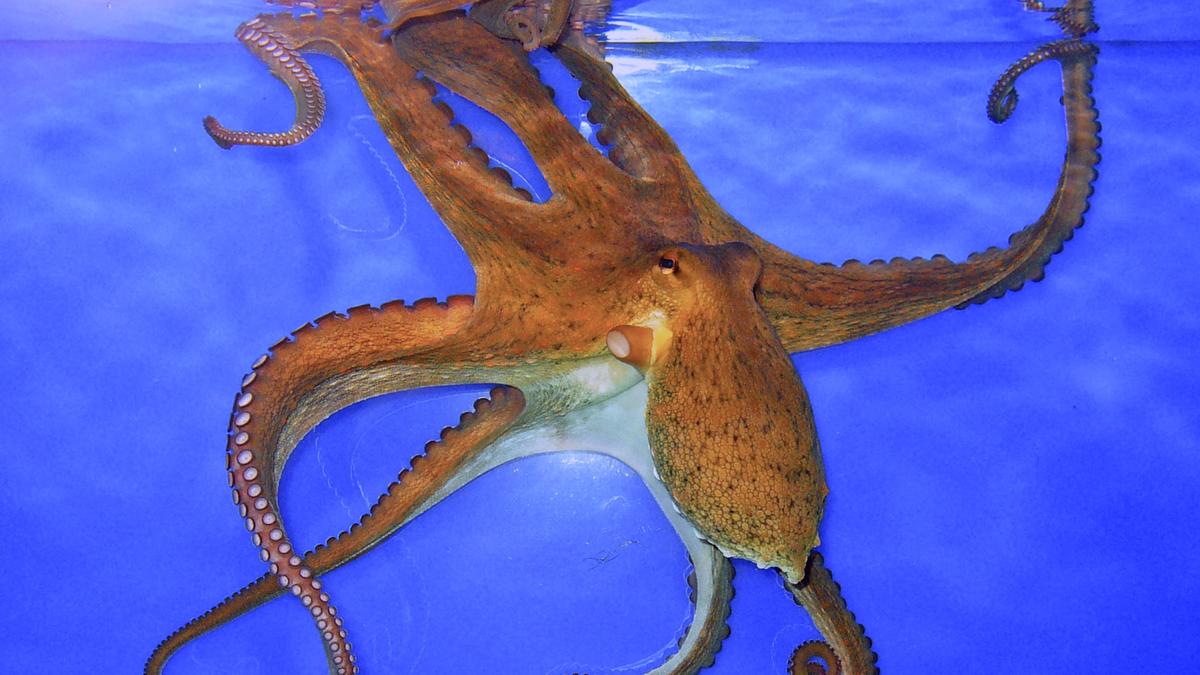
Recent biological research has unveiled groundbreaking insights into the reproductive and sensory mechanisms of octopuses. Scientists have discovered that the hectocotylus, a specialized arm in male cephalopods—serves a dual purpose: it acts as both a conduit for genetic material and a sophisticated sensory organ capable of "tasting" mates. This discovery provides a window into how molecular evolution drives complex behaviors in solitary marine species.
Understanding the Hectocotylus
In the class Cephalopoda (mollusks including octopuses, squids, and cuttlefish), the hectocotylus is a modified arm used by males to transfer sperm packets, known as spermatophores, into the female’s mantle cavity.
Key Biological Findings:
- Chemosensory "Tasting": Beyond physical transfer, the arm functions as a sensory probe. It can detect chemical signals through touch, effectively "tasting" the female.
- Detection of Progesterone: The arm is equipped to sense progesterone present on the female’s skin and within her reproductive tract.
- The Role of CRT1 Receptor: The process is mediated by a specific receptor called CRT1. Interestingly, this receptor evolved from ancient neurotransmitter receptors. It has now adapted to perform a "dual-use" function:
- Prey Detection: Identifying food sources in the marine environment.
- Mate Recognition: Distinguishing potential mates and locating the oviduct for successful insemination.
Evolutionary Significance and Survival Strategy
The evolution of the hectocotylus into a sensory powerhouse is a direct response to the ecological challenges faced by cephalopods.
- Overcoming Solitude: Octopuses are primarily solitary creatures. In the vastness of the ocean, encounters between males and females are rare. The ability to instantly identify a female through chemical "taste" ensures that mating opportunities are not wasted.
- Navigation in Darkness: Many cephalopods inhabit deep-sea or nocturnal environments. The sensory receptors on the hectocotylus allow males to locate the female’s oviduct with precision, even in complete darkness.
- Molecular Adaptation: This discovery highlights how subtle changes in protein structures (like the CRT1 receptor) can lead to the development of highly complex reproductive behaviors, ultimately contributing to the vast biodiversity of our oceans.
General Characteristics of Cephalopods
Cephalopods are among the most intelligent invertebrates, characterized by:
- Physiology: Soft bodies, prominent heads, and highly developed, large eyes.
- Appendages: A ring of arms or tentacles used for locomotion, grasping prey, andas now confirmedsophisticated sensing.
- Neurology: They possess complex nervous systems, with a significant portion of their neurons located within their arms, allowing for semi-autonomous movement and sensing.
Yuva Sangam
- 08 Apr 2026
In News:
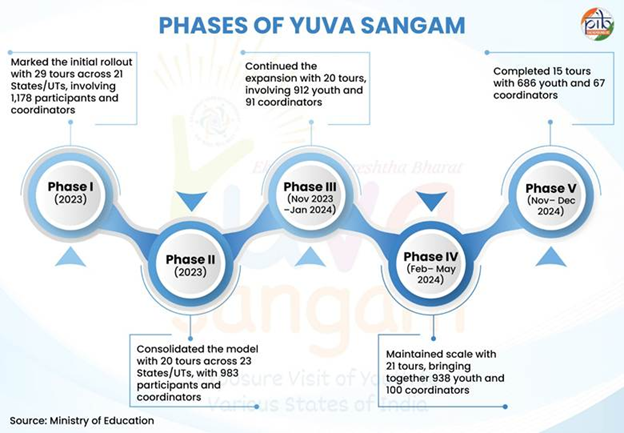
Yuva Sangam is a landmark youth exchange initiative under the Government of India’s Ek Bharat Shreshtha Bharat (EBSB) program. Launched in 2023, it has rapidly evolved into a high-impact platform for strengthening the emotional and cultural bonds between the youth of diverse regions. As of April 2026, the program has entered its Phase-VI, expanding its footprint to 22 States and Union Territories and reflecting a "whole-of-government" commitment to national unity.
The Ideological Foundation: Ek Bharat Shreshtha Bharat
The program is rooted in the vision of Ek Bharat Shreshtha Bharat, launched on October 31, 2015, to mark Rashtriya Ekta Diwas (National Unity Day).
- Objective: To celebrate India’s "Unity in Diversity" by pairing different States and UTs for sustained engagement.
- Mechanism: Paired regions collaborate across various domainsincluding language, cuisine, sports, and best practicesto dismantle regional prejudices and foster mutual respect.
Structural Framework of Yuva Sangam
Yuva Sangam operationalizes this vision through structured, immersive tours.
- Target Group: Designed for youth aged 18–30 years, encompassing university students (UG, PG, PhD), young professionals, and volunteers from the National Service Scheme (NSS) and Nehru Yuva Kendra Sangathan (NYKS).
- Implementation: Anchored by the Ministry of Education, the program is executed via Higher Education Institutions (HEIs) that serve as nodal centers. For instance, in Phase-VI, 22 eminent HEIs (like NIT Rourkela and IIM Ahmedabad) coordinate these exchanges.
- Digital Integration (2026): Aligning with the digital education push, Phase-VI requires participants to register using their APAAR ID (Automated Permanent Academic Account Registry).
The "5-P" Framework: The Core Pillars of Exposure
Every Yuva Sangam tour (typically lasting 5–7 days) is curated around five thematic pillars to provide a holistic understanding of the host state:
- Paryatan (Tourism): Visiting historical monuments and natural wonders to understand the geography and history.
- Parampara (Tradition): Immersive experiences in local arts, crafts, music, and culinary traditions.
- Pragati (Progress): Gaining insights into major developmental landmarks and government initiatives.
- Prodyogiki (Technology): Exposure to innovation hubs, startups, and research institutions.
- Paraspar Sampark (People-to-People Connect): Meaningful interactions with local heroes, SHGs, and dignitaries, including Governors and Chief Ministers.
Indian Softshell Turtles
- 08 Apr 2026
In News:
The Indian Softshell Turtle (Nilssoniagangetica), a critical component of India’s freshwater ecosystems, has recently been in the spotlight following successful enforcement actions against illegal wildlife trafficking. In a significant operation, police in Greater Noida rescued 16 turtles from a smuggler during a routine check, highlighting the persistent threat of poaching to this endangered species.
Taxonomy and Biological Profile
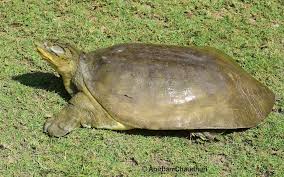
Commonly known as the Gangetic Softshell Turtle, this species belongs to the family Trionychidae. Unlike traditional turtles characterized by hard, bony scutes, these reptiles possess a flat, leathery carapace (upper shell) that lacks a keratinized cover.
- Distinctive Anatomy: They feature a large head with a prominent snout-like proboscis, an evolutionary adaptation that allows them to breathe while remaining almost entirely submerged.
- Size: They are among the largest freshwater turtles in the region, with carapaces reaching up to 94 cm in length.
- Diet: They are omnivorous scavengers. By feeding on mollusks, fish, frogs, and decaying organic matter, they act as natural "cleaners" of river systems.
Habitat and Distribution
The Indian Softshell Turtle is native to the major river systems of South Asia, specifically the Ganges, Indus, and Mahanadi.
- Range: Found across India, Pakistan, Nepal, and Bangladesh.
- Ecological Niche: They prefer deep, turbid (cloudy) waters including rivers, large canals, and lakes. They favor habitats with mud or sand bottoms, which allow them to bury themselves for camouflage and hunting.
Conservation Status and Legal Protection
Due to its dwindling population, the Indian Softshell Turtle is afforded the highest levels of legal protection, mirroring that of the Bengal Tiger.
- Wildlife Protection Act (1972): Listed under Schedule I, making any trade or harm to the species a non-bailable offense with rigorous punishment.
- IUCN Red List: Classified as Endangered.
- CITES: Included in Appendix I, which prohibits international commercial trade.
Threats: The "20-Claw" Myth and Trafficking
The primary drivers of the decline in their population are habitat loss, pollution, and illegal poaching. A unique and destructive driver is the "20-Claw Myth."
- Superstition: Poachers specifically target individuals with 20 claws (five on each limb). There is a deep-seated superstition in the black market that these specific turtles bring immense "good luck" or possess superior medicinal properties.
- Commercial Value: Beyond superstition, they are also trafficked for their meat and for the pet trade, often being transported in cramped, inhumane conditions across state borders.
Ecological Significance for India
From a conservation and civil services perspective, the health of the Indian Softshell Turtle population is a direct indicator of the health of the riverine ecosystem. As scavengers, they are vital to the Clean Ganga Mission (Namami Gange), as they help maintain water quality by consuming organic waste and carcasses that would otherwise pollute the river.
Annual Survey of Incorporated Services Sector Enterprises
- 08 Apr 2026
In News:
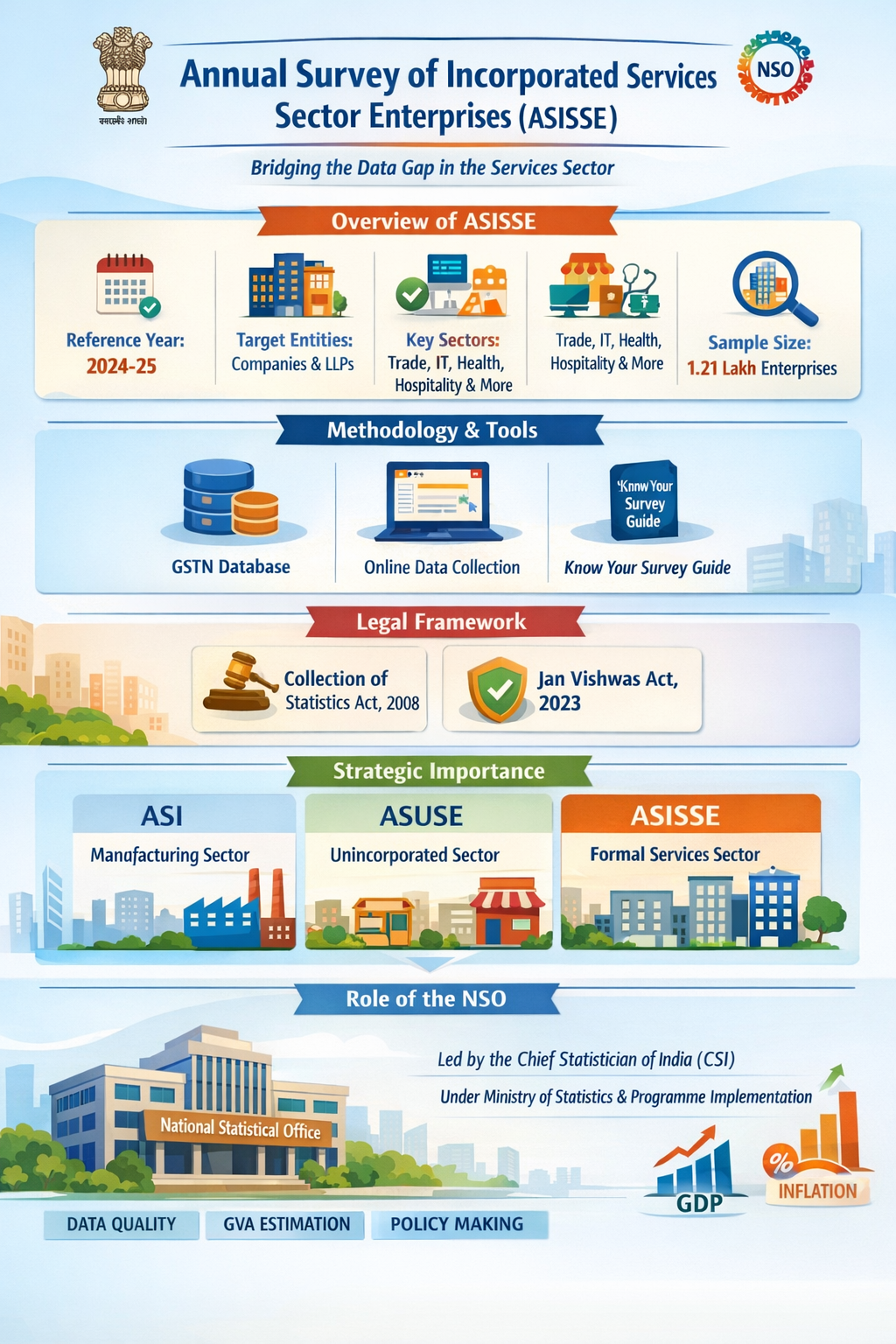
The National Statistics Office (NSO), operating under the Ministry of Statistics and Programme Implementation (MoSPI), launched the inaugural Annual Survey of Incorporated Services Sector Enterprises (ASISSE). This landmark initiative is designed to bridge a critical data gap in the services sector, which is the backbone of the Indian economy, contributing over 50% to the national GDP.
Overview and Scope of ASISSE
The ASISSE is the first dedicated annual exercise to create a formal, comprehensive database for the incorporated (registered) services sector. Historically, while the manufacturing sector was tracked via the Annual Survey of Industries (ASI), the formal services sector lacked a similar structured annual data collection mechanism.
- Reference Period: The survey focuses on the financial year 2024-25.
- Target Entities: It covers corporate entities registered under the Companies Act (1956/2013) or the Limited Liability Partnership (LLP) Act, 2008.
- Key Sectors: The survey encompasses a wide range of industries, including Trade, Transport, Hospitality (Hotels/Restaurants), Information Technology (IT), Education, Health, and other professional services.
- Sample Size: With more than 1.21 lakh enterprises being surveyed, it stands as one of the largest statistical operations of its kind in India.
Methodology and Digital Integration
To ensure high data quality and transparency, the NSO has integrated modern digital tools and outreach strategies:
- The Sampling Frame: The survey uses the Goods and Services Tax Network (GSTN) database as its primary source to identify and sample businesses, ensuring that the data reflects currently active and tax-compliant entities.
- Data Collection Mode: In line with "Digital India" initiatives, data is collected through a secure web-based portal, facilitating faster processing and better security.
- Transparency Measures: The NSO released a reader-friendly user guide titled "Know Your Survey" to help participating enterprises understand definitions, reporting requirements, and the survey's overall purpose.
Legal Framework
The ASISSE is not a voluntary exercise but is backed by stringent legislative provisions to ensure compliance and data integrity:
- It is conducted under the Collection of Statistics Act, 2008 (as amended in 2017).
- It also falls under the provisions of the Jan Vishwas (Amendment of Provisions) Act, 2023, which streamlines reporting and emphasizes trust-based governance.
Strategic Importance for India
The launch of ASISSE completes a vital "statistical trio" that allows the government to view the entire non-agricultural economy holistically:
- ASI (Annual Survey of Industries): Covers the registered manufacturing sector.
- ASUSE (Annual Survey of Unincorporated Sector Enterprises): Covers the informal/unregistered non-agricultural sector.
- ASISSE: Fills the gap for the formal, incorporated services sector.
By generating key operational and economic indicators, ASISSE enables evidence-based policymaking. It allows for more accurate estimation of Gross Value Added (GVA) and provides insights into job creation and economic transformation within the most dynamic segment of the Indian economy.
The Role of the National Statistical Office (NSO)
The NSO serves as India’s central statistical agency. Formed in 2019 through the merger of the Central Statistics Office (CSO) and the National Sample Survey Office (NSSO), it aims to improve coordination and data quality across the country.
Headed by the Chief Statistician of India (CSI), the NSO is responsible for disseminating official data—such as GDP and inflation figures—that are crucial for national planning and governance under the Ministry of Statistics and Programme Implementation.
Tar Balls Management
- 08 Apr 2026
In News:
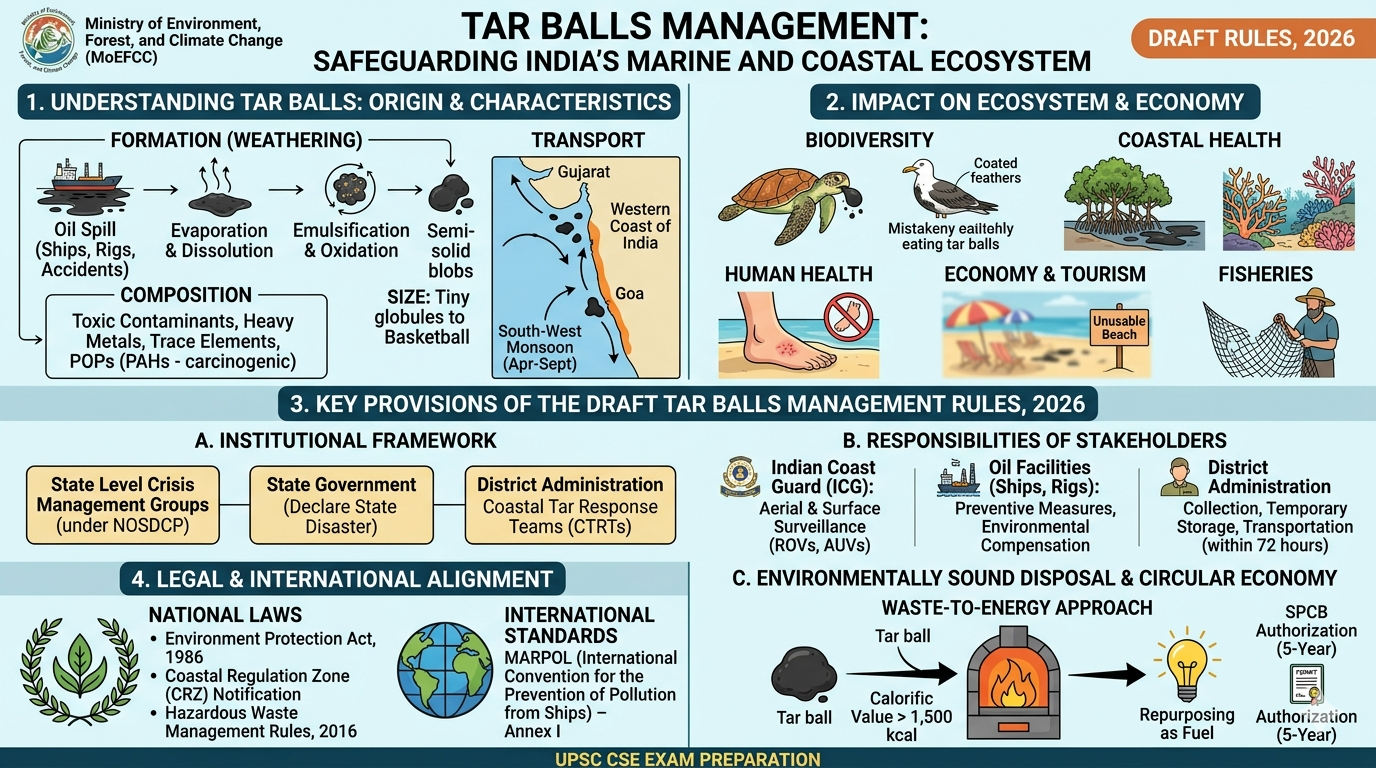
Recently, the Ministry of Environment, Forest, and Climate Change (MoEFCC) introduced the Draft Tar Balls Management Rules, 2026. This marks India's first dedicated regulatory framework aimed at managing "tar balls"—a recurring environmental hazard that plagues the Indian coastline, particularly the western stretch from Gujarat to Goa.
Understanding Tar Balls: Origin and Characteristics
Tar balls are small, dark, sticky, and semi-solid blobs of weathered crude oil. They are the physical residue of oil spills or natural seeps that undergo various transformative processes in the ocean.
- Formation (Weathering): When oil is spilled (from ships, offshore rigs, or accidents), it undergoes physical, chemical, and biological changes. Lighter components evaporate or dissolve, while the heavier residue emulsifies with seawater and oxidizes, eventually hardening into lumps.
- Transport: These blobs are transported from the open sea to the shore by sea currents and waves.
- Size: They vary significantly in size, ranging from tiny globules to masses as large as a basketball.
- Composition: Tar balls are not just oil; they are concentrated reservoirs of toxic contaminants, including heavy metals, trace elements, and Persistent Organic Pollutants (POPs) like Polycyclic Aromatic Hydrocarbons (PAHs), which are carcinogenic.
Impact on Ecosystem and Economy
The seasonal appearance of tar balls, especially between April and September (linked to the South-West Monsoon), has severe multi-dimensional impacts:
- Biodiversity: Marine animals like sea turtles and fish often mistake tar balls for food, leading to ingestion and death. Seabirds get their feathers coated, hindering their ability to fly or regulate body temperature.
- Coastal Health: They contaminate intertidal zones, harming mangroves and coral reefs.
- Human Health: Exposure to tar balls on beaches can cause skin irritation and long-term health risks due to the presence of toxic contaminants.
- Economy & Tourism: India’s western coast is a global tourism hub. Tar ball deposition makes beaches unsightly and unusable, leading to significant revenue loss.
- Fisheries: Tar balls damage fishing nets and gear, impacting the livelihoods of coastal communities.
Key Provisions of the Draft Tar Balls Management Rules, 2026
The rules shift the approach from ad-hoc beach cleaning to a structured, institutionalized response based on the "Polluter Pays Principle."
A. Institutional Framework
- State Level Crisis Management Groups: To be formed under the National Oil Spill Disaster Contingency Plan (NOSDCP).
- Declaration of State Disaster: State governments are empowered to declare tar ball pollution as a "State Disaster" under the Disaster Management Act, ensuring a coordinated emergency response.
- Coastal Tar Response Teams (CTRTs): To be constituted by district administrations for rapid action.
B. Responsibilities of Stakeholders
- Indian Coast Guard (ICG): Tasked with aerial and surface surveillance using advanced technology like Remotely Operated Vehicles (ROVs) and Autonomous Underwater Vehicles (AUVs) to detect underwater oil plumes.
- Oil Facilities: Owners of ships, oil tankers, and offshore rigs are defined as "Oil Facilities." They must comply with the Merchant Shipping Act, 2025, and take preventive measures. Failure to do so attracts Environmental Compensation.
- District Administration: Responsible for the collection, temporary storage, and transportation of tar balls to treatment facilities within a 72-hour window of a sighting.
C. Environmentally Sound Disposal & Circular Economy
The rules emphasize a "waste-to-energy" approach:
- Repurposing as Fuel: Tar balls with a calorific value over 1,500 kcal can be used as an alternative fuel source in cement kilns.
- Authorization: Any entity handling or disposing of tar balls must obtain a 5-year authorization from the State Pollution Control Board (SPCB).
Legal and International Alignment
- National Laws: The rules derive authority from Section 3 of the Environment Protection Act, 1986. They also link with the Coastal Regulation Zone (CRZ) Notification and Hazardous Waste Management Rules, 2016.
- International Standards: The rules align India’s domestic policy with its obligations under MARPOL (International Convention for the Prevention of Pollution from Ships), specifically Annex I, which deals with oil pollution.
Challenges and Gaps
While the rules are a significant step forward, critics and experts point out certain gaps:
- Community Engagement: There is a lack of explicit provisions for "citizen science" or involving local fishing communities in monitoring.
- Digital Reporting: No mandated digital platform yet exists for real-time reporting by the public.
- Source Attribution: Identifying the exact vessel responsible for weathered tar balls remains a technical challenge, requiring advanced chemical fingerprinting.