
Chandrayaan-3 Hop Experiment
- 25 May 2026
In News:
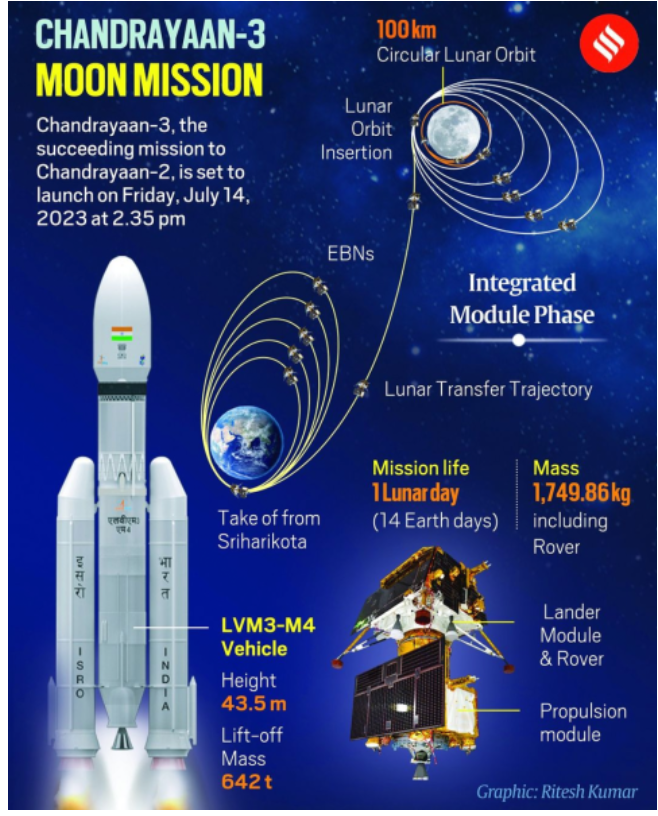
Findings from the Chandrayaan-3 Vikram lander's "hop" experiment, published in The Astrophysical Journal in April 2026, demonstrate significant heterogeneity in the Moon's surface composition at local scales — challenging previous assumptions about lunar soil uniformity and providing India's first in-situ geotechnical data from the lunar south polar region.
The Hop Experiment:
On 2 September 2023, engineers reignited Vikram's engines to perform a short vertical hop of approximately 50 centimetres using residual propellant. The manoeuvre was initially designed to validate re-ignition capabilities for future sample-return missions, but the engine exhaust inadvertently stripped away the top three centimetres of loose lunar dust, exposing denser material beneath — providing a unique opportunity to study subsurface regolith properties at the south pole for the first time.
The Chandra's Surface Thermophysical Experiment (ChaSTE) — equipped with temperature sensors and a heating probe that penetrated the regolith — was then redeployed at the new post-hop location, measuring thermal profiles during the twilight transition (16:25–17:30 lunar local time), a slow cooling period lasting hours due to the Moon's month-long day-night cycle.
Key Scientific Findings
Two-Layer "Cake-Like" Structure
The Moon's surface at the south pole exhibits a distinct, two-layer structure within the top few centimetres — not a uniform pile of dust as previously assumed.
Upper Layer (0–6 cm) — The "Fluffy Thermal Blanket": The top layer is hyper-porous and highly cohesive, behaving like loose flour near the surface. Bulk density increases dramatically from 750 kg/m³ at the surface to 1,600 kg/m³ at a depth of just 6.5 cm — where the material becomes significantly stiffer, behaving more like damp clay.
Thermal Behaviour:ChaSTE captured a sharp temperature drop after 17:00 lunar local time, as the absence of an atmosphere allows heat to radiate rapidly into space once the Sun's rays are blocked by local shadows — demonstrating how the hyper-porous top layer functions as a critical thermal insulator.
Supporting Evidence: 3D simulations using Chandrayaan-2's OHRC (Orbiter High Resolution Camera) high-resolution imagery confirmed the regolith's layered stratigraphy.
What is Lunar Regolith?
Scientists emphasise that the Moon's surface layer is more accurately termed "lunar regolith" rather than "lunar soil" — it consists of shattered rock fragments and jagged glass-like shards formed by billions of years of micrometeorite bombardment. Unlike terrestrial soil, it lacks organic material or water-formed minerals, and its jagged, angular particles create unusual mechanical properties — high cohesion yet extreme looseness at the surface.
Why It Matters: Five Implications
- Water-Ice Storage: The hyper-porous top layer is particularly significant for trapping water-ice molecules in the subsurface — critical for assessing the viability of in-situ resource utilisation (ISRU) at lunar south polar bases.
- Future Lunar Base Planning: The dramatic density gradient within just 6.5 cm means that drilling, foundation engineering, and habitat construction at the lunar south pole will require significantly different approaches than originally modelled — directly informing NASA's Artemis programme and ISRO's own lunar ambitions.
- Rocket Plume-Surface Interaction: Understanding how engine exhaust erodes the regolith is essential for safe landing zone design for future crewed and cargo missions — preventing landing struts from sinking into loose surface material.
- Sample Return Missions: The hop experiment validates critical engine re-ignition capabilities, setting a precedent for future sample-return missions.
- Chandrayaan-4 Design Inputs: India's upcoming Chandrayaan-4 mission — designed for lunar sample collection and return — will directly incorporate these findings in its lander design and landing site selection.
Actinarctusodissi

- 25 May 2026
In News:
An international team including researchers from the CSIR-National Institute of Oceanography (CSIR-NIO), the University of Minho, Portugal, and the Academy of Scientific and Innovative Research (AcSIR) discovered a new species of tardigrade in the shallow marine waters of the Bay of Bengal, near the coastal region of Markandi, Odisha. This marks the first time in 43 years that a new member of the elusive Actinarctus genus has been identified — a landmark moment for India's marine biodiversity documentation.
About Actinarctusodissi
- The new tardigrade has been officially named Actinarctusodissi, with "odissi" chosen to honour the famous traditional classical dance form originating from Odisha, where the tiny animal was unearthed.
- Researchers collected sand samples from the ocean floor at a depth of 14 metres in shallow marine waters off the Odisha coast.
- The study was published in the journal Marine Biodiversity (Springer Nature). The new species belongs to the family Tanarctidae under Heterotardigrada, and can be distinguished from its congeners by the structure and ornamentation of the dorsal body cuticle, shape and arrangement of lateral epicuticular alae (wing-like flaps), structure and length of the leg IV sensory organ, and the presence of Van der Land's organ in cephalic and leg sensory organs.
Unique morphological features:
- A dome-shaped body surrounded by transparent, wing-like flaps called alae, supported by translucent pillars
- Noticeably shorter lateral wings compared to other members of the genus
- Blunt-tipped sensory appendages (rather than sharp ones)
- Back uniquely heavily sculptured with tiny, trombone-shaped pillars
- Simple, un-split sensory organs on back legs, shorter than those of its congeners
What are Tardigrades?
Tardigrades — colloquially known as "water bears" or "moss-piglets" — are microscopic animals, typically 0.05 mm–1.2 mm in body length. About 1,300 species have been identified globally. They are bilaterally symmetrical, segmented organisms with four pairs of legs, each ending in four to eight claws, feeding on plant cell fluids, animal cell fluids, and bacteria.
Marine tardigrades account for 17% of all known tardigrade species — a category that remains among the most understudied in global marine biodiversity.
Their most remarkable trait is extreme environmental resilience: they can survive punishing heat, freezing cold, ultraviolet radiation, and even the vacuum of outer space. Under unfavourable conditions, they enter a state of suspended animation called the "tun" state — during which the body desiccates and metabolism drops to as low as 0.01% of its normal rate. Tardigrades can survive as tuns for years or even decades, making them candidates for research in astrobiology, cryptobiosis, and pharmaceutical biotechnology.
Scientific and Policy Significance
Marine tardigrades from Indian waters represent an important but largely overlooked component of regional biodiversity, and every new record contributes significantly to understanding their distribution and taxonomy. The discovery highlights the hidden diversity of marine meiofauna in the Indian subcontinent.
The discovery carries broader implications:
- Biodiversity documentation: India's coastal and deep-sea environments remain significantly under-surveyed. The Actinarctusodissi find demonstrates that major taxonomic discoveries remain possible even in relatively shallow, accessible coastal zones — underlining the case for sustained marine biological surveys under India's Deep Ocean Mission.
- Biotechnology potential: Tardigrades' extraordinary survival mechanisms — particularly cryptobiosis and DNA repair under extreme stress — are of active interest to pharmaceutical research, space biology, and materials science. India's discovery of a new marine species adds to the genetic and biochemical resource pool accessible for future research.
- CSIR-NIO's Role: The involvement of CSIR-NIO — India's premier oceanographic research institution based in Goa — highlights the institution's expanding contribution to marine taxonomy beyond its traditional focus on physical and chemical oceanography.
I4C Advisory on iPhone Phishing
- 25 May 2026
In News:
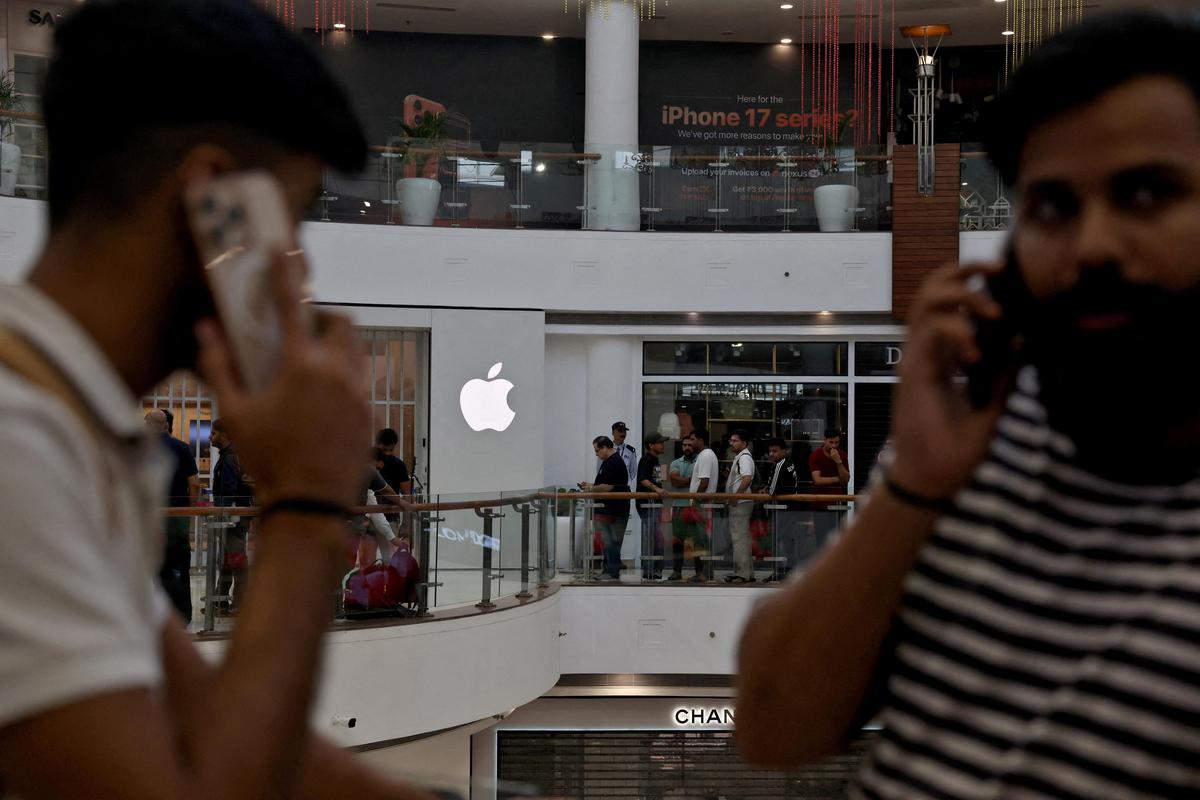
The National Cybercrime Threat Analytics Unit (NCTAU) of the Indian Cybercrime Coordination Centre (I4C) under the Ministry of Home Affairs issued a nationwide advisory warning iPhone users about a sophisticated "hybrid cybercrime" campaign targeting people whose devices have been lost or stolen. The advisory highlights the growing convergence of physical theft with digital fraud — a new frontier in cybercrime requiring urgent public awareness.
The Modus Operandi: A Three-Stage Attack
Unlike mass phishing campaigns sent indiscriminately, this campaign focuses on a narrower group: people whose iPhones have recently been lost or stolen. The perpetrators may already possess the physical device, making the attack more dangerous because the phishing attempt is not random — it is linked to a real incident in the victim's life.
- Stage 1 — Targeted Victim Selection: Criminals identify individuals with recently lost or stolen iPhones, exploiting the psychological vulnerability of device loss — photos, contacts, bank-linked apps, and personal data.
- Stage 2 — Phishing SMS Delivery: Attackers impersonate Apple Support and exploit victims' urgency by sending fraudulent SMS messages containing phishing links. The messages closely resemble legitimate "Find My iPhone" or Apple Support notifications, typically sent from numeric SMS headers, claiming the lost device has been temporarily switched off or that urgent action is required to erase contacts, media, and other data.
- Stage 3 — Credential Theft and Account Takeover: The phishing links redirect users to fake websites designed to closely resemble legitimate Apple or iCloud login pages. Victims are prompted to enter their Apple ID credentials, followed by One-Time Passwords (OTPs) or two-factor authentication codes sent by Apple. Once obtained, perpetrators gain unauthorised access to the victim's iCloud account, remove the Apple ID linked to the stolen device, disable 'Find My iPhone,' and bypass security protections. The stolen device can then be resold or reused without restrictions.
What is Phishing?
Phishing is a social engineering cyberattack that uses deceptive messages from seemingly legitimate sources to trick victims into revealing sensitive information — login credentials, passwords, OTPs, or financial data. Modern phishing employs domain spoofing, fake websites, generative AI-crafted messages, and SMS-based smishing to maximise credibility and urgency. It commonly supports downstream crimes like account takeovers, ransomware attacks, and financial fraud.
About I4C: India's National Cybercrime Architecture
The Indian Cybercrime Coordination Centre (I4C) was established under the Ministry of Home Affairs as a nodal agency to coordinate India's fight against cybercrime. Its key components include:
- National Cybercrime Threat Analytics Unit (NCTAU) — threat identification and advisory issuance
- National Cybercrime Reporting Portal (NCRP) — centralised complaint platform
- National Toll-Free Helpline '1930' — citizen assistance for financial cyber fraud
- CyberDost — social media handle for cyber safety awareness
- Pratibimb — geospatial crime mapping platform for law enforcement
- Citizen Financial Cyber Fraud Reporting System — near-real-time fraud reporting and fund-siphoning prevention
- Cyber Crime Volunteers Program — citizen engagement in cybercrime prevention
Protective Measures Advised
I4C recommended the following safeguards:
- Approach any SMS links related to lost or stolen devices with healthy scepticism, particularly when messages originate from unfamiliar, numeric, or international identifiers.
- Never enter Apple ID credentials or OTPs on pages accessed through SMS links.
- Always access Apple services directly through the official website or the device itself.
- Keep "Find My iPhone" enabled and regularly update recovery contact information.
- Report suspicious messages to 1930 or via the NCRP portal.
Ayushman Bharat Digital Mission (ABDM)
- 25 May 2026
In News:
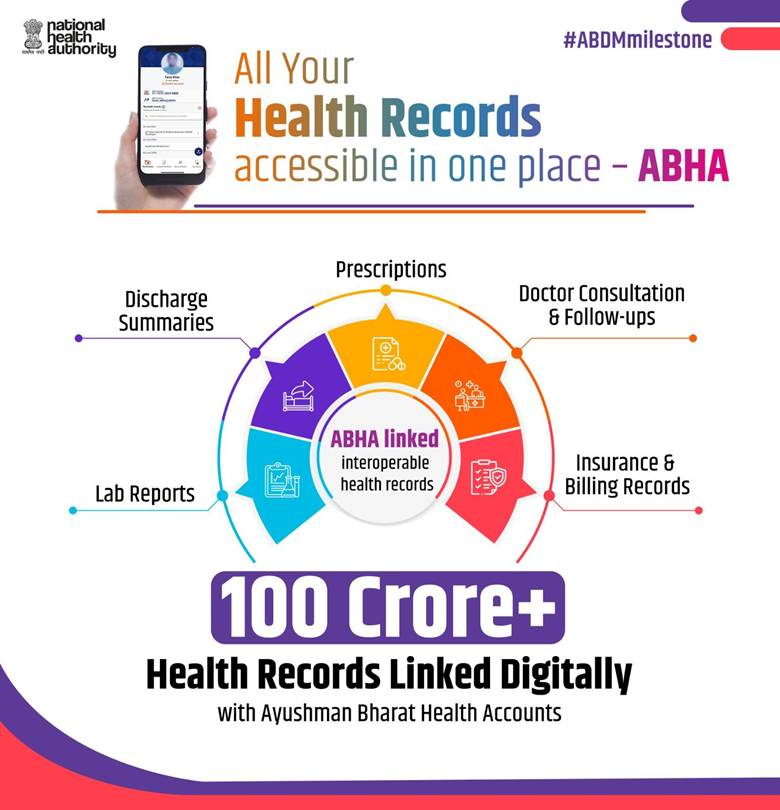
The Ayushman Bharat Digital Mission (ABDM), implemented by the National Health Authority (NHA) under the Ministry of Health and Family Welfare, has achieved a landmark milestone with over 100 crore health records successfully linked with Ayushman Bharat Health Accounts (ABHA). The achievement positions ABDM as one of the world's largest digital health ecosystems — a defining moment for India's Digital Public Infrastructure (DPI) in healthcare.
Scale and Speed of Achievement
ABDM doubled the number of linked health records from 50 crore in February 2025 to over 100 crore in just 15 months, with nearly 10 crore health records now being added every two to three months. From fewer than 1,000 linked records during its initial phase, the mission has evolved into a continental-scale digital health infrastructure.
More than 450 public and private health technology solutions have successfully integrated with the ABDM ecosystem, accelerating digitisation and seamless exchange of health records across healthcare facilities nationwide.
State-Wise Performance
Uttar Pradesh has emerged as the leading contributor with over 15.03 crore ABHA-linked health records, followed by Andhra Pradesh with over 11.95 crore. Bihar, Rajasthan, and Gujarat have linked over 7.37 crore, 6.32 crore, and 4.77 crore records respectively.
Key Government Platforms Contributing to the Milestone
Major contributing programmes and platforms include the NCD Programme and CoWIN (MoHFW), PM-JAY, UP's eKavach platform, AP's health programmes, the Reproductive and Child Health (RCH)programme, eHospital (NIC), eSushrut (C-DAC), Gujarat's TeCHO platform, and Rajasthan's iHMS platform.
Key Components of ABDM
The mission operates through six digital building blocks:
- ABHA (Ayushman Bharat Health Account): A 14-digit unique health ID enabling citizens to securely link and access health records across hospitals, clinics, labs, and pharmacies.
- Healthcare Professionals Registry (HPR): Comprehensive repository of all healthcare professionals across modern and traditional medicine systems.
- Health Facility Registry (HFR): Registry of all public and private health facilities — hospitals, clinics, diagnostic labs, pharmacies.
- HIE-CM (Health Information Exchange and Consent Manager): Enables consent-based, secure sharing of health records — placing data sovereignty with the citizen.
- Unified Health Interface (UHI): Open protocol enabling interoperability across digital health service applications.
- National Health Claims Exchange (NHCX):Standardises health claim information exchange between payers, providers, and beneficiaries — streamlining insurance claim processing.
Significance
ABDM represents a pivotal application of India's DPI model — the same stack of interoperable, consent-based, open-protocol infrastructure that powers UPI in payments and Aadhaar in identity — now applied to healthcare data. The milestone has several transformative implications:
- Continuity of Care: Longitudinal digital health records empower citizens with secure, consent-based access to their health information — enabling seamless record sharing across providers and eliminating dependence on physical documents.
- Insurance Efficiency: NHCX integration reduces claim processing delays and fraud — a critical reform for PM-JAY's effective implementation at scale.
- Public Health Surveillance: Aggregated, anonymised ABHA-linked data can power population-level disease surveillance, NCD monitoring, and health planning — aligning with India's One Health Mission and post-pandemic preparedness frameworks.
- Global DPI Leadership: India's ABDM model — open, interoperable, consent-driven, and rapidly scalable — is increasingly cited by the WHO and G20 as a replicable template for low- and middle-income countries building digital health infrastructure.
Myopia
- 25 May 2026
In News:
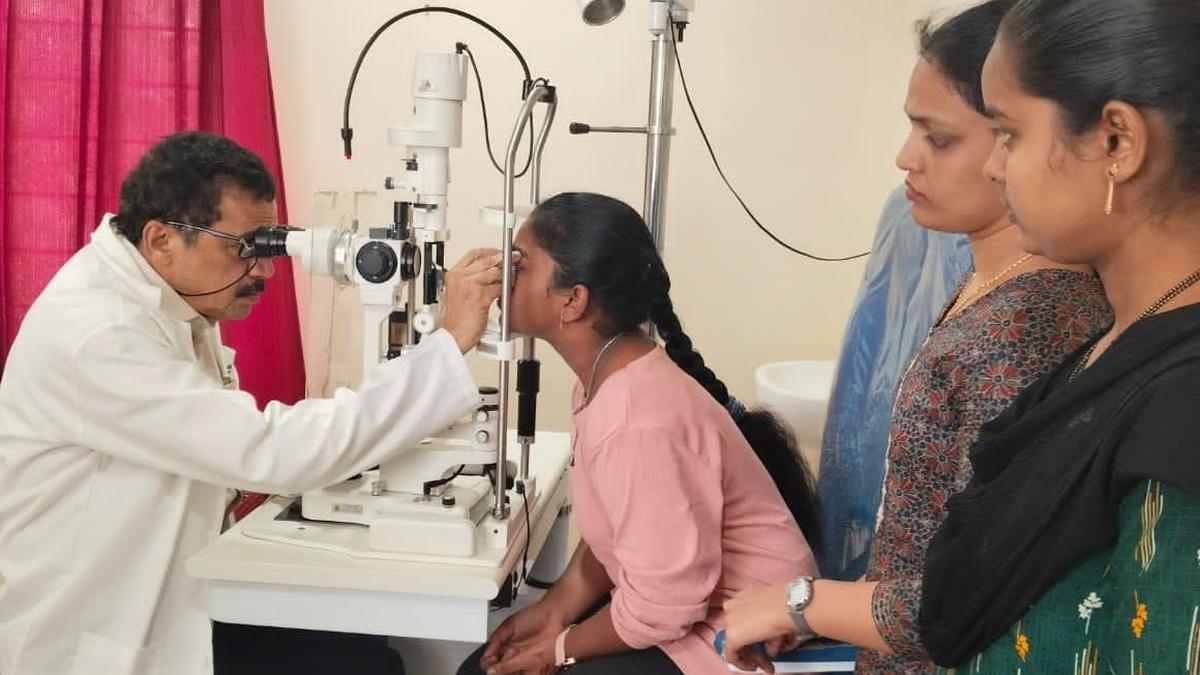
The global prevalence of myopia has surged from 22.9% in 2000 to an estimated 34% in 2020 and is expected to reach 50% by 2050, affecting nearly 5 billion people — making it one of the most pressing public health challenges of the 21st century. Once regarded as a benign, correctable refractive error, myopia is now recognised as a progressive, potentially sight-threatening condition with significant socioeconomic consequences.
What is Myopia?
- Myopia — commonly known as nearsightedness — is a refractive error in which close objects appear clear while distant objects appear blurry.
- It occurs when the eyeball is elongated from front to back, causing incoming light to focus in front of the retina rather than directly on it. The longer the eyeball, the more severe the nearsightedness.
- Eye experts attribute myopia to a combination of hereditary and environmental factors. It typically begins in childhood or adolescence, worsening progressively until adulthood when it may stabilise.
The Scale of the Crisis
- Researchers predict that by 2050, 4,758 million people (49.8% of the world population) will be myopic, and 938 million will have high myopia — a severe form carrying significantly elevated risks of permanent vision loss.
- High myopia raises the risk of serious ocular diseases such as myopic macular degeneration (MMD), retinal detachment, glaucoma, and cataract — conditions that can cause irreversible blindness.
- Myopia's prevalence has dramatically increased in recent decades, now affecting as much as 88% of the population in some Asian countries — though its growing prevalence is by no means an exclusively regional trend.
Why is it Rising so fast? The "Changing Childhood" Factor
The sharp rise in myopia prevalence is strongly linked to urbanisation-driven lifestyle changes — particularly among children:
- Increased near-work activity: Prolonged screen time, reading, and digital device use force the eye to focus at short distances for extended periods — a key risk factor for axial elongation of the eyeball.
- Reduced outdoor time: Health officials increasingly highlight that children need more outdoor time as a countermeasure — natural light exposure and distant vision are believed to stimulate dopamine release in the retina, which inhibits excessive eye elongation.
- Earlier onset: As the number of people with myopia increases, the age of onset is decreasing — a critical concern since earlier onset leads to greater lifetime myopic progression and higher risk of complications.
- In South Asia, urban children show a 2–3 fold higher prevalence of myopia compared to rural children, predominantly due to increased near-work activity in urban school environments.
India's Burden
South Asia — comprising India, Pakistan, Bangladesh, and six other countries — hosts 23% of the world's population but bears a disproportionately large 30% share of global visual impairment. Uncorrected refractive errors, predominantly myopia, account for as much as 63% of visual impairment in the region — far exceeding the global average of 50%. India's rapid urbanisation, competitive education culture, and explosive growth in screen time among children are accelerating this trajectory.
Treatment and Prevention
- Corrective options: Glasses and contact lenses remain the primary correction tools. Negative (minus) powered lenses diverge light before it enters the eye, compensating for the elongated eyeball. Refractive surgeries (LASIK, PRK) are available for adults.
- Myopia control strategies — aimed at slowing progression rather than merely correcting existing refractive error — include orthokeratology (overnight contact lenses), low-dose atropine eye drops, and multifocal lenses. However, access to these therapies remains highly unequal globally.
The most cost-effective intervention remains behavioural: increasing children's daily outdoor exposure to at least 90–120 minutes and reducing near-screen time — a public health message with direct policy implications for India's school education and digital learning frameworks.