
Tourism Sector in India
- 04 Aug 2026
In News:
The Government highlighted India's growing potential as a global tourism hub, supported by improved infrastructure, connectivity, digital platforms, travel facilitation, and sustainable tourism initiatives.
Key Highlights
- India recorded 2.9 billion domestic tourist visits (2024) and 2.02 crore international tourist arrivals (2025).
- Tourism contributed ?15.73 lakh crore (5.22% of GDP) in 2023–24 and supported 84.6 million jobs.
- Foreign exchange earnings from tourism reached USD 31.7 billion in 2025.
India's Tourism Potential
India's diverse cultural heritage, 45 UNESCO World Heritage Sites, 106 National Parks, 18 Biosphere Reserves, pilgrimage centres, wildlife, wellness traditions, and varied landscapes make it one of the world's most attractive tourism destinations.
Major tourism segments include:
- Spiritual & Buddhist tourism
- Heritage & cultural tourism
- Wellness & medical tourism
- Eco & wildlife tourism
- Rural & community tourism
- MICE tourism
- Coastal, cruise & adventure tourism
Major Government Initiatives
- Swadesh Darshan: 76 projects worth ?5,295.24 crore across 14 thematic circuits.
- Swadesh Darshan 2.0: 53 destination-centric projects worth ?2,207.08 crore.
- PRASHAD Scheme: 54 projects worth ?1,726.24 crore for pilgrimage destinations.
- Special Assistance to States for Capital Investment: 40 tourism projects worth ?3,295.76 crore.
- Challenge-Based Destination Development: 37 projects worth ?687.99 crore.
Improving Connectivity & Ease of Travel
- Expansion of highways, Vande Bharat trains, UDAN airports and last-mile connectivity.
- Viksit UDAN aims to develop over 100 aerodromes and 200 helipads.
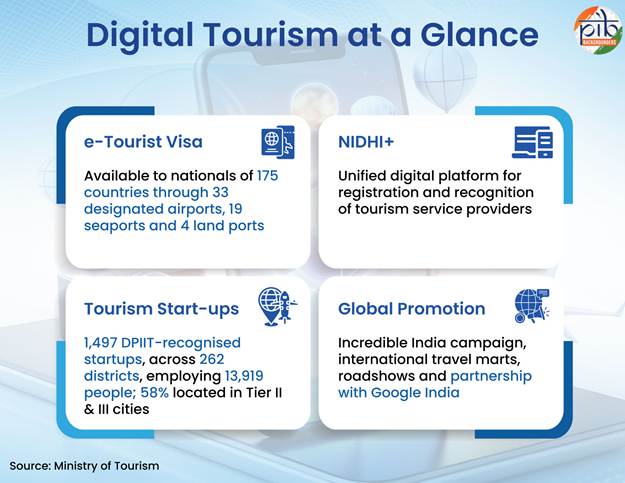
- e-Tourist Visa facility is available for nationals of 175 countries through 33 airports, 19 seaports and 4 land ports.
- NIDHI provides a unified digital platform for registration and classification of tourism service providers.
Tourism Start-ups
India has 1,497 DPIIT-recognised tourism start-ups across 262 districts, generating nearly 13,919 jobs. Around 58% are located in Tier-II and Tier-III cities, promoting innovation in travel technology, homestays, rural tourism and AI-based travel services.
Sustainable Tourism
The Government promotes responsible tourism through the Travel for LiFE initiative, destination diversification, community participation, and conservation of heritage and biodiversity. Sustainable tourism also contributes to SDG 8.9, SDG 12.B, and SDG 14.7.
Significance
- Generates employment and foreign exchange.
- Promotes regional and rural development.
- Preserves cultural heritage and biodiversity.
- Strengthens India's position as a global tourism destination.
- Supports inclusive and sustainable economic growth.
Geological Survey of India (GSI)
- 04 Aug 2026
In News:
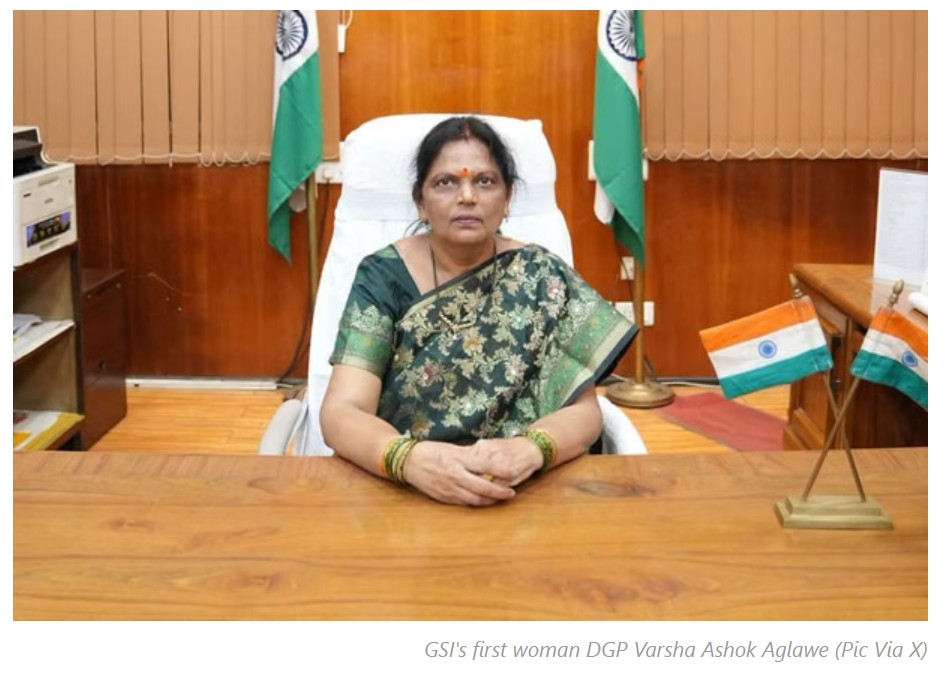
Smt. Varsha Ashok Aglawe has assumed charge as the 54th Director General of the Geological Survey of India (GSI), becoming the first woman to head India's premier geoscientific organization in its 176-year history.
About the Geological Survey of India (GSI)
The Geological Survey of India (GSI) is India's premier geoscientific organization responsible for geological mapping, mineral exploration, and geoscientific research. It functions as an attached office of the Ministry of Mines.
History
- Established: 1851
- Parent Ministry: Ministry of Mines
- Origin: Initially established to identify coal deposits for the expansion of the Indian railway network.
- First Director:Sir Thomas Oldham, who took charge on 4 March 1851.
- The term "Geological Survey of India" was first used by John McClelland in 1848.
Objectives
- Systematically map India's geology.
- Assess and explore mineral and energy resources.
- Generate reliable geoscientific data for policy and development.
- Support natural hazard assessment and sustainable resource management.
Key Functions
- Geological Mapping: Conducts ground, airborne, satellite, and marine geological surveys.
- Mineral Exploration: Explores and assesses mineral resources, including critical minerals such as lithium, cobalt, rare earth elements, and copper.
- Natural Hazard Studies: Undertakes landslide zonation, seismotectonic studies, glaciology, and geotechnical investigations for infrastructure projects.
- Geoscientific Data Repository: Maintains the national repository of geological and geospatial information.
- Research & Collaboration: Carries out multidisciplinary research in earth sciences, including paleontology, climate geology, and polar studies, in collaboration with national and international institutions.
TRAI MyCall
- 04 Aug 2026
In News:
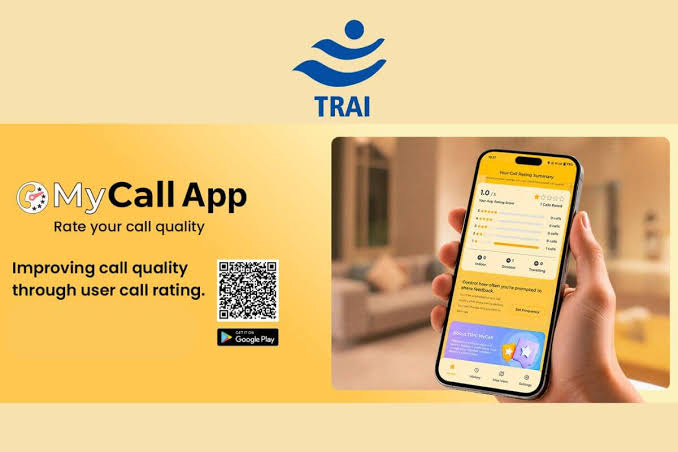
The Telecom Regulatory Authority of India (TRAI) has launched a revamped version of the "TRAI MyCall" mobile application to enable consumers to directly rate and report their voice-calling experience, thereby improving telecom service quality.
About TRAI MyCall
TRAI MyCall is a mobile application developed by the Telecom Regulatory Authority of India (TRAI) that allows telecom subscribers to provide real-time feedback on the quality of voice calls. The application collects users' call experience along with relevant network parameters to help improve telecom service quality.
Key Features
- Real-Time Consumer Feedback: Enables users to rate voice calls through a simple 1–5 star rating system.
- Issue Reporting: Consumers can report problems such as:
- Call drops
- Echo during calls
- Audio delay
- Cross connections
- Voice breaking
- One-way audio
- Delayed call connection
- Automatic Feedback Prompt: Prompts users for feedback immediately after voice calls.
- Feedback History: Allows users to view their ratings and feedback history on an interactive map.
- Coverage Test: Assesses mobile network signal strength.
- Multilingual Support: Integrated with BHASHINI for multiple Indian languages.
How it Works
- Consumer feedback is shared with Telecom Service Providers (TSPs) and TRAI in an anonymised form.
- The information helps TSPs identify network problem areas and undertake corrective measures.
- It also enables TRAI to assess the Quality of Experience (QoE) of telecom services alongside technical Quality of Service (QoS) parameters.
Telecom Regulatory Authority of India (TRAI)
The Telecom Regulatory Authority of India (TRAI) is the statutory regulator responsible for overseeing India's telecommunications sector.
Key Facts
- Established: 1997
- Statutory Basis: Telecom Regulatory Authority of India Act, 1997
- Objective: Promote orderly growth of the telecom sector, ensure fair competition, protect consumer interests, and improve service quality.
Major Functions
- Regulates telecom tariffs.
- Prescribes and monitors Quality of Service (QoS) standards.
- Protects consumer interests and addresses grievances.
- Recommends licensing conditions for telecom service providers.
- Ensures transparency and fair competition in the telecom sector.
- Monitors compliance and imposes penalties for regulatory violations.
Composition
- One Chairperson
- Up to two full-time members
- Up to two part-time members
Tenure: Three years or until attaining 65 years of age, whichever is earlier.
Telecom Disputes Settlement and Appellate Tribunal (TDSAT)
- Established through an amendment to the TRAI Act.
- Adjudicates disputes between:
- Licensor and licensee
- Telecom service providers
- Service providers and consumer groups
- Hears appeals against TRAI's directions, decisions, and orders.
Glaw Lake
- 04 Aug 2026
In News:
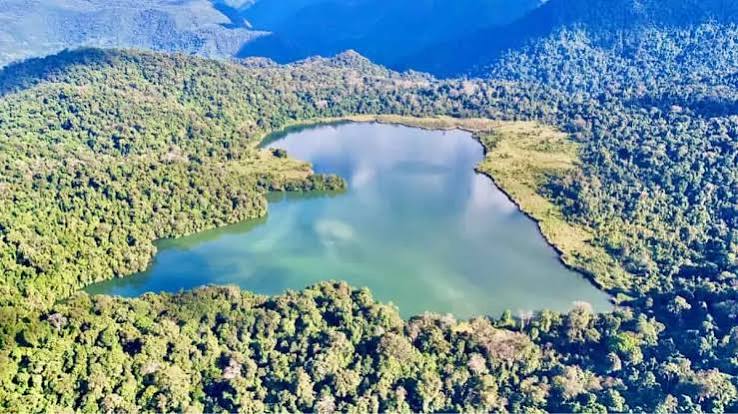
Glaw Lake in Lohit district, Arunachal Pradesh, has been designated as India's 101st Ramsar Site under the Ramsar Convention on Wetlands, becoming the first Ramsar Site in Arunachal Pradesh.
About Glaw Lake
Glaw Lake is a freshwater wetland located in the Eastern Himalayas within the Kamlang Tiger Reserve and Wildlife Sanctuary in Lohit district, Arunachal Pradesh. It is recognized for its rich biodiversity, ecological significance, and role in conserving high-altitude freshwater ecosystems.
Key Features
- Location: Lohit district, Arunachal Pradesh.
- Status: First Ramsar Site in Arunachal Pradesh and India's 101st Ramsar Site.
- Type: Freshwater lake.
- Elevation:1,168 metres above sea level.
- Water Source: Fed by perennial mountain streams.
Biodiversity
The lake and its catchment support remarkable floral and faunal diversity:
- More than 150 tree species.
- 49 orchid species.
- Habitat for several high-altitude species, including:
- White-bellied Heron(Endangered)
- Clouded Leopard
Its location within the Kamlang Tiger Reserve further enhances its ecological importance.
Ramsar Convention on Wetlands
The Ramsar Convention is an intergovernmental treaty that provides the global framework for the conservation and wise use of wetlands.
Key Facts
- Adopted: 1971
- Place: Ramsar, Iran
- Came into Force: 1975
- Significance: First global environmental treaty dedicated exclusively to the conservation and sustainable use of wetlands.
Three Pillars of the Convention
- Conservation of Wetlands of International Importance (Ramsar Sites).
- Promotion of the wise use of all wetlands.
- International cooperation on shared wetlands, river basins, and migratory species.
COSPAR Vikram Sarabhai Medal
- 04 Aug 2026
In News:
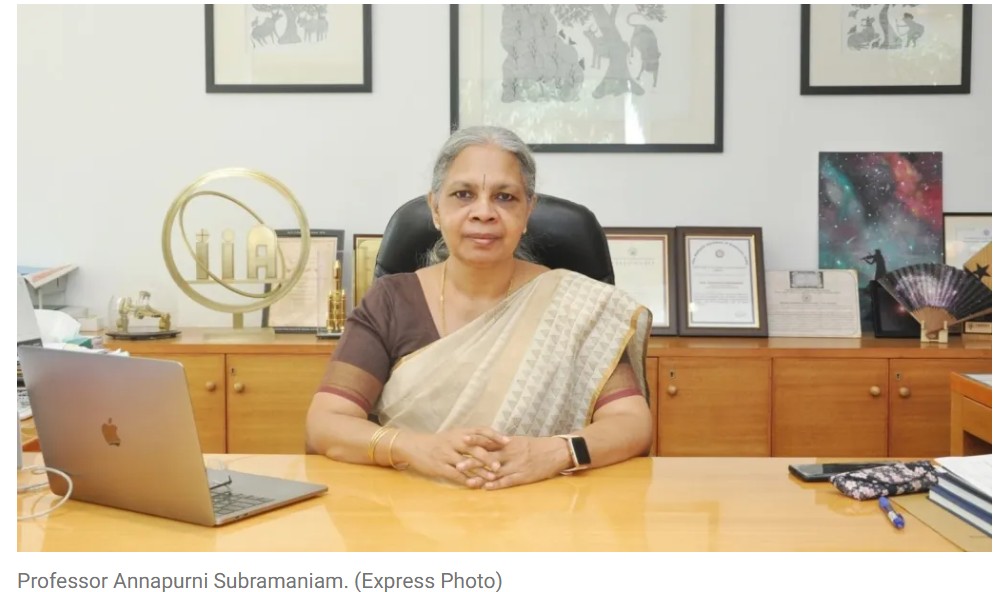
Indian astrophysicist Dr. Annapurni Subramaniam has been awarded the COSPAR Vikram Sarabhai Medal 2026 for her outstanding contributions to space research.
About the COSPAR Vikram Sarabhai Medal
The COSPAR Vikram Sarabhai Medal is an international award instituted in 1990 in memory of Dr. Vikram Sarabhai, the father of India's space programme. It is jointly awarded by the Committee on Space Research (COSPAR) and the Indian Space Research Organisation (ISRO) to recognize outstanding contributions to space research by scientists from developing countries.
Key Features
- Instituted: 1990
- Awarded by: Committee on Space Research (COSPAR) and Indian Space Research Organisation (ISRO)
- Objective: To honour scientists from developing countries for exceptional contributions to space research.
- Eligibility: The candidate's significant work should have been carried out primarily during the five-year period ending one year before the COSPAR Scientific Assembly at which the medal is presented.
2026 Recipient
- Dr. Annapurni Subramaniam
- Fourth Indian to receive the medal.
- First Indian woman scientist to receive the honour.
- Third woman globally to receive the award.
Previous Indian Recipients
- Anil Bharadwaj (2024)
- Gurbax Singh Lakhina (2014)
- U. R. Rao (1996)
Committee on Space Research (COSPAR)
The Committee on Space Research (COSPAR) is an international scientific organization established in 1958 to promote global cooperation in space research.
Key Facts
- Established: 1958
- Affiliation: International Science Council (ISC)
- Associated with: United Nations through the Committee on the Peaceful Uses of Outer Space (UN-COPUOS)
- Scientific Assembly: Held biennially and serves as one of the world's largest forums for space scientists.