
Supreme Court Upholds GST on Online Gaming

- 02 Jun 2026
In News:
In a significant judgment with implications for India's rapidly growing digital gaming industry, the Supreme Court has upheld the constitutional validity of levying Goods and Services Tax (GST) on organised online gaming involving money stakes. The Court rejected challenges against the GST levy on actionable claims arising from online gaming and fantasy sports, affirming that such activities fall within the category of betting and gambling for taxation purposes.
The ruling provides legal clarity to the GST framework governing online gaming and reinforces the powers of both the Union and State governments to regulate gaming activities involving monetary stakes.
Background of the Case
Several online gaming and fantasy sports platforms had challenged the imposition of GST on online money gaming, arguing that games involving substantial skill should not be treated on par with gambling activities. The petitioners contended that fantasy sports and skill-based games differ fundamentally from games of chance and therefore should not attract the same tax treatment.
However, the Supreme Court rejected these arguments and upheld the legislative framework introduced through amendments to the GST law.
Actionable Claims and GST
A key issue before the Court concerned the taxation of actionable claims.
An actionable claim refers to a legally enforceable claim to:
- An unsecured debt, or
- A beneficial interest in movable property not in the claimant’s possession.
Under the GST framework, actionable claims relating to:
- Lottery,
- Betting,
- Gambling,
- Casinos,
- Horse racing, and
- Online money gaming
can be brought within the taxation regime.
The Court held that online gaming transactions involving monetary stakes generate actionable claims that can legitimately be subjected to GST.
Online Gaming as Betting and Gambling
The Court observed that online gaming activities involving staking money on uncertain outcomes constitute betting and gambling for the purpose of taxation.
Accordingly, it upheld the levy of 28% GST on online gaming bets, affirming the government's authority to tax such transactions under the GST regime.
Skill vs Chance: Court’s Clarification
One of the most important aspects of the judgment is the distinction drawn between the nature of the game and the act of wagering.
The Court clarified that:
- Even if a game involves substantial skill,
- The act of staking money on an uncertain outcome can still bring the activity within the ambit of betting and gambling.
Thus, the presence of skill does not automatically exempt an activity from taxation or regulation when monetary stakes are involved.
Rummy and Poker
The Court also upheld statutory restrictions on online games such as:
- Rummy
- Poker
when played for a wager, bet, money, or other stakes.
It rejected the argument that games traditionally recognised as skill-based should automatically remain outside the scope of betting and gambling laws when played for money.
States’ Regulatory Powers
The judgment reaffirmed the constitutional authority of States to regulate or prohibit online gaming involving betting and wagering.
The Court emphasized that States have a legitimate responsibility to safeguard:
- Public order,
- Public health,
- Social well-being, and
- Consumer protection.
The Court acknowledged growing concerns regarding online gaming addiction, financial distress, and social harms associated with wagering-based digital platforms.
Significance of the Judgment
The ruling establishes a clear legal distinction between playing a game and betting on a game, strengthening the GST framework governing online gaming. It provides certainty for tax administration, reinforces regulatory oversight over money gaming platforms, and underscores the State's role in balancing technological innovation with public welfare concerns.
UN Adds Israel and Russia to Sexual Violence Blacklist
- 02 Jun 2026
In News:
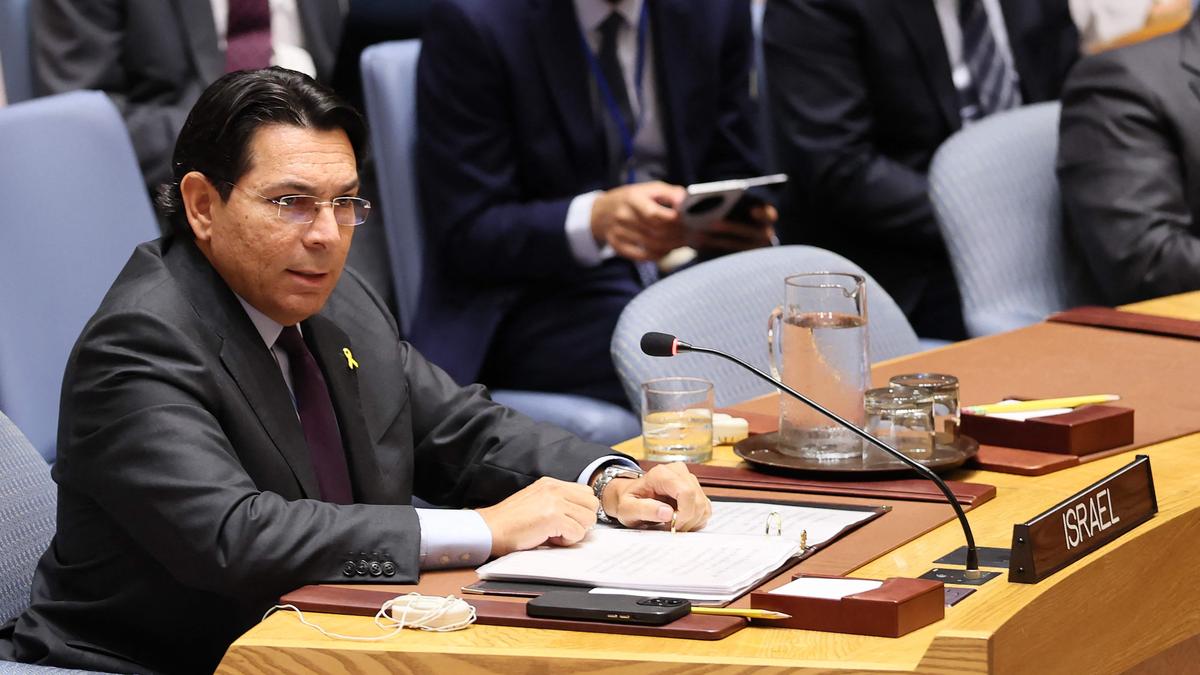
The United Nations (UN) has added Israel and Russia to its annual blacklist of parties responsible for conflict-related sexual violence (CRSV). The move comes through the UN Secretary-General’s annual report on conflict-related sexual violence, which documents patterns of sexual violence linked to armed conflicts across the world. The development is significant because Hamas had already been included in the list following the October 2023 attacks that triggered the Gaza conflict.
What is Conflict-Related Sexual Violence (CRSV)?
Conflict-related sexual violence refers to acts such as:
- Rape
- Sexual slavery
- Forced prostitution
- Forced pregnancy
- Enforced sterilisation
- Other forms of sexual violence directly or indirectly linked to armed conflict
The United Nations recognises CRSV as a grave violation of International Humanitarian Law (IHL), International Human Rights Law, and, in certain circumstances, a war crime, crime against humanity, or an act constituting genocide.
UN Conflict-Related Sexual Violence Blacklist
The blacklist forms part of the annual report prepared by the United Nations Secretary-General on conflict-related sexual violence. It identifies parties for whom credible information exists indicating patterns of sexual violence during armed conflicts.
Being included on the list does not automatically trigger sanctions, but it carries significant diplomatic and reputational consequences. Repeated offenders may face restrictions affecting participation in UN peacekeeping activities and increased international scrutiny.
Why Were Israel and Russia Listed?
Israel
The UN report verified 31 cases involving Palestinian men, women and children from Gaza and the occupied West Bank between 2023 and 2025. These cases included allegations of sexual violence occurring during detention, interrogation and military operations. Based on verified patterns, Israel was included in the blacklist.
Russia
Russia was listed for conflict-related sexual violence committed in the context of the ongoing conflict in Ukraine. The report documented incidents attributed to Russian armed and security forces involving sexual violence against civilians and detainees.
Global Scale of the Problem
The latest UN report highlights the continuing prevalence of conflict-related sexual violence across multiple conflict zones.
Key Data and Facts
- The report recorded nearly 10,000 verified cases of conflict-related sexual violence worldwide during the last year.
- The annex to the report lists 77 parties responsible for patterns of conflict-related sexual violence.
- Of these, 62 are non-state actors, demonstrating the growing role of armed groups in perpetrating such violations.
- The blacklist includes state forces, militias, insurgent groups, terrorist organisations and other armed actors operating in conflict zones.
Birth Anniversary of Lokmata Ahilyabai Holkar
- 02 Jun 2026
In News:
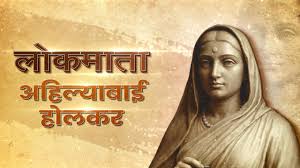
Prime Minister Narendra Modi recently paid tribute to Ahilyabai Holkar on her birth anniversary, remembering her wisdom, compassion, administrative excellence, and unwavering commitment to public welfare. Revered as “Lokmata” (Mother of the People), Ahilyabai Holkar remains one of India's most celebrated women rulers and a timeless symbol of inclusive governance, social reform, and cultural renaissance.
Early Life and Rise to Power
- Ahilyabai Holkar was born on 31 May 1725 in Chondi, in present-day Maharashtra. In 1733, she married Khanderao Holkar, the son of Malhar Rao Holkar, ruler of Malwa and founder of the Holkar dynasty.
- Her life took a dramatic turn when Khanderao Holkar died during the Siege of Kumher Fort in 1745. Although she intended to commit sati, Malhar Rao Holkar prevented her from doing so and instead trained her in military affairs, administration, and statecraft. Following the death of Malhar Rao Holkar in 1766 and her son Male Rao Holkar in 1767, Ahilyabai assumed the reins of the Malwa kingdom and became the ruler of Indore in 1767.
- She appointed Tukoji Rao Holkar as commander of her army and shifted the capital of the Holkar state to Maheshwar, which emerged as a major centre of administration, trade, and culture.
Contributions to Governance and Society
Ahilyabai Holkar's reign is widely regarded as a golden period of peace, prosperity, and welfare-oriented governance. She emphasized justice, efficient administration, and public welfare, earning immense respect from her subjects.
A pioneering social reformer, she promoted:
- Women's education
- Widow remarriage
- Opposition to harmful social practices such as sati
- Welfare and upliftment of marginalized communities, including the Bhil and Gond tribes and lower castes
Her governance reflected a rare combination of social sensitivity and administrative efficiency, making her one of the earliest champions of inclusive development in India.
Cultural and Religious Legacy
Ahilyabai Holkar played a transformative role in preserving India's civilizational heritage. During the 18th century, she undertook the reconstruction and restoration of several important Hindu pilgrimage sites.
Her most notable achievements include:
- Reconstruction of the Kashi Vishwanath Temple
- Restoration of the Somnath Temple
Both temples are among the most revered Jyotirlingas of Lord Shiva. She also sponsored the construction and renovation of numerous temples, ghats, wells, and dharamshalas across the Indian subcontinent.
A great patron of arts and literature, she supported scholars and poets such as:
- Khushali Ram
- Moropant
- Anantaphandi
Economic Contributions
Ahilyabai transformed Maheshwar and Indore into thriving centres of commerce and trade. She actively promoted the Maheshwari weaving industry, leading to the emergence of the famous Maheshwari Sarees, which today enjoys Geographical Indication (GI) tag recognition.
6 Years of PM SVANidhi Scheme
- 02 Jun 2026
In News:
The Prime Minister Street Vendor’s AtmaNirbhar Nidhi (PM SVANidhi) scheme completed six years on 1 June 2026, marking a significant milestone in India's efforts to promote financial inclusion, urban livelihoods, and social security for street vendors.
Launched in June 2020 by the Ministry of Housing and Urban Affairs (MoHUA) in collaboration with the Department of Financial Services (DFS), the scheme was introduced during the Covid-19 pandemic to provide much-needed working capital support to street vendors whose livelihoods had been severely disrupted.
About PM SVANidhi
PM SVANidhi is a Central Sector Scheme and India's first dedicated micro-credit programme for street vendors. It provides collateral-free working capital loans through the formal banking system, reducing dependence on informal moneylenders while promoting entrepreneurship and financial inclusion.
Key Features
|
Component |
Details |
|
Working Capital Loans |
Progressive collateral-free loans of ?15,000, ?25,000 and ?50,000 |
|
Interest Subsidy |
7% annual interest subsidy for timely or early repayment |
|
Digital Incentives |
Cashback rewards for digital transactions |
|
Credit Expansion |
UPI-linked RuPay Credit Cards up to ?30,000 for eligible beneficiaries |
|
Capacity Building |
Training in financial literacy, digital literacy, and food safety & hygiene (with FSSAI) |
|
Extended Timeline |
Scheme extended till March 2030, targeting 1.15 crore vendors, including 50 lakh new beneficiaries |
The Small Industries Development Bank of India (SIDBI) serves as the technical and implementation partner and manages the Credit Guarantee Trust Fund.
‘SVANidhi se Samriddhi’: Beyond Credit to Comprehensive Welfare
To convert financial inclusion into holistic socio-economic empowerment, MoHUA launched the SVANidhi se Samriddhi initiative.
The programme maps the socio-economic profile of vendor households and links them with major welfare schemes, including:
- Pradhan Mantri Jeevan Jyoti Bima Yojana (PMJJBY)
- Pradhan Mantri Suraksha Bima Yojana (PMSBY)
- PM Jan Dhan Yojana
- Building and Other Construction Workers (BoCW) Registration
- PM Shram Yogi Maandhan Yojana
- One Nation One Ration Card (ONORC)
- Janani Suraksha Yojana (JSY)
- PM Matru Vandana Yojana (PMMVY)
Six Years of Impact: Key Achievements
The scheme has emerged as one of India's most successful urban livelihood interventions:
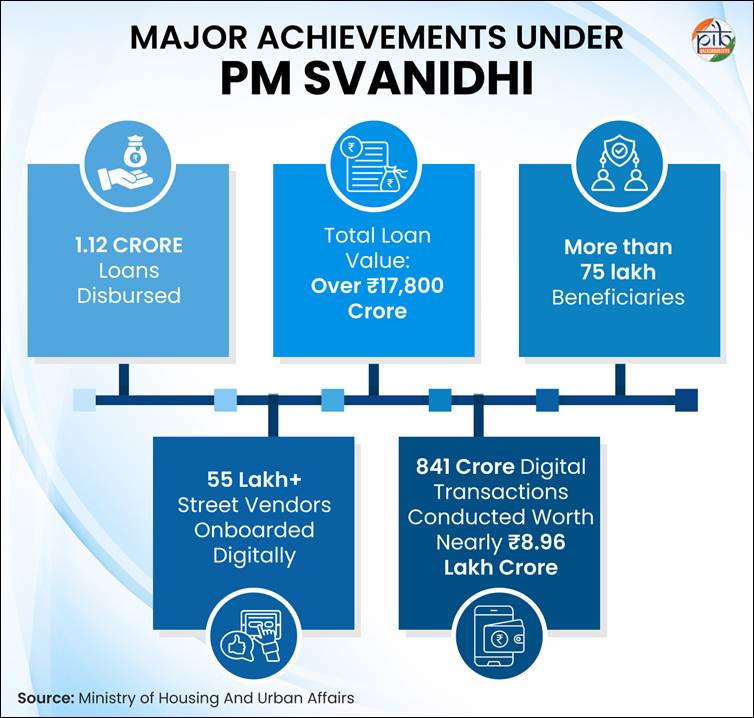
- More than 1.12 crore loans sanctioned to over 75.5 lakh street vendors.
- Nearly 95% beneficiaries accessed formal institutional credit for the first time.
- Around 30% beneficiaries secured additional formal credit, reflecting improved creditworthiness.
- Beneficiary incomes increased by an average of 20% annually.
- 46% of beneficiaries are women, promoting women's economic empowerment.
- Nearly 70% belong to marginalized communities, enhancing social inclusion.
- More than 55 lakh vendors digitally onboarded.
- Vendors have collectively undertaken over 841 crore digital transactions.
- Under SVANidhi se Samriddhi, over 50 lakh vendor families have been socio-economically profiled and linked to more than 1.52 crore welfare benefits across eight flagship schemes.
Significance
PM SVANidhi has evolved from a pandemic relief initiative into a powerful instrument for financial inclusion, digital empowerment, entrepreneurship development, and social security expansion. By integrating credit access with welfare convergence, the scheme exemplifies the government's approach to inclusive urban development and grassroots economic empowerment.
Shangri-La Dialogue
- 02 Jun 2026
In News:
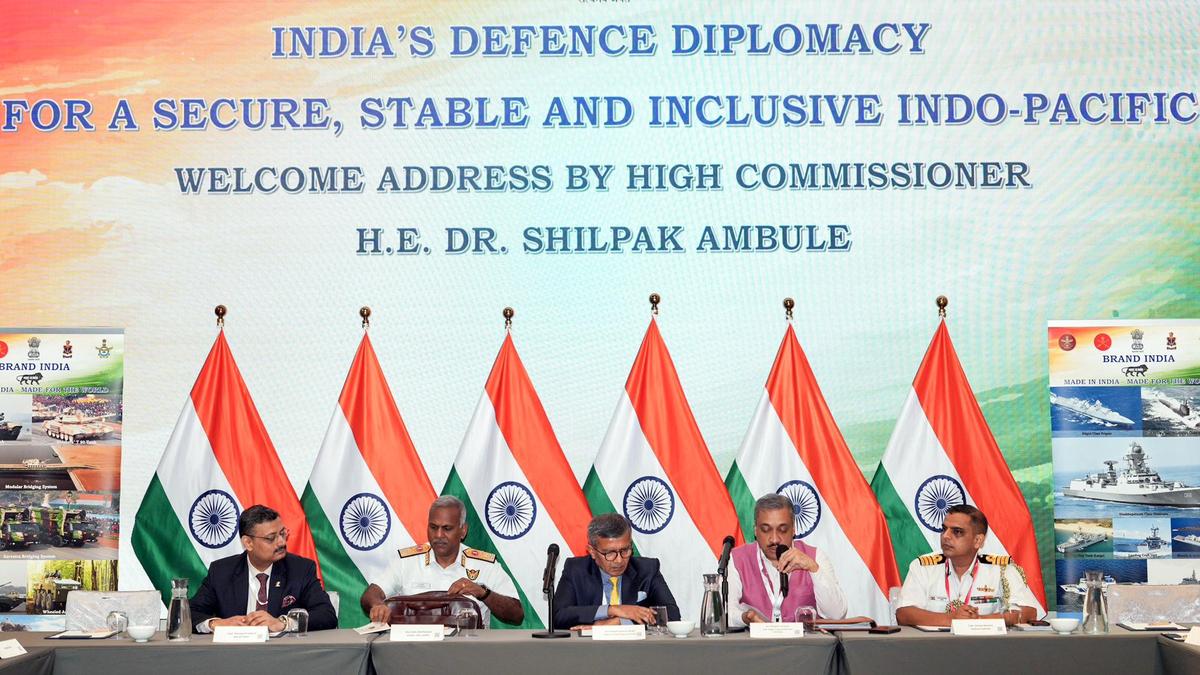
The Shangri-La Dialogue 2026, held in Singapore, served as a major platform for advancing defence diplomacy and addressing emerging security challenges in the Indo-Pacific. On the sidelines of the summit, India’s Defence Secretary held a series of high-level bilateral engagements with defence leaders from various countries, focusing on strengthening defence partnerships, enhancing maritime security cooperation, promoting defence industrial collaboration, and ensuring a free, open, and rules-based Indo-Pacific.
About the Shangri-La Dialogue
Also known as the Asia Security Summit, the Shangri-La Dialogue is Asia’s premier defence and security forum. Since its inception in 2002, it has evolved into the most influential multilateral security dialogue in the Asia-Pacific region.
The summit is held annually at the Shangri-La Hotel, Singapore, and is organized by the International Institute for Strategic Studies (IISS), London, in collaboration with the Ministry of Defence of Singapore.
The dialogue brings together:
- Defence Ministers
- Military Chiefs
- Policymakers
- Strategic Experts
- Security Practitioners
from across the world to deliberate on regional and global security issues.
Agenda and Significance
- The agenda reflects the evolving security environment of the Indo-Pacific and covers both traditional and non-traditional security concerns.
Traditional Security Issues
- Maritime disputes
- Military modernization
- Defence partnerships
- Regional power balance
- Strategic competition
Non-Traditional Security Issues
- Terrorism
- Cybersecurity
- Climate change
- Disaster response
- Emerging technologies
India’s Participation and Engagements
India has been a regular and prominent participant in the Shangri-La Dialogue, represented by the Defence Minister, Chief of Defence Staff, Service Chiefs, or senior defence officials.
At the 2026 Dialogue, the Defence Secretary utilized bilateral meetings to deepen cooperation with key partners in the Indo-Pacific. Discussions focused on:
- Strengthening bilateral defence relations.
- Expanding maritime security cooperation.
- Enhancing military-to-military exchanges.
- Promoting defence technology and industrial collaboration.
- Supporting regional stability and freedom of navigation.
- Addressing common security challenges in the Indo-Pacific.
These engagements align with India’s vision of a free, open, inclusive and rules-based Indo-Pacific, consistent with its broader strategic initiatives such as SAGAR (Security and Growth for All in the Region) and the Indo-Pacific Oceans Initiative.
Importance for India
The Shangri-La Dialogue provides India with an important platform to:
- Advance defence diplomacy.
- Build strategic partnerships.
- Shape regional security discourse.
- Promote maritime cooperation.
- Enhance defence industrial partnerships.
- Reinforce its role as a net security provider in the Indian Ocean Region.
The forum also complements India's growing engagement with regional groupings such as the Association of Southeast Asian Nations and the Quadrilateral Security Dialogue.