
Medical Innovations Patent Mitra Initiative
- 06 Jul 2026
In News:
The National Medical Commission (NMC) has advised all medical colleges and healthcare institutions to utilize the Indian Council of Medical Research (ICMR)'s Medical Innovations Patent Mitra platform to promote patenting and commercialization of indigenous medical innovations.
About Medical Innovations Patent Mitra Initiative
The Medical Innovations Patent Mitra is a centralized, expert-driven digital platform developed by the Indian Council of Medical Research (ICMR) to provide end-to-end support for protecting, managing, and commercializing medical innovations developed by researchers, clinicians, faculty, students, and startups.
The initiative aims to bridge the gap between medical research and commercialization by providing comprehensive intellectual property (IP) assistance and removing financial and procedural barriers to patent filing.
Objectives
- Promote innovation and patent culture in India's healthcare sector.
- Facilitate protection of biomedical research through intellectual property rights.
- Support commercialization of indigenous healthcare technologies.
- Reduce financial and legal barriers associated with patent filing.
- Strengthen India's medical innovation ecosystem.
Key Features
The platform provides 100% government-funded support for the complete patent lifecycle, including patent filing, legal drafting, patent prosecution, examination responses, hearings, and maintenance fees, eliminating out-of-pocket expenses for eligible innovators.
It offers expert assistance through intellectual property professionals and medical experts, who conduct prior-art searches, evaluate the novelty of inventions, and prepare high-quality patent applications to improve the chances of successful patent grants.
The initiative supports a broad range of innovators, including:
- ICMR intramural and extramural research projects
- Faculty, clinicians, researchers, and students of recognized medical colleges and institutions
- DPIIT-recognized biomedical startups
- Independent medical innovators and research institutions
The platform also manages the entire patent prosecution process by responding to examination reports, handling patent opposition proceedings, and maintaining intellectual property portfolios.
In addition, Patent Mitra facilitates technology transfer by connecting innovators with pharmaceutical companies, medical device manufacturers, and industry partners for licensing and commercialization of healthcare innovations.
Specialised Investment Fund (SIF)Specialised Investment Fund (SIF)
- 06 Jul 2026
In News:
The Specialised Investment Fund (SIF) category has witnessed rapid investor adoption, with Assets Under Management (AUM) crossing ?13,814 crore, indicating growing interest in this new investment framework introduced by the Securities and Exchange Board of India (SEBI).
About Specialised Investment Fund (SIF)
The Specialised Investment Fund (SIF) is a new investment product introduced by SEBI to bridge the gap between traditional mutual funds and Portfolio Management Services (PMS). The framework has been notified through amendments to the SEBI (Mutual Funds) Regulations, 1996.
SIF offers greater investment flexibility than conventional mutual funds while remaining more accessible than PMS, thereby catering to sophisticated investors with higher risk appetite and larger investment capacity.
Key Features
The minimum investment required in a Specialised Investment Fund is ?10 lakh per investor. While investors can invest through Systematic Investment Plans (SIPs) and withdraw through Systematic Withdrawal Plans (SWPs), the prescribed minimum investment threshold must be maintained.
SIFs can be structured as:
- Open-ended funds
- Closed-ended funds
- Interval funds
Investment Strategies
SEBI has permitted three broad categories of investment strategies under the SIF framework:
Equity-Oriented Strategies
- Equity Long-Short Fund
- Equity Ex-Top 100 Long-Short Fund
- Sector Rotation Long-Short Fund
Debt-Oriented Strategies
- Debt Long-Short Fund
- Sectoral Debt Long-Short Fund
Hybrid Strategies
- Active Asset Allocator Long-Short Fund
- Hybrid Long-Short Fund
Currently, only one investment strategy is permitted under each category for every Specialised Investment Fund.
Eligibility Criteria for Asset Management Companies (AMCs)
SEBI has prescribed two alternative routes for Asset Management Companies (AMCs) to establish an SIF.
Under the first route, the AMC must:
- Have been operational for at least three years, and
- Maintain an average Assets Under Management (AUM) of ?10,000 crore during the immediately preceding three years.
Under the second route, the AMC must:
- Appoint a Chief Investment Officer (CIO) with at least 10 years of experience and experience in managing assets worth ?5,000 crore or more.
- Appoint an additional fund manager with a minimum of three years' experience managing assets worth ?500 crore.
MANAS (Madak Padarth Nishedh Asoochna Kendra)
- 06 Jul 2026
In News:
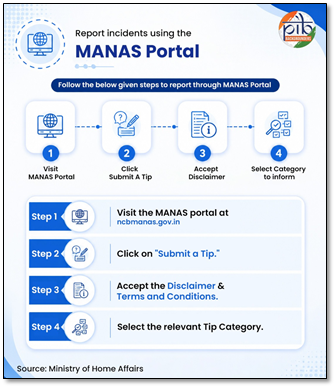
To strengthen India's fight against drug abuse and narcotics trafficking, the Government has expanded technology-enabled citizen participation through MANAS (Madak Padarth Nishedh Asoochna Kendra), the National Narcotics Helpline under the Narcotics Control Bureau (NCB).
About MANAS
MANAS (Madak Padarth Nishedh Asoochna Kendra) is India's National Narcotics Helpline, launched on 18 July 2024 by the Narcotics Control Bureau (NCB) under the Ministry of Home Affairs (MHA).
The platform enables citizens to confidentially report drug-related offences while also providing access to counselling and de-addiction support. It combines digital technology, citizen participation, and inter-agency coordination to strengthen the country's anti-narcotics ecosystem and support the vision of a Nasha Mukt Bharat.
Objectives
- Encourage citizen participation in combating drug trafficking.
- Facilitate confidential reporting of narcotics-related crimes.
- Strengthen coordination among anti-narcotics agencies.
- Provide counselling and rehabilitation support for persons affected by substance abuse.
- Improve intelligence gathering through digital monitoring and analytics.
Key Features
MANAS allows citizens to anonymously report activities such as drug trafficking, peddling, illegal cultivation of narcotic crops, and other narcotics-related offences, ensuring that the identity of the informant remains confidential.
The platform has been developed in collaboration with the Digital India Corporation and is accessible through multiple channels, including:
- National Helpline: 1933
- Official MANAS portal
- UMANG application
For individuals suffering from substance addiction, MANAS provides access to counselling and rehabilitation services. Calls related to de-addiction are seamlessly transferred to the Ministry of Social Justice and Empowerment's National Helpline (14446).
The platform employs digital ticket generation, workflow management, case tracking, and real-time data analytics, enabling authorities to identify emerging drug hotspots, improve response time, and enhance operational efficiency.
Institutional Linkages
MANAS integrates citizens with the country's anti-drug enforcement network by connecting reports to:
- 30 Narcotics Control Bureau (NCB) Zonal Units
- 36 State and Union Territory Anti-Narcotics Task Forces (ANTFs)
This facilitates faster intelligence sharing, coordinated investigations, and timely enforcement action.
LokOS Platform
- 06 Jul 2026
In News:
The LokOS platform has significantly expanded its reach across India, enabling large-scale digital transformation of Self-Help Groups (SHGs) and other Community-Based Organizations (CBOs) under the Deendayal Antyodaya Yojana–National Rural Livelihoods Mission (DAY-NRLM).
About LokOS Platform
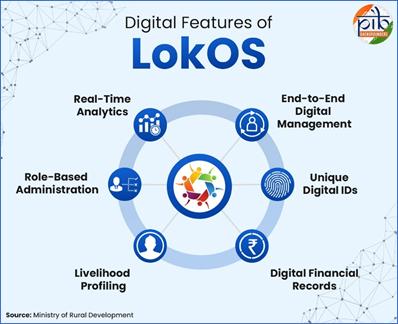
LokOS (Lok = People, OS = Operating System) is a web- and mobile-based digital platform developed under DAY-NRLM to facilitate end-to-end digital management of Self-Help Groups (SHGs) and Community-Based Organizations (CBOs).
It serves as a unified digital operating system for creating, managing, monitoring, and strengthening community institutions while promoting transparency, financial inclusion, and efficient implementation of rural livelihood programmes.
Objectives
- Digitally manage community institutions under DAY-NRLM.
- Improve governance, transparency, and accountability.
- Strengthen women-led rural enterprises and financial inclusion.
- Enable real-time monitoring and data-driven policymaking.
- Support implementation of the Lakhpati Didi initiative through digital beneficiary tracking.
Key Features
- The web application enables administrators, e-bookkeepers, and transaction approvers to create and manage Self-Help Groups (SHGs), Village Organizations (VOs), Cluster Level Federations (CLFs) and their members.
- The mobile application facilitates field-level recording and management of community activities, allowing real-time data collection and updates.
- LokOS provides end-to-end digital management by registering community institutions, maintaining member databases, and generating Aadhaar- and bank-linked digital identities for organizations and beneficiaries.
- The platform records savings, internal lending, loan repayments, and other financial transactions, thereby improving financial transparency and record keeping.
- It also captures livelihood profiling of members, enabling convergence with government welfare schemes and better livelihood planning.
- Role-based access ensures secure user management, approvals, monitoring, and reporting at village, block, district, state, and national levels. In addition, real-time dashboards and one-click analytical reports support evidence-based decision-making.
Coverage
The platform has been rolled out across 34 States and Union Territories, enabling nationwide digital integration of:
- Self-Help Groups (SHGs)
- Village Organizations (VOs)
- Cluster Level Federations (CLFs)
- SHG members
Delhi Electric Vehicle (EV) Policy, 2026
- 06 Jul 2026
In News:
The Government of Delhi has notified the Delhi Electric Vehicle (EV) Policy, 2026, a comprehensive roadmap aimed at accelerating the transition to zero-emission mobility and reducing vehicular pollution in the National Capital Territory.
About Delhi EV Policy, 2026
- The Delhi EV Policy, 2026 is the capital's new electric mobility framework that will remain in force from 1 July 2026 to 31 March 2030. Unlike the previous policy, it exclusively promotes Battery Electric Vehicles (BEVs) and does not provide incentives or tax concessions for strong hybrid vehicles.
- The policy seeks to reduce air pollution, expand electric mobility, strengthen charging infrastructure, and position Delhi as a leader in sustainable urban transport.
Need for the Policy
Vehicular emissions remain one of the major contributors to Delhi's deteriorating air quality. According to the Delhi Transport Department, commercial goods vehicles contribute about 33% of vehicular pollution, while two- and three-wheelers together account for nearly 46%. Since these segments dominate urban mobility, the policy focuses on accelerating their electrification.
Major Features
- The policy provides phased financial incentives to encourage EV adoption. Electric two-wheelers are eligible for subsidies of ?30,000 in the first year, reducing to ?20,000 and ?10,000 over the following two years. Electric auto-rickshaws receive subsidies of ?50,000, ?40,000 and ?30,000 respectively during the three-year incentive period.
- Eligible battery electric vehicles receive a 100% exemption from road tax and registration fees, although this benefit for passenger cars is restricted to vehicles costing up to ?30 lakh (ex-showroom).
- A dedicated digital subsidy portal enables online applications within 30 days of purchase, with subsidies transferred through Direct Benefit Transfer (DBT) within 60 days.
Key Regulatory Measures
The policy introduces a phased transition towards complete electrification of high-polluting vehicle categories.
- From 1 January 2027, only electric L-5 passenger auto-rickshaws and N1 category light goods carriers will be eligible for fresh registration.
- From 1 April 2028, registration of new petrol and CNG-powered two-wheelers will cease, permitting only electric models.
- Institutional schools are required to progressively electrify their bus fleets by achieving 10% conversion within two years, 20% within three years, and 30% by March 2030.
To prevent misuse of subsidies, beneficiaries cannot sell or register subsidised electric vehicles outside Delhi for three years.
Charging Infrastructure and Digital Support
- The policy envisages expanding Delhi's public charging ecosystem to nearly 32,000 charging points, supported through the PM e-Drive initiative. It also proposes dedicated residential electricity connections and lower off-peak charging tariffs in coordination with power distribution companies.
- Grid strengthening will be undertaken by Delhi Transco Limited (DTL) to ensure reliable electricity supply for large-scale EV adoption.
Challenges
Despite its ambitious vision, the policy faces several implementation challenges. Excluding strong hybrid vehicles has drawn criticism from automobile manufacturers, who view hybrids as an important transitional technology. The relatively higher upfront cost of electric vehicles may discourage lower-income groups such as auto-rickshaw drivers and delivery operators without adequate financing support.
Rapid growth in EV charging demand also requires significant investment in electricity distribution infrastructure. Effective implementation will depend upon timely expansion of charging facilities, stable power supply, affordable financing, and efficient subsidy disbursal.
Significance
The Delhi EV Policy, 2026 represents one of India's most ambitious state-level electric mobility initiatives. By combining financial incentives, regulatory mandates, digital governance and infrastructure development, it seeks to reduce urban air pollution, lower greenhouse gas emissions, strengthen the electric vehicle ecosystem, and promote sustainable urban transport.