
Sperm Whales

- 22 May 2026
In News:
A study published in Proceedings of the Royal Society B by researchers from the University of California, Berkeley has revealed that sperm whale communication possesses a multi-layered acoustic structure strikingly parallel to human phonology — the organisational system underlying human language. The findings fundamentally challenge how scientists have understood non-human animal communication and open new frontiers in comparative linguistics and evolutionary biology.
What are Codas?
Sperm whales (Physeter macrocephalus) — the largest of the toothed whales (Odontocetes) and possessors of the largest brain of any creature in geological history — do not sing like humpback whales. Instead, they communicate using short rhythmic sequences of rapid clicks called codas, exchanged while coordinating within their highly social, matriarchal family and clan groups. Until now, codas were classified purely by timing and rhythm — the number of clicks and the spacing between them (inter-click intervals) — in a system likened to Morse code.
The Breakthrough: Whale "Vowels"
The new study reveals an entirely overlooked dimension. When researchers analysed the frequency components within individual clicks, they found two distinct categories: clicks with a single dominant frequency peak and those with two peaks. In human linguistics, such peaks are called formants — the resonant frequencies that allow humans to distinguish between vowels such as "ah" and "ee." The researchers accordingly labelled these whale click types "a" and "i".
Crucially, the same coda pattern — say, a 1 1 3 sequence — can be produced using either "a" clicks or "i" clicks, meaning whales control both timing and click type as independent variables. This represents a second, previously invisible layer of communicative structure.
Multiple Layers of Phonological Organisation
The study identifies several additional layers of structure:
- Length variation: "a" codas are consistently longer than "i" codas even when the timing pattern is identical, mirroring how vowel length carries meaning in human languages.
- Individual variation: Different individual whales produce codas of different lengths within the same type, yet all follow the same underlying "a longer than i" rule — indicating both individual identity and shared group conventions.
- Sequential dependency: The first click of a new coda is sometimes influenced by the type of coda that immediately preceded it — demonstrating that codas are not produced in isolation but form part of a structured sequence, again paralleling rules of human speech production.
Convergent Evolution: The Deeper Significance
The researchers invoke convergent evolution to explain these parallels — humans and sperm whales diverged tens of millions of years ago, yet both independently developed complex vocal systems organised by discrete sound categories, timing, and positional rules. The rich social and cultural lives of sperm whales — where behaviours are transmitted across generations within matriarchal clans — likely drove the evolution of this communicative complexity.
However, scientists caution against prematurely labelling sperm whale codas as "language." The fundamentally rhythmic nature of codas sets them apart from the combinatorial flexibility of human speech, and what specific information these patterns convey remains unknown. Project CETI (Cetacean Translation Initiative) — which uses machine learning and acoustic AI to decode whale communication — is expected to shed further light on the semantic content of these signals.
India Hosts 68th APO Governing Body Session

- 22 May 2026
In News:
The Government of India, as Chair of the Asian Productivity Organization (APO), hosted the 68th Session of the APO Governing Bodyat Bharat Mandapam, New Delhi. The event brought together over 60 senior delegates representing 20 APO member economies, alongside observers from Kazakhstan, Uzbekistan, Bhutan, and the Global Green Growth Institute — reflecting the organisation's expanding engagement with prospective members and multilateral partners.
About the Asian Productivity Organization
- Established in 1961, the APO is an intergovernmental organisation comprising 21 member economies from the Asia-Pacific region.
- Its founding mandate is to enhance productivity for sustainable socioeconomic development through mutual cooperation, knowledge sharing, policy dialogue, and technical assistance. Membership is open to countries in Asia and the Pacific that are members of the UN Economic and Social Commission for Asia and the Pacific (UN ESCAP).
- India is a founding member of the APO. The designated National Productivity Organization (NPO) for India is the National Productivity Council (NPC), functioning under the Ministry of Commerce and Industry.
- The APO Secretariat is headquartered in Tokyo, Japan and is led by a Secretary-General. The Governing Body is the APO's highest decision-making authority, meeting annually to set strategic direction, approve proposals, and review Secretariat performance.
Key Agenda Items
The three-day session addressed several critical institutional and policy matters:
- APO Vision 2030 — review of progress under the medium-term strategic framework guiding the organisation's priorities through the decade.
- Budget Deliberations — consideration of the preliminary budget for the 2027–28 biennium and associated institutional reforms.
- Governance — election of the APO Chair and Vice Chairs for 2026–27; review of Secretary-General election procedures; adoption of the APO Annual and Financial Report; and endorsement of key policy recommendations.
- APO National Awards Programme — awards were conferred in two categories: APO National Award for Productivity Advocates and APO National Award for Productivity Technical Experts — recognising outstanding contributors to productivity promotion across member economies and strengthening the role of NPOs in fostering a culture of measurable productivity improvement.
Strategic Significance for India
India's hosting reflects its positioning as a regional productivity and innovation leader — aligned with national priorities including the Make in India initiative, the National Manufacturing Mission, and India's ambition to become a developed economy by 2047 (Viksit Bharat). The APO platform enables India to export its productivity policy frameworks — including digital public infrastructure, quality management systems, and MSME capacity-building models — to the Asia-Pacific region.
The presence of observers from Kazakhstan, Uzbekistan, and Bhutan is also diplomatically significant, as it indicates potential future expansion of the APO's membership base — with India well-positioned to facilitate this through its regional diplomatic relationships under the Neighbourhood First and Act East policies.
RAINMUMBAI
- 22 May 2026
In News:
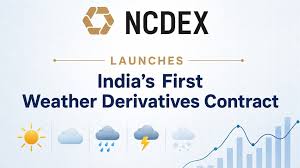
The National Commodity Derivatives Exchange Limited (NCDEX) announced RAINMUMBAI as India's first SEBI-approved exchange-traded weather derivatives contract, with trading set to commence on 29 May 2026. The launch represents the emergence of a new climate-linked asset class in India and a significant step in strengthening the country's climate risk management ecosystem.
What are Weather Derivatives?
Weather derivatives are financial contracts that derive value from weather variables — such as rainfall, temperature, snowfall, or wind speed — rather than from conventional financial assets. Unlike traditional insurance products, weather derivatives are settled purely on observed weather data and do not require physical loss assessment, enabling faster settlement and greater operational efficiency. They are widely used globally in agriculture, power, construction, logistics, tourism, and energy — sectors where revenues are significantly impacted by weather variability. Their inclusion in India's financial architecture became possible after weather derivatives were formally included in the Securities Contracts (Regulation) Act, 1956 (SCRA) in 2024, clearing the regulatory pathway for their exchange-traded launch.
About RAINMUMBAI
RAINMUMBAI was developed in collaboration with IIT Bombay and is based on a scientifically structured Cumulative Deviation Rainfall (CDR) metric, which measures the deviation of actual rainfall from Mumbai's Long Period Average (LPA) during the monsoon months of June to September. Built using daily rainfall data benchmarked against a robust 30-year historical dataset (1991–2020 LPA), the framework ensures transparency, consistency, and reliability.
Underlying data will be sourced from IMD surface rainfall observations and Automatic Weather Stations (AWS) at Santacruz and Colaba — two of Mumbai's principal weather monitoring points. The contract is cash-settled, with a base price of ?50 per millimetre of rainfall, a tick size of 1 mm, and a maximum order size of 50 lots. Trading hours are Monday to Friday, 10:00 a.m. to 11:30/11:55 p.m.
Who Benefits?
The futures contract is designed for a broad range of stakeholders with financial exposure to rainfall fluctuations — farmers, construction companies, power utilities, logistics operators, and banks with agricultural loan portfolios. For farmers, it provides a market-based hedge against crop losses from deficient or excess rainfall, without the documentation burden associated with traditional crop insurance. For banks, it offers a tool to hedge the credit risk embedded in agriculture-linked loan portfolios — a significant concern given India's monsoon-dependent rural economy.
Institutional Architecture
The NCDEX-IMD MoU signed in December 2025 gave NCDEX access to IMD's historical and real-time weather data, enabling development of statistically validated weather indices that form the foundation of weather-linked futures contracts. NCDEX — established in 2003, headquartered in Mumbai, and regulated by SEBI — primarily focuses on agricultural commodity derivatives including wheat, sugar, spices, and cotton.
The RAINMUMBAI initiative is explicitly city-specific and monsoon-specific for now, but the underlying CDR framework can be scaled to other cities and weather parameters — potentially unlocking India's first temperature or wind-based derivatives in future iterations.
Ammonium Sulphate for Paddy

- 22 May 2026
In News:
The Indian Council of Agricultural Research (ICAR) has recommended the use of ammonium sulphate for paddy cultivation as a low-cost fertilizer option to help farmers improve crop nutrition and maintain soil fertility. The recommendation comes amid growing concerns over India's heavy dependence on urea, fertilizer import disruptions from West Asia, and widespread sulphur deficiency in Indian agricultural soils.
What is Ammonium Sulphate?
Ammonium sulphate — chemical formula (NH?)?SO? — is an inorganic, water-soluble mineral fertilizer produced by reacting ammonia with sulphuric acid. It is also recovered as a valuable industrial byproduct from coke-oven gases in steel plants and from the manufacture of caprolactam (used in nylon production) and other metallurgical and chemical processes. This dual origin — direct synthesis and industrial recovery — makes it a resource-efficient fertilizer with significant circular economy value.
Its key nutritional composition: 21% Nitrogen (in the ammonium form) and 24% Sulphur (as active sulphate) — making it one of the richest dual-nutrient fertilizers available.
Why Ammonium Sulphate for Paddy?
Rice farmers frequently apply ammonium sulphate to flooded soils since nitrate-based fertilizers are a poor choice for waterlogged paddy fields due to denitrification losses — the microbial conversion of nitrates into nitrogen gas under anaerobic conditions. The ammonium form of nitrogen in ammonium sulphate is more stable in flooded, oxygen-deficient paddy soils, making it agronomically superior to urea in such conditions.
Additionally, paddy cultivation in India is heavily concentrated in alkaline and sulphur-deficient soils across states like Uttar Pradesh, Punjab, and Haryana. Ammonium sulphate addresses both challenges simultaneously — its acidifying effect lowers soil pH in alkaline soils while replenishing sulphur, which is increasingly becoming a deficient macronutrient in Indian farmlands due to the shift away from sulphur-containing fertilizers.
Sulphur plays a critical role in protein synthesis, chlorophyll formation, oil content in oilseeds, and quality parameters of cereals — making sulphur nutrition essential for both yield and produce quality.
The Urea Problem: Why a Shift is Needed
India's fertilizer economy is dangerously skewed toward urea, which accounts for the bulk of nitrogen fertilizer consumption. This creates multiple structural problems: fiscal pressure through enormous subsidies (urea is the most heavily subsidised fertilizer), soil nutrient imbalance (urea provides only nitrogen, exacerbating sulphur and other micronutrient deficiencies), and import vulnerability (India imports significant quantities of urea and its feedstocks).
Fertilizer imports from West Asian suppliers including Saudi Arabia, Qatar, UAE, Oman, and Israel are facing major shipping and logistics disruptions due to ongoing regional conflict in 2026 — making diversification of India's fertilizer basket both an agronomic and a strategic food security imperative.
Broader Applications of Ammonium Sulphate
Beyond agriculture, ammonium sulphate finds use across several industries: water treatment (as a coagulation aid), food processing (as a dough conditioner and food additive approved under FSSAI standards), pharmaceuticals (protein precipitation in biologics manufacturing), and textile processing (in dyeing and printing). Its multisectoral utility underscores its importance as an industrial chemical beyond the farm
Blue Straggler Star

- 22 May 2026
In News:
In a breakthrough that could reshape astronomers' understanding of how stars evolve, researchers have made the world's first confirmed discovery of a blue straggler star hosting a brown dwarf companion in an extraordinarily compact binary system. The findings have been published in the prestigious journal Monthly Notices of the Royal Astronomical Society: Letters.
The Research Team: India's Scientific Institutions at the Forefront
Scientists from Gauhati University (supported under the INSPIRE programme of the Department of Science and Technology), the Indian Institute of Astrophysics (IIA), Bengaluru, the Aryabhatta Research Institute of Observational Sciences (ARIES), Nainital, and the INAF-Catania Astrophysical Observatory, Italy collaborated on the discovery. The study demonstrates how innovative analysis of archival astronomical data can yield landmark discoveries without requiring new or expensive observational facilities — a significant lesson for India's growing space science community.
What are Blue Straggler Stars?
Blue Straggler Stars (BSS) are anomalous stellar objects found in old, dense stellar systems such as globular and open star clusters. In a cluster, all stars are expected to be of roughly similar age — meaning they should evolve at comparable rates. Yet blue stragglers appear brighter, hotter, and bluer than their peers, defying the standard stellar evolution timeline. Instead of cooling and expanding as expected at a certain stage, they remain on — or even extend beyond — the main sequence.
Three formation mechanisms are hypothesised: the star accretes mass from a companion (mass transfer); two stars directly merge; or a third star facilitates mass transfer through gravitational perturbations — known as Kozai-Lidov oscillations.
The Historic Discovery
The team found that the binary system has an exceptionally short orbital period of approximately 5.6 hours (0.234 days) and contains the lightest companion ever detected around a blue straggler, with a mass of approximately 0.056 times the mass of the Sun — placing it firmly below the hydrogen-burning limit.
This companion is a brown dwarf — an object too massive to be classified as a planet, but too small to ignite nuclear fusion and become a true star. The study reveals the shortest-period binary system discovered inside the so-called "brown dwarf desert" — a region in stellar science where such companions are considered extremely rare.
Formation Pathway: The Triple-Star Origin
The researchers propose that the system originated as a hierarchical triple-star system — with an inner binary containing a brown dwarf companion and an outer evolved tertiary star. Mass transfer and Kozai-Lidov oscillations induced orbital excitation and merger of the progenitor and the tertiary star, forming the blue straggler. Subsequent tidal dissipation then circularised the inner orbit, producing the present-day compact BSS-BD binary with a short-period, nearly circular orbit.
Scientific Significance
The discovery has multi-layered implications for astronomy. It refines theoretical models of stellar evolution, binary interactions, and substellar object formation — models that underpin data interpretation from both ground-based observatories and space telescopes globally. It also advances understanding of how extreme stellar environments affect orbital dynamics and evolutionary pathways — essential for modelling the long-term structure of the universe.