
Design Linked Incentive (DLI) Scheme

- 05 Jun 2026
In News:
Union Minister for Electronics and IT Ashwini Vaishnaw stated, that India's Design Linked Incentive (DLI) scheme is delivering encouraging results, citing the development of India's first Edge AI System-on-Chip (SoC) — NETRA A2000 — by Thiruvananthapuram-based fabless semiconductor startup Netrasemi as a key milestone.
The NETRA A2000 Achievement
- Netrasemi designed India's first flagship AI System-on-Chip, the NETRA A2000, at the advanced 12nm technology node. The chip has completed successful silicon bring-up — a critical stage that validates chip functionality after fabrication — and is now moving toward commercial production.
- It is designed to support smart vision devices and real-time AI applications across sectors such as surveillance, automotive, robotics, and drones. The SoC integrates Netrasemi's proprietary Neural Processing Unit (NPU), Vision Processing Unit (VPU), Image Signal Processor (ISP), crypto engines, and specialised hardware acceleration IP cores, and was fabricated at TSMC using its 12nm process technology.
- Netrasemi was one of the first four startups selected for ?15 crore DLI support in 2023 by MeitY, and has raised ?125 crore in total funding to date.
About the DLI Scheme
- The Design Linked Incentive (DLI) Scheme is implemented by the Ministry of Electronics and Information Technology (MeitY) under the broader Semicon India Programme.
- It is a key instrument in advancing India's ambition to develop a strong fabless semiconductor capability — i.e., companies that design chips without owning fabrication facilities.
- The nodal agency for implementation is C-DAC (Centre for Development of Advanced Computing).
- The scheme aims to reduce India's import dependence in semiconductors, strengthen supply chain resilience, and enhance domestic value addition across the full chip lifecycle — from design and development to deployment — covering Integrated Circuits (ICs), Chipsets, Systems-on-Chip (SoCs), Systems, and IP Cores.
Eligibility and Financial Incentives
- Startups and MSMEs are eligible for both financial incentives and design infrastructure support. Other domestic companies are eligible for financial incentives for deploying semiconductor designs.
- The scheme operates through two incentive tracks. Under the Product Design Linked Incentive, eligible entities receive reimbursement of up to 50% of eligible expenditure, capped at ?15 crore per application.
- Under the Deployment Linked Incentive, incentives of 4–6% of net sales turnover are provided for five years, capped at ?30 crore per application, with a minimum cumulative net sales requirement of ?1 crore for startups/MSMEs and ?5 crore for other domestic companies over the first five years.
Project UDAYAK

- 05 Jun 2026
In News:
The Border Roads Organisation (BRO) celebrated the 37th Raising Day of Project UDAYAK, at Doomdooma, Assam, marking over three decades of strategic infrastructure development in India's northeastern frontier.
About Project UDAYAK
Established in 1989, Project UDAYAK is a specialised territorial wing of the BRO, which functions under the Ministry of Defence. It is tasked with the development and maintenance of strategic road infrastructure across some of the most remote and geographically challenging terrains in India. The project currently manages over 1,457 km of strategic roads.
Area of Responsibility
The project operates in the easternmost regions of Arunachal Pradesh and parts of Assam, covering the districts of Anjaw, Lohit, Dibang Valley, Longding, Tirap, and Changlang. It manages road infrastructure along two highly sensitive international boundaries — the Line of Actual Control (LAC) with China and the Indo-Myanmar border — making it central to India's border security architecture in the northeast.
37th Raising Day Highlights
The Raising Day was marked by a Swachhata Abhiyan, road safety awareness campaigns, a run and walkathon, and medical and dental camps for nearby communities. Internal activities including SainikSammelan and troop interactions were conducted to strengthen camaraderie among personnel, reflecting the project's dual commitment to operational excellence and community welfare.
Strategic Significance
Project UDAYAK occupies a critical position in India's national security calculus for several reasons.
- First, connectivity along the LAC is essential for the Indian Army's logistics, rapid troop mobilisation, and supply chains — an area where China has historically held an advantage due to its superior infrastructure on the Tibetan plateau.
- Second, the Indo-Myanmar border region is prone to insurgency and illegal trafficking; road and fencing infrastructure directly aids security forces in surveillance and response.
- Third, beyond security, the roads and bridges built by the project connect isolated tribal communities to markets, healthcare, and education, accelerating socio-economic integration of border populations with the national mainstream.
About BRO
The Border Roads Organisation was established in 1960 and operates under the Ministry of Defence. It is responsible for the construction and maintenance of road infrastructure in border areas and strategically sensitive regions across India and friendly neighbouring countries. BRO's work is considered integral to both national security and the development of remote areas.
India-Oman Comprehensive Economic Partnership Agreement (CEPA)
- 05 Jun 2026
In News:
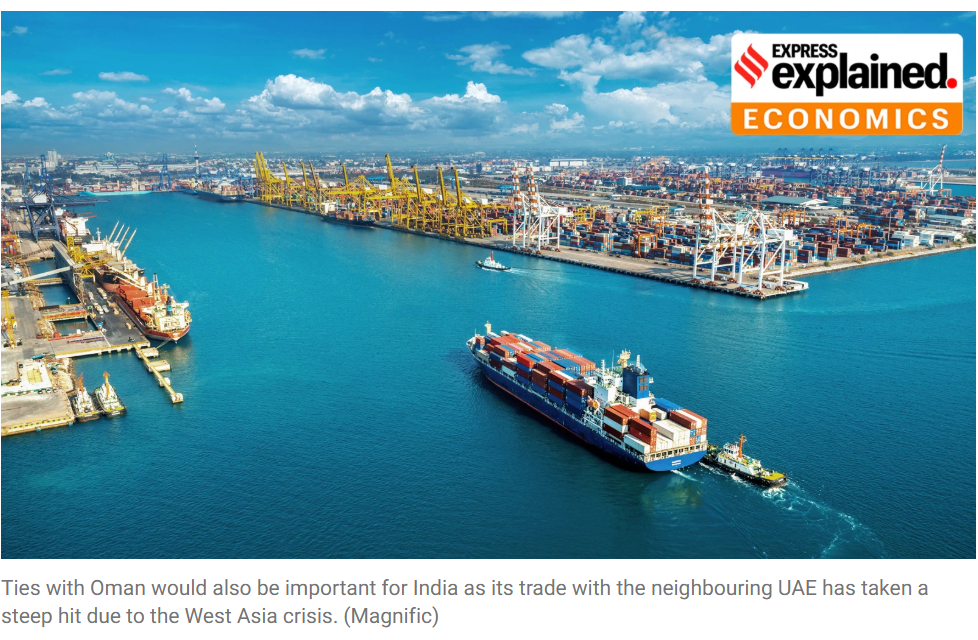
The India-Oman Comprehensive Economic Partnership Agreement (CEPA), signed in December 2025, has come into force at a critical juncture, as disruptions in the Strait of Hormuz due to continuing regional conflict have raised serious concerns over global trade, energy supplies, and freight costs across West Asia.
India-Oman Bilateral Relations: Overview
- India and Oman share one of the oldest maritime and commercial partnerships in the Indian Ocean region. Oman is India's oldest strategic partner in the Gulf, and their relationship has evolved into a comprehensive engagement covering trade, energy, defence, connectivity, and people-to-people ties.
- Nearly 700,000 Indians reside in Oman, making the Indian diaspora the Sultanate's largest expatriate community and a vital bridge between the two nations. Bilateral trade stood at USD 11.18 billion in FY 2025-26.
- India imports crude oil, LNG, fertilisers, methanol, and ammonia from Oman, while exporting machinery, petroleum products, iron and steel, rice, ceramics, and engineering goods. Strategically, the two countries cooperate in maritime security and counter-piracy operations, and Oman provides India logistical access to the Duqm Port, enhancing India's presence in the western Indian Ocean.
Why Oman Matters More Now: The Hormuz Factor
- The Strait of Hormuz is one of the world's most critical maritime chokepoints, through which a substantial portion of global oil and gas trade passes. Ongoing regional conflict has driven up freight costs and disrupted trade flows across West Asia. India-UAE trade, which had crossed $100 billion in the previous financial year, reportedly declined by approximately 35% in April 2026 due to port disruptions.
- Oman offers a strategic advantage in this scenario: unlike many Gulf states whose ports depend on Hormuz access, a significant portion of Oman's coastline lies along the Gulf of Oman and the Arabian Sea — outside the strait. Key ports such as Salalah and Duqm therefore remain accessible even during Hormuz disruptions, making Oman an indispensable partner for India's trade and energy continuity.
Key Provisions of the CEPA
The CEPA is a comprehensive free trade agreement aimed at deepening economic integration. Its major features include: Oman has granted zero-duty access on 98% of tariff lines, covering approximately 99% of India's exports. Prior to the agreement, some Indian goods attracted duties of up to 100% in Oman. The deal aims to diversify trade beyond traditional energy cooperation, enhance investment flows, and strengthen supply chain integration.
- Energy Security: India's energy imports from Oman — crude oil, LNG, fertilisers, methanol, and ammonia — were valued at over $7.2 billion in FY 2025-26. Stable access to Omani supplies significantly reduces India's vulnerability to geopolitical disruptions in the region.
- Export Opportunities: Sectors likely to benefit include machinery and engineering goods, petroleum products, steel and iron, rice and agricultural products, electronics, and consumer goods. Notably, Oman's electronics imports are estimated at around $3 billion annually while India's exports in this segment remain modest, indicating significant untapped potential.
Index of Industrial Production and Revision of Base Year
- 05 Jun 2026
In News:
Recently, the government released India's revised Index of Industrial Production (IIP) series with 2022-23 as the new base year (replacing 2011-12), alongside April 2026 industrial output data showing a slowdown in growth.
April 2026 Performance
IIP growth slowed to 4.9% in April 2026, down from 5.8% in April 2025. Of the four sectoral indices, three grew at a slower pace and one contracted. Mining and quarrying recorded a sharp decline of over 5% year-on-year. Manufacturing sector output grew at 6.2%, marginally slower than 6.3% in the corresponding month of 2025.
Within manufacturing — which constitutes approximately 75% of the IIP basket — six industries contracted. Notable contractions include: coke and refined petroleum products (–0.4%), wearing apparel (–7%), and wood products other than furniture (–12.5%, the steepest decline). On the positive side, electrical equipment output surged 19.2%.
Use-Based Classification (April 2026)
Under use-based classification, IIP tracks six categories: primary goods, capital goods, intermediate goods, infrastructure/construction goods, consumer durables, and consumer non-durables. Growth slowed in three categories — primary goods (0.8%), consumer durables (4.3%), and consumer non-durables (2.8%) — compared to April 2025. However, capital goods output growth accelerated sharply to 16% and infrastructure/construction goods to 7.1%, signalling continued momentum in investment activity. Intermediate goods grew at 7.7%, slightly faster than the previous year.
Revised IIP Series: Key Changes
The base year revision to 2022-23 is the latest in a broader statistical overhaul of major macroeconomic indicators in 2026, following the GDP revision. The index value for the base year is set to 100, against which subsequent growth is measured.
Key changes in the new series:
- Expanded product basket: The revised IIP now covers 1,042 products mapped to 463 item groups, up from 839 items and 407 item groups in the old series, improving representativeness.
- Broadened sectoral coverage: Beyond the traditional categories of mining and quarrying, manufacturing, and electricity, the new series incorporates gas supply, water supply, sewerage, and waste management activities.
- Improved granularity: The mining sector index now separately classifies fuel minerals, metallic minerals (including rare earth minerals), and non-metallic minerals (including minor minerals). Electricity generation is now disaggregated into renewable and non-renewable sources, enabling sharper tracking of India's green energy transition.
- Revised weights: Sector and industry weights have been realigned with the updated Gross Value Added (GVA) 2022-23 series, ensuring the index better reflects the current structure of India's economy.
- Linkage formula: A bridging formula has been provided to maintain comparability between the old and new series.
About IIP
IIP is a monthly macroeconomic indicator published by the National Statistical Office (NSO) under MoSPI. It measures short-term changes in the volume of industrial production and serves as a high-frequency barometer of industrial health — critical because GDP data is released only quarterly. It informs RBI monetary policy, government fiscal decisions, and analyst forecasts of economic momentum.
Doctrine of Promissory Estoppel
- 05 Jun 2026
In News:
Recently, a Supreme Court bench of Justice J.B. Pardiwala and Justice K.V. Viswanathan, in State of Himachal Pradesh v. M/s Kundlas Loh Udyog, ruled that the doctrine of promissory estoppel cannot be invoked to claim a benefit under a government policy that was never intended for a specific class of industrial unit.
Background of the Case:
The respondent company, an existing industrial unit established in 2005–06 engaged in metal processing and stamping, undertook substantial expansion in 2020, increasing plant and machinery by 88.69% and generating additional employment. It claimed concessional electricity tariff benefits under Himachal Pradesh's Industrial Policy, 2019, arguing that the term "eligible enterprises" in Clause 16(a) covered existing industries undergoing expansion. The Himachal Pradesh High Court ruled in the company's favour. The State appealed to the Supreme Court.
The Supreme Court set aside the High Court's order, holding that the policy was exclusively intended for new industrial enterprises, not existing ones. Extending the benefit would also create double benefit, since the respondent had already availed a 15% rebate on energy charges under Clause 16(b) of the same policy.
What is the Doctrine of Promissory Estoppel?
Promissory estoppel is an equitable legal doctrine that prevents a promisor from reneging on a promise when the promisee has reasonably relied on it and suffered a detriment as a result. It operates not within the strict law of contract or evidence but on broader principles of fairness, justice, and good conscience. Under Indian law, it can function not merely as a defence but also as an independent cause of action.
Key requirements for invoking the doctrine: (i) a clear, unequivocal, and unambiguous promise; (ii) the promisee must have acted in reliance on the promise; and (iii) the promisee must have altered their position — through investments, liabilities, or rearrangement of affairs — on the faith of the representation. Actual detriment need not be proven; alteration of position suffices.
Landmark Precedent:
- In ChhaganlalKeshavalal Mehta v. Patel Narandas Haribhai (1981), the Supreme Court had first laid down a checklist: a clear promise, reasonable reliance by the plaintiff, and resultant loss.
Key Principles Laid Down (2026 Judgment):
Drawing from IFGL Refractories Ltd. v. Orissa State Financial Corporation (2026), the Court consolidated the following principles:
- The doctrine applies with full force against the State, its departments, statutory bodies, and instrumentalities under Article 12.
- Where the State frames industrial incentive schemes to attract investment, representations therein become enforceable once entrepreneurs act upon them and satisfy eligibility conditions.
- The State may ordinarily modify or revoke an exemption under the same power it granted it, but promissory estoppel may preclude such withdrawal, subject to equity and public interest.
- The doctrine cannot be used to claim benefits never intended for that class of industry — the promise must correspond to what was actually offered.
- The ultimate object of the doctrine is to prevent manifest injustice and ensure governmental consistency and fairness.
Significance for Governance:
This ruling underscores that while the State cannot arbitrarily retreat from representations it has made to investors, citizens cannot stretch the scope of a policy beyond its intended beneficiaries using equitable doctrines. It balances investor protection with fiscal discipline and sound public policy.