
Suryastra: India's Indigenous Multi-Calibre Rocket System
- 23 May 2026
In News:
India achieved a major milestone in indigenous defence technology after private defence firm Nibe Limited successfully tested the long-range Suryastra rocket system at the Integrated Test Range (ITR), Chandipur, Odisha. Trials included both the 150 km and 300 km strike-range variants, both delivering highly accurate strikes with minimal error.
What is Suryastra?
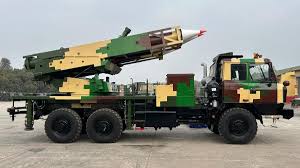
- Suryastra is India's first indigenous universal multi-calibre rocket launcher system — a fully guided, precision rocket artillery platform designed for long-range strategic strikes.
- Developed by Pune-based Nibe Limited in collaboration with Israel's Elbit Systems, based on Elbit's PULS (Precise & Universal Launching System) technology.
- Mounted on a highly mobile 6×6 Tatra truck, enabling rapid deployment and shoot-and-scoot survivability against counter-battery fire.
- Mission profile: precision strikes against enemy command centres, radar installations, logistics hubs, and military infrastructure deep inside hostile territory.
Technical Specifications
- Multi-calibre, Modular Design: Uses interchangeable modular pods capable of firing:
- 122 mm rockets — shorter-range battlefield engagements
- 306 mm EXTRA missiles — range up to 150 km
- 370 mm Predator Hawk missiles — range up to 300 km
- SkyStriker loitering munitions (suicide drones) — range up to 100 km
- Precision: The 150 km variant achieved a Circular Error Probable (CEP) of 1.5 metres; the 300 km variant struck within 2 metres of the target — exceptional accuracy for long-range guided rocket artillery.
- Fire Control: Integrates GPS, inertial navigation, and digital ballistic computation for all-weather, day-night precision targeting.
- Semi-automated reload reduces crew exposure during operations.
Strategic Significance
- Operational Depth: The 300 km strike range allows India's military to engage high-value strategic targets deep inside enemy territory while keeping personnel and equipment outside conventional artillery range — a critical operational advantage in mountainous or contested border terrains.
- Multi-domain Lethality: The inclusion of loitering munitions (SkyStriker) alongside conventional rockets gives Suryastra a hybrid character — combining saturation fire with precision drone strike capability in a single platform, mirroring doctrinal lessons from the Ukraine and Nagorno-Karabakh conflicts.
- Atmanirbhar Bharat Validation: Private companies like Nibe are now stepping up to build missile platforms, drones, and advanced electronics — reducing India's reliance on imports and demonstrating the maturation of India's private defence-industrial ecosystem.
- Comparative Context:Suryastra's capability profile places it alongside systems like the US M270 MLRS and Russia's BM-30 Smerch, but with the added distinction of being indigenously integrated and domestically produced — a significant leap for a country historically dependent on imported artillery.
Policy Context
The Suryastra test aligns with India's Defence Acquisition Procedure (DAP) 2020, which prioritises indigenously designed, developed, and manufactured (IDDM) systems. India's Defence Production and Export Promotion Policy (DPEPP) 2020 targets defence exports of USD 5 billion by 2025 — systems like Suryastra, once inducted, could form the core of India's emerging guided rocket artillery export portfolio
Arunachal Kiwi Mission
- 23 May 2026
In News:
Union Minister for Development of North Eastern Region (DoNER), Shri Jyotiraditya Scindia, launched the "Arunachal Kiwi: The USP of Arunachal Pradesh" — a Cluster-based Kiwi Cultivation and Value Chain Development Mission — in New Delhi. With a financial outlay of approximately ?167 crore, the mission is designed through a whole-of-government and convergence-led approach, marking a significant step in building globally competitive agricultural value chains rooted in the Northeast's natural strengths.
Why Kiwi for Arunachal Pradesh?
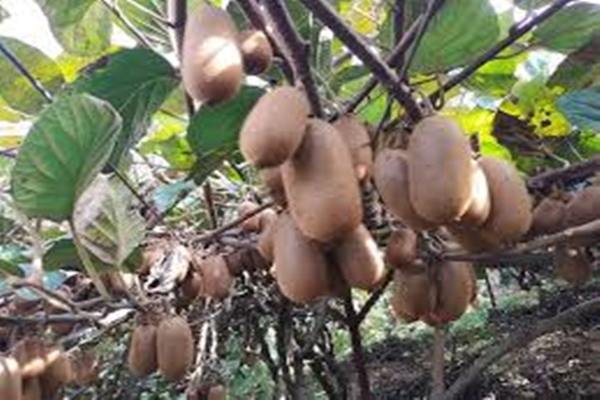
- Arunachal Pradesh is India's largest kiwi-producing state and the first state in the country to receive organic kiwi certification under the Mission Organic Value Chain Development for North East Region (MOVCD-NER) in 2020.
- The state's high-altitude, organic agro-climatic conditions are ideal for producing premium-grade Hayward and Allison cultivars of kiwi — varieties with high domestic and export market value.
- Kiwi (Actinidia deliciosa, also called Chinese Gooseberry) thrives between 900–1,600 metres above mean sea level in warm, humid climates with well-distributed annual rainfall of around 150 cm and 700–800 chilling hours during winter — conditions naturally present across Arunachal's hill terrain.
- The fruit is a rich source of Vitamins B and C and minerals including phosphorus, potassium, and calcium, placing it in growing demand in health-conscious domestic and global markets.
Four Strategic Pillars of the Mission
The Arunachal Kiwi Mission is anchored on four pillars:
- Convergence: Integration of schemes across multiple ministries and departments to eliminate fragmented implementation and maximise fund utilisation.
- Value Addition: Moving beyond raw fruit production toward processed kiwi products — juices, jams, dried kiwi, nutraceuticals — to enhance farmer income and reduce post-harvest losses.
- Branding: Developing a distinct, recognisable identity for Arunachal kiwi in domestic and global markets — leveraging its organic certification as a premium differentiator.
- Market Integration: Creating structured supply chain linkages connecting farmers to retail, e-commerce, institutional buyers, and export channels.
Northeast's Unique Product Strategy: One State, One USP
The Arunachal Kiwi Mission is part of a broader DoNER strategy to identify one flagship agricultural or cultural product per Northeastern state with a distinct Unique Selling Proposition (USP):
- Mizoram — Ginger
- Nagaland — Coffee
- Sikkim — Organic Farming
- Manipur — Polo Heritage
- Assam — Muga Silk
- Meghalaya — Lakadong Turmeric
- Arunachal Pradesh — Kiwi
This state-specific, product-anchored approach reflects a shift from generic rural development to competitive, brand-led agricultural specialisation — a model aligned with global agri-value chain thinking.
Policy Context
The mission converges with several existing schemes:
- MOVCD-NER — organic value chain development specific to the Northeast.
- PM-KISAN and Pradhan Mantri Kisan SAMPADA Yojana — for farmer income support and food processing infrastructure.
- One District One Product (ODOP) — for cluster-level product specialisation.
- Agricultural Export Policy 2018 — for integrating Indian agricultural produce into global value chains.
UMMID Programme
- 23 May 2026
In News:
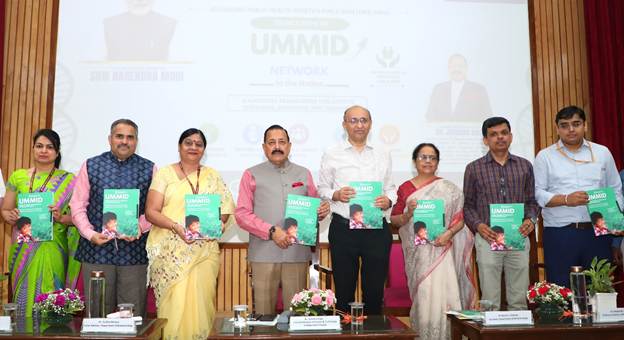
Union Minister Dr. Jitendra Singh dedicated the UMMID (Unique Methods of Management of Inherited Disorders)Programme for Rare Genetic Disorders to the Nation at Prithvi Bhawan, New Delhi.
What is UMMID?
- Nodal Ministry: Department of Biotechnology (DBT), Ministry of Science & Technology.
- Nature: India's first comprehensive national initiative addressing inherited and rare genetic disorders through an integrated, multi-pronged public health approach.
- Policy linkage: Supports implementation of the National Policy for Rare Diseases (NPRD) 2021 by creating structured care pathways for affected patients.
Three Pillars of UMMID
- NIDAN Kendras: Nearly 30 NIDAN Kendras have been established for advanced genetic diagnostics and counselling, ensuring genomic healthcare reaches beyond metropolitan centres to ordinary citizens.
- Outreach in Aspirational Districts: Targeted screening and awareness programmes in underserved and aspirational district populations — addressing the equity gap in rare disease detection.
- Specialised Training Centres: Capacity-building for clinicians, genetic counsellors, and healthcare professionals — addressing the long-standing knowledge deficit around rare disorders in mainstream medical practice.
Key Achievements
- The programme has benefited nearly three lakh individuals through screening and diagnostic services.
- Services span prenatal and newborn screening, genetic counselling, diagnostics, clinician training, and community outreach — all under one unified public health model.
- The UMMID Dashboard launched alongside will enable real-time nationwide monitoring of programme reach and outcomes.
Why It Matters: The Silent Burden
- Inherited and rare genetic disorders remained neglected for decades because diagnosis was difficult, treatment inaccessible, and medicines either unavailable or prohibitively expensive.
- Families often spend years moving from hospital to hospital in search of a diagnosis — imposing enormous emotional, social, and financial hardship despite affecting comparatively smaller populations.
- India's vast genetic diversity compounds the challenge, requiring robust ecosystem-level responses rather than isolated interventions.
Fourth India-Africa Forum Summit (IAFS-IV)

- 23 May 2026
In News:
- The Fourth India-Africa Forum Summit (IAFS-IV), scheduled in New Delhi, has been postponed due to concerns over the spread of the Ebola Virus Disease (EVD) in parts of Africa.
- The summit was to be held after a gap of 11 years — the longest inter-summit interval since IAFS's establishment.
About the Ebola Outbreak
- The WHO has declared the latest Ebola outbreak in the Democratic Republic of Congo (DRC) a Public Health Emergency of International Concern (PHEIC) — the DRC's 17th Ebola outbreak.
- The outbreak has caused approximately 139 deaths with around 600 suspected cases, with the first case now confirmed in South Kivu province, controlled by Rwanda-backed M23 rebels.
- Containment efforts have been severely hampered by ongoing armed conflict in eastern DRC.
- India issued a health advisory for travellers arriving from or transiting through Ebola-affected countries; the Union Health Secretary chaired a high-level review with health secretaries of all states and UTs to assess preparedness.
About India-Africa Forum Summit (IAFS)
- Established: 2008 — the apex institutional platform for India-Africa dialogue and cooperation.
- Previous Summits: IAFS-I (2008, New Delhi) → IAFS-II (2011, Addis Ababa) → IAFS-III (2015, New Delhi).
- Purpose: Strengthens political dialogue, trade, investment, technology transfer, capacity building, and people-to-people ties between India and the 55 African Union member states.
- Reflects: Commitment to South-South cooperation, inclusive development, multilateralism, and sustainable partnerships.
Note: Ebola has twice disrupted India-Africa summitry — the IAFS-III was also delayed from 2014 to 2015 partly due to the West African Ebola epidemic.
Significance of IAFS-IV (What Was at Stake)
- IAFS-IV was expected to announce India's next 10-year Africa engagement roadmap, building on the USD 29 billion in Lines of Credit and 50,000 scholarships committed at IAFS-III.
- The summit coincided with India's growing strategic interest in Africa for critical minerals, maritime security (Indian Ocean Region), food security partnerships, and UN Security Council reform support.
- Africa's 54-member bloc is India's largest voting bloc in multilateral forums — including the UN, WTO, and Commonwealth.
About Ebola Virus Disease (EVD)
- Caused by the Ebola virus (genus Ebolavirus); transmitted through direct contact with blood or body fluids of infected persons.
- Incubation period: 2–21 days; symptoms include fever, weakness, vomiting, diarrhoea, and unexplained bleeding.
- WHO has noted a low global risk but warns that a vaccine could take nine months to deploy at scale.
- No established cure exists; treatment remains supportive; the rVSV-ZEBOV vaccine (Ervebo) has been used in outbreak response since 2019.
Rupa Tarakasi
- 23 May 2026
In News:
Cuttack's centuries-old Rupa Tarakasi (silver filigree) industry — the craft identity of Odisha's "Silver City" — is facing an acute livelihood crisis. Soaring silver prices and a steep hike in import duty from 5% to 15% have disrupted orders, delayed production, and pushed thousands of artisan families into financial uncertainty.
About Rupa Tarakasi
- Rupa Tarakasi is one of India's most sophisticated traditional crafts, practised in Cuttack, Odisha for nearly a millennium.
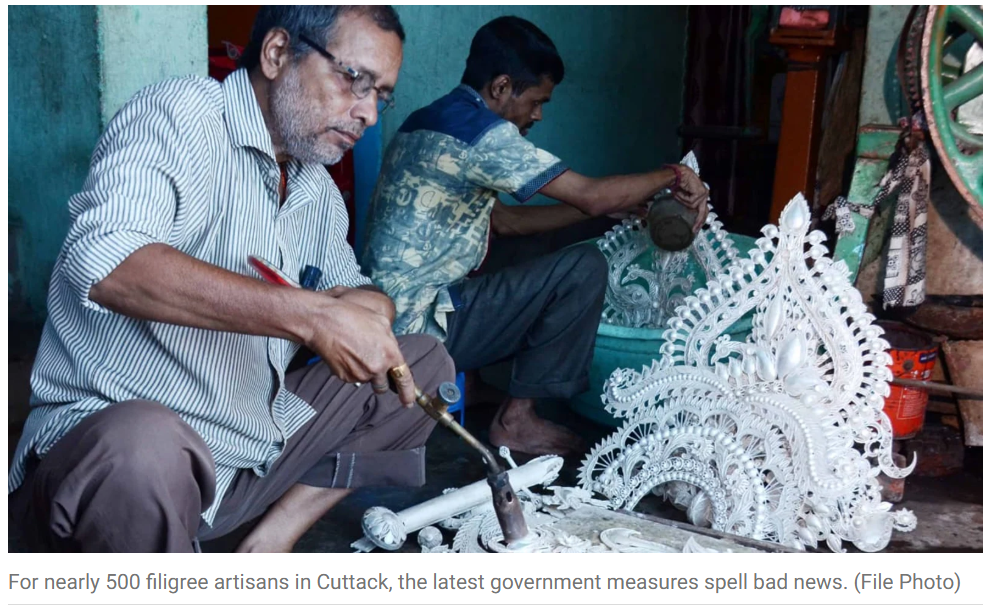
- In Odia, "tara" means wire and "kasi" means design — together capturing the essence of a craft where silver bricks are drawn into ultra-fine wires or foils and intricately shaped into jewellery, religious artefacts, ceremonial objects, and accessories — including ornaments worn by Odissi dancers.
- The artisans practising this craft are called "Rupa Banias" or "Roupyakaras".
- The craft dates to at least the 12th century and received significant patronage under the Mughal Empire, evolving aesthetically with each successive ruling influence.
- It received a Geographical Indication (GI) tag in 2024 — recognition of its unique regional identity and cultural significance.
- Cuttack's filigree also serves as a significant tourism draw, with visitors to nearby Puri and the Konark Sun Temple routinely travelling to the city to witness and purchase this handmade artistry.
The Double Blow: Prices and Policy
The crisis facing Tarakasi artisans is driven by two converging pressures.
- Soaring silver prices: Global silver prices have risen sharply in recent months, directly inflating raw material costs for artisans who operate on thin margins with little buffer capital.
- Import duty hike: The government raised import duty on silver from 5% to 15% — a 10% increase — which, while aimed at reducing smuggling and curbing misuse of Free Trade Agreements, has significantly raised input costs for artisans. The duty hike followed a tenfold surge in silver jewellery imports from Thailand — volumes rising from 4 to 40 metric tonnes — with Thailand's share increasing from 78% to 98% of such imports, prompting the Directorate General of Foreign Trade (DGFT) to impose import restrictions on unstudded silver jewellery.
Broader Implications
The Tarakasi crisis illustrates a recurring structural tension in Indian economic governance: macro-level trade protection measures creating micro-level distress among artisan communities that lack the financial resilience to absorb sudden input cost spikes. Thousands of Cuttack families depend on this craft for livelihood — many operating as generational cottage industries with no alternative income stream.
The situation calls for targeted policy differentiation — exempting authentic handcraft raw material imports from punitive duties designed to curb industrial-scale misuse of FTAs. The GI tag, while enhancing brand recognition and export potential, cannot independently insulate artisans from input price volatility without complementary fiscal and financial support mechanisms.