
Abathsahayeswarar Temple (Thukkachi Temple)

- 16 Jul 2026
In News:
The 12th-century Abathsahayeswarar Temple at Thukkachi, Tamil Nadu, has been conferred the UNESCO Asia-Pacific Award of Distinction (2024) for its exemplary heritage conservation, recognising the successful integration of traditional temple-building practices with modern conservation technologies.
About the Abathsahayeswarar Temple
The Abathsahayeswarar Temple is a 12th-century Chola-period Hindu temple located in Thanjavur district, Tamil Nadu. It is a living heritage monument, continuing to function as an active place of worship while being protected as a monument of national importance.
The temple is closely associated with the Later Chola dynasty. It was initially endowed by Kulottunga I for the recitation of Thevaram hymns and was later expanded during the reign of Vikrama Chola, making it one of the few major temples attributed entirely to his period. Temple inions refer to the site as Thenthirukalathi or Vikramacholeeswaram.
Architectural Features
The temple is renowned for its distinctive Kara Kovil architecture, in which the sanctum is designed in the form of a processional chariot, a rare feature in Tamil temple architecture.
It also houses one of the oldest known stone sculptures of Lord Sarabeshwarar, making it an important site for the study of Shaivite iconography.
UNESCO-Awarded Conservation
The restoration project combined traditional Sthapatya Veda and Agama Shastra principles with modern conservation engineering.
A key feature of the conservation process was the use of digital anastylosis, involving:
- Drone surveys and digital mapping of the temple.
- Individual numbering of every displaced granite block.
- Careful dismantling and reassembly of the structure in its original configuration.
The project involved close collaboration between traditional sthapathis (temple architects) and structural engineers, ensuring both historical authenticity and structural stability.
Trial in Absentia

- 16 Jul 2026
In News:
A Special NIA Court in Jammu issued a non-bailable warrant (NBW) against Lashkar-e-Taiba (LeT) chief Hafiz Saeed in connection with the Pahalgam terror attack. The National Investigation Agency (NIA) may seek to conduct his trial in absentia under Section 356 of the Bharatiya Nagarik Suraksha Sanhita (BNSS), 2023.
What is Trial in Absentia?
Trial in absentia refers to a criminal trial conducted in the absence of the accused.
Under Section 356 of the BNSS, 2023, a court may conduct the inquiry, trial and pronounce judgment against a proclaimed offender who has deliberately absconded to evade trial and where there is no immediate prospect of arrest.
The provision seeks to prevent serious offenders from defeating the criminal justice system by remaining outside the jurisdiction of Indian courts.
Legal Background
Under the Code of Criminal Procedure (CrPC), 1973, courts could deal with absconding accused but could not ordinarily complete a trial and pronounce judgment in their absence.
Important provisions under the CrPC included:
- Section 82(4): Declaration of a proclaimed offender.
- Section 299: Recording evidence when the accused had absconded and arrest was unlikely.
- Section 317: Permitting proceedings in the temporary absence of the accused in specified situations.
The BNSS, 2023 introduces Section 356, creating a comprehensive legal framework for conducting a full-fledged trial in absentia against proclaimed offenders.
Key Features of Section 356, BNSS
Trial in absentia is subject to strict safeguards:
- Applicable only to proclaimed offenders declared under Section 84(4) of the BNSS.
- Applicable only in offences punishable with at least 10 years' imprisonment, life imprisonment or death.
- The court must be satisfied that the accused has deliberately absconded to evade trial and there is no immediate prospect of arrest.
- Deliberate absence may be treated as a waiver of the right to be present, after recording reasons in writing.
Before commencing the trial, the court must ensure:
- Two consecutive arrest warrants issued at an interval of at least 30 days.
- Publication of a public notice granting the accused 30 days to appear, including publication in newspapers and display at the last known residence.
- A minimum waiting period of 90 days from the date of framing of charges before the trial can begin.
The BNSS also mandates that, as far as practicable, witness examination and depositions should be audio-visually recorded and preserved to enhance transparency and facilitate judicial review.
Index of Services Production (ISP)
- 16 Jul 2026
In News:
The Ministry of Statistics and Programme Implementation (MoSPI) has released the first trial Index of Services Production (ISP) for 19 services sub-sectors for April 2026. It is India's first monthly indicator to measure short-term performance of the formal services sector.
About the Index of Services Production (ISP)
The Index of Services Production (ISP) is a monthly economic indicator that measures changes in the volume of output in India's formal services sector, which contributes more than 50% of India's GDP. It seeks to complement existing indices such as the Index of Industrial Production (IIP) by providing high-frequency data on the services sector.
The trial ISP has 2024–25 as its base year and is compiled using the National Industrial Classification (NIC), 2025. At present, it covers 19 sub-sectors, accounting for about 60% of the services sector, while core government services, non-market activities and the informal sector remain outside its scope.
Methodology
The conceptual and methodological framework for the ISP was developed by the Technical Advisory Committee on Index of Services Production (TAC-ISP), constituted in May 2025.
The index follows a hybrid data model by using:
- GST data for market-driven service sectors.
- Administrative data for regulated sectors such as Railways, Air Transport, Banking and Insurance.
- Annual Survey of Incorporated Services Sector Enterprises (ASISSE) for assigning sectoral weights.
To estimate real output, nominal values are deflated using:
- Wholesale Price Index (WPI) for wholesale trade.
- Sub-sector-specific or proxy Consumer Price Indices (CPI) for most service sectors.
- CPI-General for repair services, banking and insurance.
Key Highlights (April 2026)
The inaugural release indicates strong growth in the services sector, with 14 out of 19 sub-sectors recording double-digit year-on-year growth.
The fastest-growing sectors were:
- Accommodation & Food: 37.2%
- Retail Trade: 30.8%
- Administrative & Support Services: 28.7%
- Real Estate: 27.7%
Only Air Transport (-13.9%) and Railway Transport (-0.4%) registered negative growth during the period.
Future Roadmap
- Sub-sectoral ISP will be released every month on the 29th.
- A composite Overall ISP will be introduced after sufficient improvement in data coverage, stability and resilience of the individual sub-sector indices.
Civil Registration System (CRS) Report 2024
- 16 Jul 2026
In News:
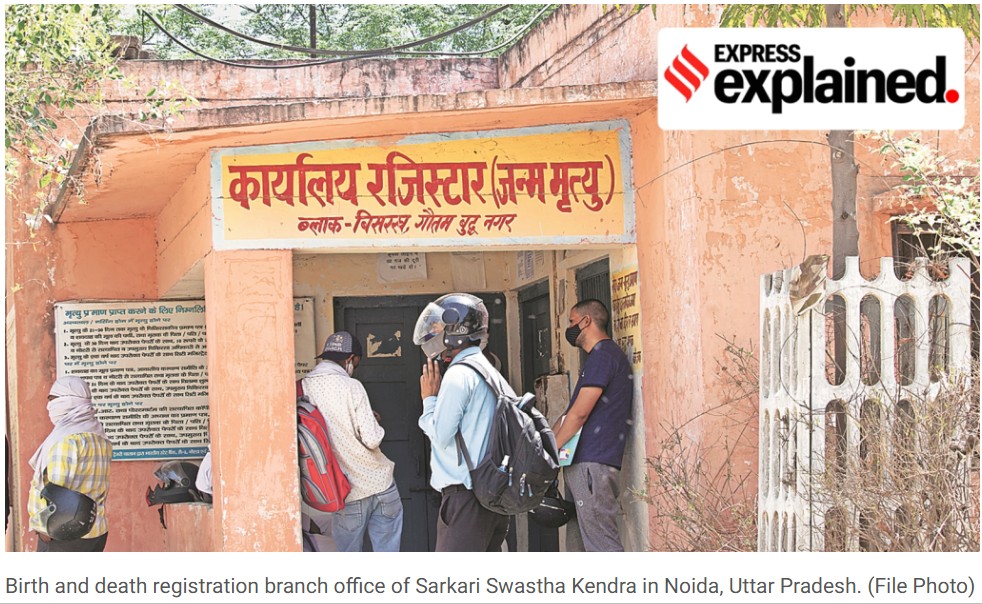
According to the Civil Registration System (CRS) Report, 2024, India has achieved near-universal registration of vital events, recording 99.1% of estimated births and 99.4% of estimated deaths. This marks a remarkable improvement from 2000, when only 56% of births and 48% of deaths were officially registered.
About the Civil Registration System (CRS)
The Civil Registration System (CRS) is a continuous, compulsory and permanent system for recording births, deaths and stillbirths in India. It functions under the Registration of Births and Deaths (RBD) Act, 1969, which was amended in 2023, and is administered by the Office of the Registrar General and Census Commissioner of India (RGI) under the Ministry of Home Affairs.
Although the system became operational in 1970, the completeness of registration has improved substantially only over the last two decades.
Key Highlights of the CRS Report, 2024
India registered 99.1% of estimated births and 99.4% of estimated deaths in 2024, reflecting a major improvement in the coverage of civil registration.
A total of 18 States/UTs achieved 100% birth registration, while 21 States/UTs recorded 100% death registration.
Registration coverage has improved steadily over time:
- 2000: Births – 56%, Deaths – 48%
- 2014: Births – 86.6%, Deaths – 72.5%
- 2024: Births – 99.1%, Deaths – 99.4%
Despite near-universal coverage, many events are still not registered within the prescribed 21-day period.
The report also highlights persistent concerns:
- Infant death registration remains disproportionately low in rural areas, with 84.2% of registered infant deaths reported from urban areas and only 15.8% from rural areas, suggesting under-registration.
- Registration of a death does not necessarily imply medical certification of its cause, limiting the usefulness of CRS data for disease surveillance and mortality analysis.
- Since estimates of registration completeness rely on the Sample Registration System (SRS), which may itself undercount births and deaths, actual CRS coverage could be slightly overestimated.
Significance of CRS
The Civil Registration System serves as the primary source of vital statistics, providing reliable information on births, deaths, fertility, mortality and sex ratio at birth.
It supports:
- Evidence-based health and social policy formulation.
- District-level and local planning under decentralised governance.
- Issuance of legally valid birth and death certificates required for education, identity documents, inheritance, pensions, insurance and welfare benefits.
- Monitoring demographic trends and public health emergencies such as the COVID-19 pandemic.
Registration of Births and Deaths: Legal Provisions
The Registration of Births and Deaths Act, 1969 (amended in 2023) mandates the registration of all births, deaths and stillbirths at the place of occurrence.
Key provisions include:
- Registration is carried out digitally through the Civil Registration System (CRS).
- Births, deaths and stillbirths should be reported within 21 days of occurrence; delayed registration attracts the prescribed fee.
- The Registrar General of India (RGI) oversees the system nationally, while Chief Registrars, District Registrars and Local Registrars implement it at the State and local levels.
- Births and deaths of Indian citizens abroad are registered through Indian Consulates under the Citizenship Act, 1955, with additional provisions for registration upon return to India under the RBD Act.
- Negligence by a registrar in discharging statutory duties is punishable with a fine up to ?1,000.
Digital Threat Report 2025-26
- 16 Jul 2026
In News:
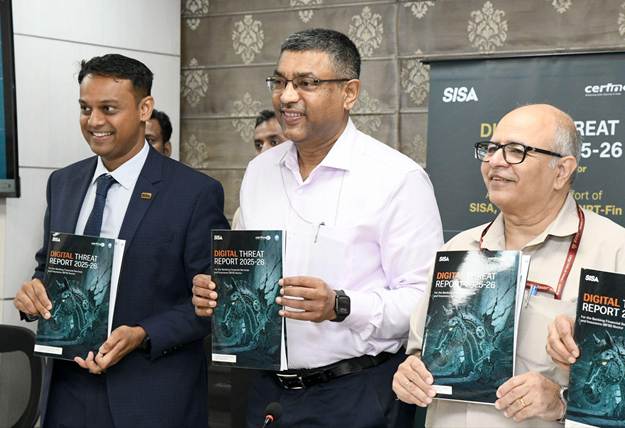
The Ministry of Electronics and Information Technology (MeitY), in collaboration with CERT-In, CSIRT-Fin and SISA, has released the second edition of the Digital Threat Report 2025–26 for India's Banking, Financial Services & Insurance (BFSI) and digital payments ecosystem. The report assesses emerging cyber threats and provides a roadmap to strengthen the resilience of India's financial sector.
About the Digital Threat Report 2025–26
The report is based on Digital Forensics and Incident Response (DFIR) investigations, threat intelligence, observations from CERT-In and CSIRT-Fin, and research on adversarial Artificial Intelligence (AI).
A key finding is that six of the seven cyber threat predictions made in the previous edition have already materialised, indicating that the gap between the emergence of a cyber threat and its exploitation has reduced dramatically—from years to months or even weeks.
Key Findings
The report notes that cyberattacks have evolved beyond conventional hacking methods. Increasingly, attacks appear as legitimate user sessions, authorised transactions, manipulated workflows and normal user behaviour, making them difficult to detect until significant damage has occurred.
One of the most significant concerns identified is AI asymmetry, where malicious actors are leveraging AI to launch sophisticated attacks at machine speed, while defensive and regulatory systems struggle to keep pace.
The report also highlights that threats such as:
- Social engineering
- Credential theft
- Supply-chain attacks
- Cloud exploitation
have now become mainstream attack vectors for the financial sector.
4-Layer Gap Archetype Framework
A major feature of this edition is the "Anatomy of Cyber Failure" – 4-Layer Gap Archetype Framework, which explains how cyber breaches typically result from a series of interconnected weaknesses rather than a single security lapse.
The framework enables organisations to:
- Identify systemic vulnerabilities.
- Prioritise high-risk security gaps.
- Invest in long-term cyber resilience instead of isolated security controls.
Recommendations
The report recommends shifting from periodic cybersecurity measures to continuous risk assessment and proactive cyber resilience.
It proposes:
- Continuous monitoring of cyber risks.
- Greater information sharing among financial institutions.
- Coordinated incident response mechanisms.
- Building resilient security architectures.
- An 18-month roadmap to strengthen foundational controls and develop long-term cybersecurity capabilities.
Key Institutions
CERT-In
The Indian Computer Emergency Response Team (CERT-In) is India's national nodal agency for responding to cybersecurity incidents. It is responsible for:
- Collecting and analysing cyber incident information.
- Issuing alerts, advisories and vulnerability notes.
- Coordinating national cyber incident response.
- Publishing cybersecurity guidelines and best practices.
CSIRT-Fin
The Computer Security Incident Response Team in Finance (CSIRT-Fin) is the sectoral cyber incident response agency for India's financial sector. It coordinates cybersecurity across:
- Banking
- Insurance
- Securities market infrastructure
- Pension funds
It also issues sector-specific advisories, coordinates incident response and promotes cyber resilience across financial institutions.