
Ru-Soam Bridges
- 03 May 2026
In News:
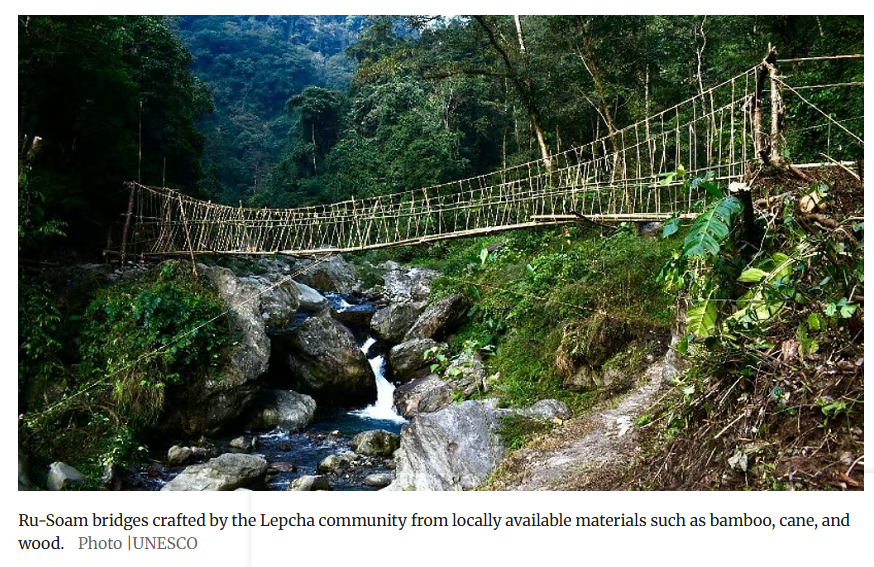
UNESCO partnered with the Government of Sikkim supported by Airbnb to formally document Ru-Soam, the traditional cane bridges of the Lepcha community, and nominate them for UNESCO's Intangible Cultural Heritage (ICH) list.
What is Ru-Soam?
Ru-Soam are traditional suspension bridges built by the Lepcha community of Sikkim, found primarily in the Khangchendzonga Biosphere Reserve (Dzongu Tribal Reserve, North Sikkim). In the Lepcha language, 'Ru' means cane or rattan and 'Soam' means bridge. Regarded as one of the oldest suspension bridge traditions in the Eastern Himalaya, British botanist Joseph Dalton Hooker documented them in the 19th century as "works of art."
Structural Features
The bridge rests on two parallel cane cables (soamgyang) anchored to trees at both ends. Cane loops called ahool serve as handrails, while bamboo planks (soamgur) form the walkway. Bridges span over 100 metres and hang 30 metres above rivers, supporting 2–3 persons at a time. Construction is led by master craftsmen (Soam-nokbu) alongside ritual specialists (Bongthing), with knowledge passed entirely through oral tradition.
The critical engineering advantage is flexibility — the bridge sways and absorbs flood force rather than rigidly resisting it, a property decisive during recent Himalayan disasters.
Climate Resilience
During the 2023 South Lhonak Lake GLOF (Glacial Lake Outburst Flood), modern bridges across the Teesta basin were destroyed, cutting off Dzongu for weeks. Several Ru-Soam bridges survived and sustained critical connectivity for villages and relief operations. A 2024 cloudburst repeated the pattern — modern infrastructure failed while communities rapidly rebuilt cane bridges, restoring access within days. Scholar Sonam R. Lepcha, in a study published in the journal Pleione, documented how these bridges became lifelines for the region.
About Khangchendzonga:
Declared UNESCO World Heritage Site in 2016 (Mixed Category) — India's first Mixed World Heritage Site. Part of the World Network of Biosphere Reserves since 2018.
Past Risk and Return Verification Agency (PaRRVA)
- 03 May 2026
In News:
In a significant move to bolster investor protection and curb misleading claims in the capital market, the Securities and Exchange Board of India (SEBI) has operationalized the Past Risk and Return Verification Agency (PaRRVA). This regulatory initiative is aimed at introducing a standardized, independent verification mechanism for performance claims made by various financial intermediaries, ensuring that the "past performance" shown to investors is both accurate and reliable.
Key Institutional Framework
The implementation of PaRRVA involves a strategic partnership between specialized financial entities:
- The Verification Body:CARE Ratings Limited has been designated and recognized as the primary agency responsible for the verification process.
- The Data Infrastructure: The National Stock Exchange of India Limited (NSE) will serve as the PaRRVA Data Centre (PDC), providing the necessary technological backbone and data repository for the agency's operations.
Objective and Scope of PaRRVA
The primary objective of PaRRVA is to eliminate the practice of "cherry-picking" performance data, where intermediaries might highlight only their most successful periods to lure investors.
Eligible Entities and Users: The agency’s services are tailored for a wide spectrum of market participants:
- Investment Advisers (IA) and Research Analysts (RA): To validate their advice-based performance history.
- Trading Members (TM): Specifically those providing algorithmic or automated trading services.
- Investors: As the ultimate beneficiaries, they can now access a centralized pool of verified, credible data.
Core Features and Functionalities
PaRRVA acts as a "Trust Layer" in the investment ecosystem through the following features:
- Standardization of Metrics: It ensures that risk-return metrics are calculated and presented using a uniform methodology, making comparisons between different advisors or analysts more meaningful.
- Independent Validation: By moving away from self-certification, SEBI ensures that performance claims are vetted by an independent third party (CARE Ratings) against data hosted by the NSE.
- Advertisement Compliance: Regulated entities are now permitted to use PaRRVA-verified data in their advertisements. This provides a legal and ethical framework for marketing, ensuring that promotional materials remain compliant with SEBI’s stringent disclosure guidelines.
- Informed Decision Making: By providing access to reliable data, PaRRVA empowers retail investors to move beyond marketing hype and evaluate intermediaries based on factual, long-term performance records.
Significance for the Indian Capital Market
The operationalization of PaRRVA is a proactive step toward building a more transparent and mature financial market.
- Curbing Mis-selling: It acts as a deterrent against fraudulent claims and exaggerated "get-rich-quick" schemes often promoted on social media by unregistered "finfluencers" or unscrupulous analysts.
- Enhancing Accountability: By requiring independent verification, SEBI places the onus of accuracy squarely on the intermediary.
- Boosting Investor Confidence:This initiative aligns with the broader goal of Financial Inclusion and Investor Education, ensuring that the influx of new retail investors into the Indian stock market is protected by robust regulatory safeguards.
Public Accounts Committee
- 03 May 2026
In News:
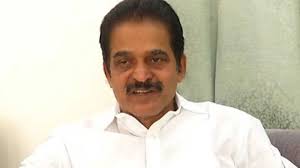
In the latest development within the Indian parliamentary framework, K.C. Venugopal has been reappointed as the Chairman of the Public Accounts Committee (PAC) for the 2026–27 term. As one of the most powerful financial standing committees, the PAC serves as a vital instrument of the legislature to ensure that the executive remains accountable for every rupee spent from the public exchequer.
Historical Evolution and Genesis
- The PAC is the oldest of the parliamentary committees in India. Its origins trace back to the Montagu-Chelmsford Reformsof 1919, leading to its formal establishment in 1921. Post-independence, it evolved into a permanent parliamentary committee under the Constitution of India in 1950.
- A significant democratic tradition was established in 1967, since when the Chairman of the PAC is invariably appointed from the Opposition party. This convention is designed to ensure an unbiased and critical scrutiny of government expenditure, fostering a robust system of checks and balances.
Composition and Appointment
The committee represents both houses of Parliament, ensuring a bicameral oversight mechanism.
- Membership: It consists of 22 members—15 from the Lok Sabha and 7 from the Rajya Sabha.
- Election Process: Members are elected annually through the principle of proportional representation by means of a single transferable vote, allowing for the representation of various political parties in proportion to their strength.
- Exclusion of Ministers: To maintain independence and prevent a conflict of interest, ministers cannot be members of the committee.
- Tenure: The term of office for members is limited to one year.
- Chairmanship: The Chairman is appointed by the Speaker of the Lok Sabha.
Core Mandate and Scope of Scrutiny
The primary responsibility of the PAC is to examine the accounts showing the appropriation of sums granted by Parliament.
- Financial Audit: It scrutinizes the Appropriation Accounts and the Finance Accounts of the Union Government, along with any other accounts laid before the Lok Sabha.
- Beyond Legality: The PAC’s mandate is not limited to technical legality. It dives into the “Propriety Audit,” evaluating government spending on the grounds of efficiency, economy, and wisdom. It aims to uncover cases of waste, loss, or financial irregularity.
- Handling Excess Expenditure: If the government spends more than the amount sanctioned by Parliament, the PAC investigates the circumstances. These excesses must be regularized under Article 115 of the Constitution, based on the committee’s recommendations.
The PAC-CAG Synergy: "Friend, Philosopher, and Guide"
The functioning of the PAC is fundamentally supported by the Comptroller and Auditor General (CAG) of India. The CAG submits three main audit reports to the President, which are then laid before Parliament:
- Audit report on Appropriation Accounts.
- Audit report on Finance Accounts.
- Audit report on Public Undertakings.
The CAG assists the committee during its deliberations, helping members navigate complex financial data. This relationship is so integral that the CAG is often termed the “friend, philosopher, and guide” of the PAC.
Ensuring Impact: Follow-up and Monitoring
To ensure that its recommendations do not remain mere paper tigers, a structured follow-up mechanism exists:
- Action Taken Reports (ATRs): The government is required to submit "Action Taken Notes" on the committee's recommendations, usually within six months.
- Modern Monitoring: The Audit Para Monitoring System (APMS) has been implemented to electronically track the status of these notes, ensuring transparency and reducing the pendency of unresolved audit observations.
Cauvery Water Management Authority
- 03 May 2026
In News:
In a significant step toward resolving one of India’s longest-standing inter-state water conflicts, the Cauvery Water Management Authority (CWMA) has directed Karnataka to release 2.5 TMC (Thousand Million Cubic feet) of water to Tamil Nadu for the month of May 2026. This directive reaffirms the 2018 Supreme Court verdict and emphasizes the role of statutory bodies in maintaining federal harmony during periods of climatic stress.
The Kaveri River:
- The Kaveri, popularly known as the "Ganga of the South" (Dakshin Bharat ki Ganga), is the lifeblood of agricultural and urban centers in Southern India.
- Origin and Course: The river rises at Talakaveri in the Brahmagiri Range of the Western Ghats (Kodagu, Karnataka). It flows approximately 800 km through Karnataka and Tamil Nadu before emptying into the Bay of Bengal.
- Drainage Basin: The basin is shared by Karnataka, Tamil Nadu, Kerala, and Puducherry.
- Key Tributaries:
- Left Bank: Harangi, Hemavati, Shimsha, and Arkavati.
- Right Bank: Lakshmana Tirtha, Kabini, Suvarnavathi, Bhavani, Noyyal, and Amaravati.
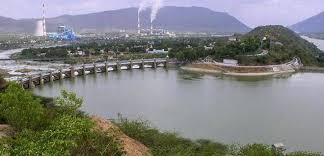
- Strategic Infrastructure: Major reservoirs like Krishna Raja Sagara (KRS) in Karnataka and the Mettur Dam in Tamil Nadu serve as the primary control points for water regulation.
The Legal Evolution of the Dispute
The conflict over Kaveri's waters is rooted in colonial-era agreements (1892 and 1924) between the Madras Presidency and the Princely State of Mysore. Post-independence, Karnataka contested these agreements as unfair, leading to decades of legal friction.
1. Constitutional and Statutory Framework
Under Article 262 of the Constitution, which empowers Parliament to adjudicate inter-state river disputes, the Inter-State River Water Disputes Act, 1956 was enacted. This led to the formation of the Cauvery Water Disputes Tribunal (CWDT) in 1990.
2. The Landmark 2018 Supreme Court Verdict
In February 2018, the Supreme Court modified the earlier Tribunal award, establishing several key principles:
- National Asset Doctrine: The Court declared that no single state has proprietary rights over a river; it is a shared national asset.
- Bengaluru’s Needs: Karnataka was granted an additional 14.75 TMC to meet the drinking water requirements of Bengaluru.
- Final Share Allocation (Annual):
- Tamil Nadu: 404.25 TMC
- Karnataka: 284.75 TMC
- Kerala: 30 TMC
- Puducherry: 7 TMC
CWMA and CWRC
To move away from ad-hoc management and frequent litigation, the Centre established the Cauvery Water Management Authority (CWMA) and its subordinate body, the Cauvery Water Regulation Committee (CWRC), in June 2018.
Structure and Governance
The CWMA is a statutory, quasi-judicial body notified under Section 6A of the 1956 Act.
- Headquarters: New Delhi, under the Union Ministry of Jal Shakti.
- Composition: Led by a Chairperson (eminent engineer or IAS officer), it includes full-time members for Water Resources and Agriculture, alongside part-time members representing the four basin states.
Core Functions
- Water Apportionment: Regulating reservoir releases to ensure each state receives its mandated share.
- Distress Sharing: During years of poor monsoon, the CWMA determines the proportionate sharing of water shortages (distress) among states.
- Data Monitoring: Collecting real-time data on storage positions and inflows via the CWRC.
- Technological Advisory: Encouraging micro-irrigation and crop diversification to improve water-use efficiency.
Padma Doree

- 03 May 2026
In News:
The North Eastern Handicrafts and Handlooms Development Corporation (NEHHDC) has officially unveiled‘Padma Doree’, a landmark cross-regional textile initiative. By merging the Eri (Ahimsa) silk of Northeast India with the sophisticated Chanderi weaving traditions of Madhya Pradesh, the project creates a unique fusion of "fiber and finesse." This collaboration marks a significant step toward integrating India’s diverse craft heritage into a cohesive, sustainable fashion ecosystem.
The Essence of Padma Doree:
Padma Doree is more than just a textile collection; it is a strategic bridge between Central and Northeast India. The initiative is designed to modernize indigenous knowledge systems, making them competitive in the global luxury and sustainable fashion markets while ensuring the economic upliftment of local artisans.
- Material Innovation: The project utilizes Eri Silk, famously known as Ahimsa Silk because it is processed after the moth leaves the cocoon, ensuring no harm to the silkworm. This rugged, warm, and wool-like fiber is intricately woven with the delicate motifs and sheer, lightweight textures characteristic of Chanderi.
- Artisan Collaboration: The initiative fosters a direct exchange of skills. Weavers from Madhya Pradesh and artisans from the Northeast work together, blending the durability of Eri with the refined zari work and transparency of traditional Chanderi.
- A Multi-Sensory Experience: The launch featured a three-day interactive exhibition that showcased the entire "fiber-to-fabric" journey through live demonstrations. To provide a holistic cultural experience, the event also integrated regional culinary showcases from both participating regions.
Key Components:
Eri Silk (Northeast India)
- Predominantly produced in Assam and Meghalaya, Eri silk is derived from the Samia ricini silkworm. It is unique among silks for its matte appearance and thermal properties, making it "cool in summer and warm in winter." Its status as a sustainable and ethical fiber aligns with the growing global demand for "slow fashion."
Chanderi Weaving (Madhya Pradesh)
- Hailing from the historic town of Chanderi, this craft is renowned for its shimmering texture and "Butti" (motifs). Traditionally a blend of silk and cotton, Chanderi is characterized by its transparency and sophisticated aesthetics, long favored by Indian royalty.