70–72%
of PSIR overlaps GS Paper II — more than the other three GS papers combined
You are already what Amartya Sen called the argumentative Indian — heir to a civilisation that has quarrelled over justice, duty and power for millennia. Political Science & International Relations only teaches you to see that argument clearly, and to write it the way an examiner reads. Foundation, Mentorship and a Test Series — built and taught by Swetank Pandey.

You will not lose marks because you don't know Rawls or Gramsci. You will lose them where preparation quietly breaks down.
PSIR's syllabus is famously vast. Topics get rushed, then dropped. A fixed schedule is non-negotiable.
Federalism, judicial review, electoral reforms, caste & politics — asked every year, skipped in class.
Paper II Section A seldom gets airtime. Aspirants face theoretical questions with no scaffolding.
Students drown in reading, never revise, never write. The stamina for 19 answers in 6 hours is never built.
A fixed 115-session planner with weekly targets. Nothing is dropped.
Every thinker tied to a live controversy India can't escape.
Weekly mocks, model answers and peer review — writing as reflex.
One sequenced, PYQ-mapped stack — not a library you'll never finish.
Leave your details and we'll reach out. Prefer to talk now? Call or WhatsApp +91 99993 43999.
Build both papers from the ground up, drill answer-writing until it's reflex, and test under exam conditions. Take one, or stack all three. All fees are GST-inclusive.
The complete build — Paper I & II from first principle to written answer, with the schedule that guarantees nothing is left behind.
Knowing the syllabus is not the exam. Writing it is. 450 questions across the whole syllabus, every answer evaluated.
Thirteen tests that rehearse the exam before the exam — section by section first, then full-length under the real clock.
Foundation + Mentorship + Test Series — concept to evaluated answer to exam rehearsal, as one commitment.
A daily rhythm, a weekly rhythm, and an honest measure of exactly where you stand.
Released daily, weightage-picked by PYQ frequency — a 10/15/20-marker spread across the topic.
At exam pace, read through India's national-interest lens. Volume is what builds fluency.
Released the same day, with Scholars-Handbook enrichment — quotes, thinkers, reports, data.
The programme opens with 10 answers in 100 minutes, diagnosed into a personal White Paper — strengths, gaps, time-management — and re-diagnosed at mid-programme. You start where you stand.

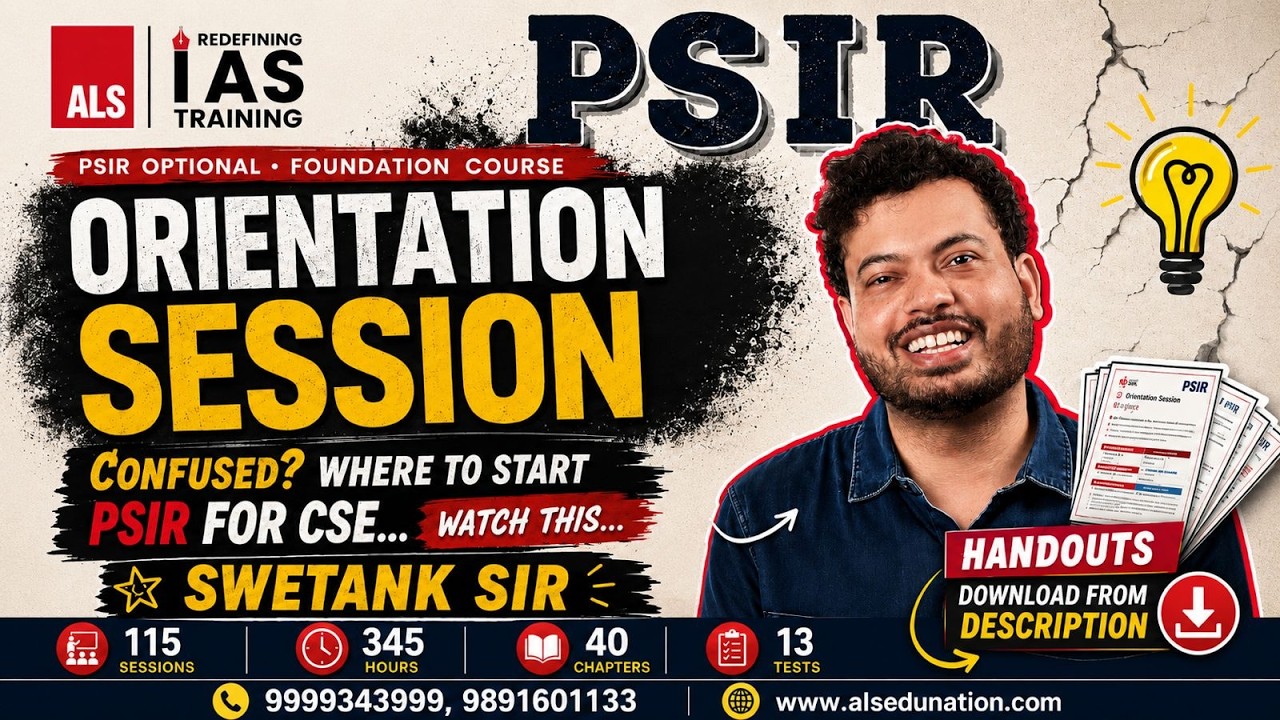
The Orientation handout is your map for the whole journey — what PSIR really is, how the exam actually rewards you, and the 115-session plan that carries you there. Keep it; you'll re-read it in month six and again in the final month, and it reads differently each time.
"Do these three, and PSIR stops being a mountain and becomes a staircase."
Whole lectures and strategy sessions, exactly as taught. Judge the teaching for yourself.


The material serious aspirants pay for elsewhere. Yours to judge us by.
The third-edition scholars handbook — quotes, thinkers, committees, reports and data for value-addition.
Download PDFThe White Paper diagnostic: 10 answers in 100 minutes, returned as a personal report of gaps and strengths.
Download PDFTen thinkers, deep-dive enrichment — Plato to Arendt, segregated by section.
Download PDFFoundation & Mentorship brochures with the full session-by-session roadmap.
Download PDF| Foundation | Mentorship | Test Series | |
|---|---|---|---|
| Best for | Building both papers from scratch | Turning knowledge into written marks | Exam temperament & timing |
| Core deliverable | 115 sessions · concepts + notes | 450 evaluated answers · 6-part rubric | 13 tests · 9 sectional + 4 full-length |
| Mode | Offline (Karol Bagh) / Online | Online / Offline | Online |
| Online fee | ₹35,500 | ₹25,000 | ₹13,500 |
| Offline fee | ₹48,500 | ₹25,000 | — |
| Evaluation | Weekly, in-class | Every answer, in 2 days | Per test, rubric-based |
| Standalone? | Yes | Yes — needs no batch | Yes |
Every unit covered in the Foundation programme. Tap a paper, then a section.
1. Political Theory: meaning and approaches.
2. Theories of the State: Liberal, Neo-liberal, Marxist, Pluralist, Post-colonial and Feminist.
3. Justice: conceptions of justice with special reference to Rawls' theory and its communitarian critiques.
4. Equality: social, political and economic; equality and freedom; affirmative action.
5. Rights: meaning and theories; kinds of rights; concept of Human Rights.
6. Democracy: classical and contemporary theories; representative, participatory and deliberative models.
7. Concept of Power: hegemony, ideology and legitimacy.
8. Political Ideologies: Liberalism, Socialism, Marxism, Fascism, Gandhism and Feminism.
9. Indian Political Thought: Dharmashastra, Arthashastra and Buddhist traditions; Sir Syed Ahmed Khan, Sri Aurobindo, M.K. Gandhi, B.R. Ambedkar, M.N. Roy.
10. Western Political Thought: Plato, Aristotle, Machiavelli, Hobbes, Locke, John S. Mill, Marx, Gramsci, Hannah Arendt.
1. Indian Nationalism: political strategies of the freedom movement; Liberal, Socialist & Marxist, Radical Humanist and Dalit perspectives.
2. Making of the Constitution: legacies of British rule; social & political perspectives.
3. Salient Features: Preamble, Fundamental Rights & Duties, DPSP; parliamentary system, amendment procedures; judicial review and basic structure.
4. Principal Organs of the Union and State Governments — Executive, Legislature, Supreme Court and High Courts.
5. Grassroots Democracy: Panchayati Raj and Municipal Government; 73rd and 74th Amendments; grassroots movements.
6. Statutory Institutions: EC, CAG, Finance Commission, UPSC, and the National Commissions.
7. Federalism: constitutional provisions; centre-state relations; regional aspirations; inter-state disputes.
8. Planning & Economic Development: Nehruvian and Gandhian perspectives; public sector, Green Revolution, land reforms, liberalisation.
9. Caste, Religion and Ethnicity in Indian politics.
10. Party System: national and regional parties; coalition politics; pressure groups; electoral behaviour.
11. Social Movements: civil liberties, human rights, women's and environmental movements.
1. Comparative Politics: nature and approaches; political economy and political sociology perspectives; limitations.
2. State in Comparative Perspective: capitalist, socialist, advanced-industrial and developing societies.
3. Politics of Representation and Participation: parties, pressure groups and social movements.
4. Globalisation: responses from developed and developing societies.
5. Approaches to IR: Idealist, Realist, Marxist, Functionalist and Systems theory.
6. Key Concepts: national interest, security, power, balance of power, deterrence, transnational actors, collective security.
7. Changing International Political Order: bipolarity, arms race, Cold War, NAM, Soviet collapse, US hegemony.
8. Evolution of the International Economic System: Bretton Woods → WTO; CMEA; NIEO; globalisation.
9. United Nations: role, record, specialised agencies, reform.
10. Regionalisation: EU, ASEAN, APEC, SAARC, NAFTA.
11. Contemporary Global Concerns: democracy, human rights, environment, gender justice, terrorism, nuclear proliferation.
1. Indian Foreign Policy: determinants; policy-making institutions; continuity and change.
2. India and NAM: contribution across phases; current role.
3. India and South Asia: SAARC, free trade, Act-East; river-water, migration, ethnic and border issues.
4. India and the Global South: Africa and Latin America; NIEO and WTO leadership.
5. India and Global Centres of Power: USA, EU, Japan, China, Russia.
6. India and the UN System: peace-keeping; permanent UNSC seat.
7. India and the Nuclear Question: changing perceptions and policy.
8. Recent Developments: Afghanistan, Iraq, West Asia; US and Israel; vision of a new world order.
Test 1 · Paper I-A: Western Political Thought — Plato, Aristotle, Machiavelli, Hobbes, Locke, Bentham, Mill, Hegel, Marx.
Test 2 · Paper I-A: Western Political Thought (Gramsci, Hannah Arendt) and Indian Political Thought.
Test 3 · Paper I-A: Political Theory & approaches; Theories of the State; Justice; Equality; Rights; Democracy; Power, Hegemony, Ideology & Legitimacy; Political Ideologies.
Test 4 · Paper I-B: Indian Nationalism — strategies & perspectives; Making of the Constitution; Social Movements.
Test 5 · Paper I-B: Salient Features of the Constitution; Principal Organs; Grassroots Democracy; Statutory Institutions; Federalism; Planning & Economic Development; Caste, Religion & Ethnicity; Party System.
Test 6 · Full-Length — Comprehensive Test, Paper I.
Test 7 · Paper II-A: Comparative Politics — nature, approaches & limitations; State in comparative perspective; Representation & Participation; Globalisation; Approaches to IR.
Test 8 · Paper II-A: Changing International Political Order — bipolarity, Cold War, NAM, unipolarity; International Economic System; United Nations; Regionalisation; Contemporary Global Concerns.
Test 9 · Paper II-B: Indian Foreign Policy — determinants, institutions, continuity & change; India and NAM; India and South Asia.
Test 10 · Paper II-B: India and the Global South; Global Centres of Power — USA, EU, Japan, China, Russia; India and the UN System; Nuclear Question; Recent Developments.
Test 11 · Full-Length — Comprehensive Test, Paper II.
Test 12 · Full-Length: Comprehensive Test — Paper I, under full exam conditions.
Test 13 · Full-Length: Comprehensive Test — Paper II, under full exam conditions.
Every test is evaluated on the rubric with score targets, followed by a discussion session and model answers. Dates on the live schedule ↗.
Yes. The course is built from first principles — an engineer or doctor masters it as well as a political-science graduate, often better. And you are not really starting from zero: you already argue about justice, power and the state every day; PSIR formalises a fluency you were born into.
70–72% of PSIR overlaps GS Paper II (polity, governance, constitution, international relations) — more than the other three GS papers combined. But the overlap doesn't stop there: GS Paper III draws on PSIR's security, economy and globalisation content (WTO, nuclear question, internal security debates); GS Paper IV borrows its thinkers directly — Rawls on justice, Gandhi and Mill on ethics, the whole vocabulary of rights and legitimacy; and Essay is where PSIR pays most visibly, since political-philosophical themes appear every single year and a PSIR student writes them with named scholars where others write generalities. Add the Interview, where questions on national and international issues are PSIR's home turf. The remaining pure-theory core is precisely what earns the optional marks, so the overlap saves time without making the optional redundant.
From day one — not after "finishing the syllabus". Delaying answer practice is one of the four chronic reasons PSIR preparation stalls. The Foundation builds writing in weekly from the start; the Mentorship makes it a daily rhythm of 3 questions with 2-day evaluation.
PSIR rewards the patient, connected thinker: the syllabus is finite and fully mappable, and the PYQ pattern is repetitive — the same question-families return year after year, so preparation compounds. What it punishes is rote cramming and a neglected Paper II; both are engineered out here by the PYQ map and a current-affairs thread from day one.
Recordings cover every missed class, the fixed 115-session planner tells you exactly where the batch stands, and in the Mentorship the model answers, session recordings and Sunday buffers keep the rhythm — you never stall.
No — it is standalone. Pre-reads and the Scholars Handbook make it self-sufficient, whether or not you're in any batch.
By PYQ weightage. 77 are exact 2016–25 PYQs; the rest mirror 2022–25 framing. Nothing outside the verified corpus is passed off as a PYQ.
Model answers, recordings and Sunday buffers keep the rhythm — you never stall.
Daily volume + 2-day evaluation + the 6-part rubric + a White Paper you can measure yourself against. You improve the thing you practise daily and measure honestly.
Offline is the live class in our Karol Bagh classroom with in-person doubt-clearing and printed notes. Online is the same live class, streamed, with recordings for revision. Both follow the identical 115-session schedule and the same PYQ-mapped material — only the mode and the fee differ. confirm exact material/recording differences
Recordings and course material stay accessible through the CSE 2027 Mains cycle, so you can revise right up to the exam. confirm exact validity window
The reference library behind the course. Every page below is free, written by Swetank Pandey from the same material the Foundation Batch is taught from.
Every UPSC PSIR question of the last 15 years with its code, organised subtopic by subtopic under the 40-chapter map. The single most useful page an aspirant can bookmark.
Read → SyllabusAll 40 chapters · 144 lessons across Paper I and Paper II — the structure every PYQ family hangs from.
Read → Video + PlaybookThe full video lecture plus the complete playbook — directive control, scholars, structure, evidence, presentation.
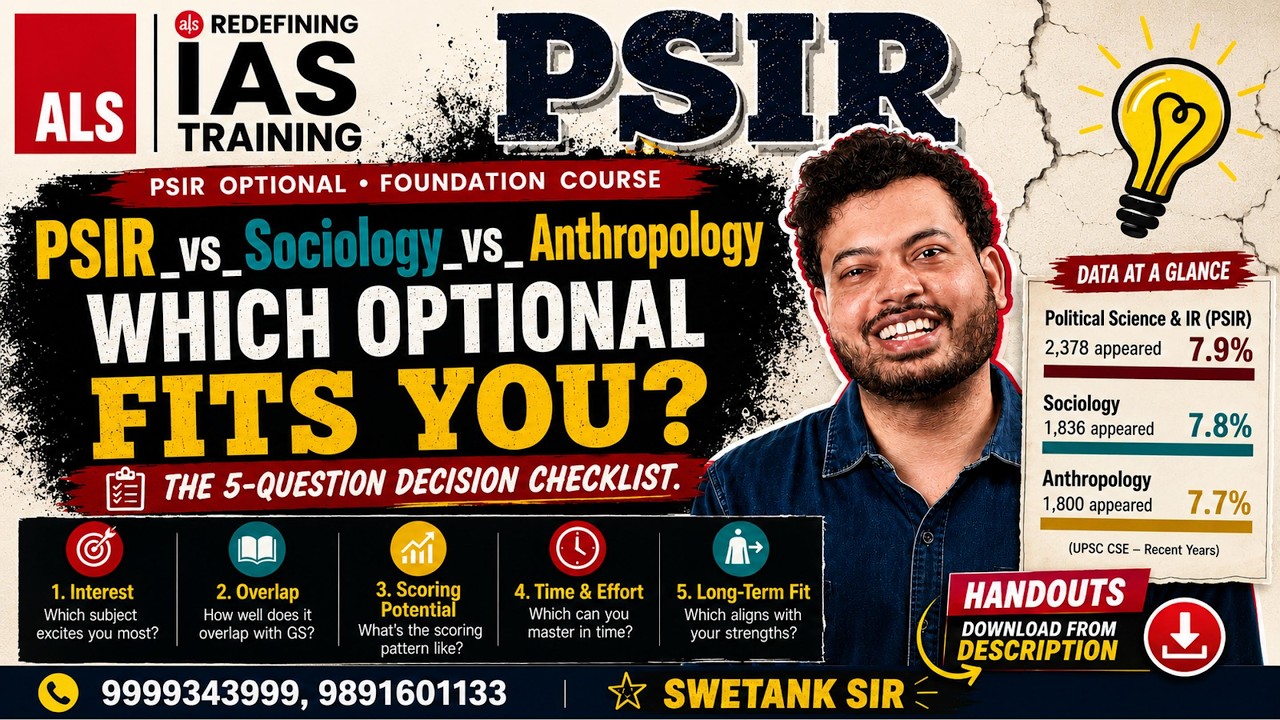
Watch & read → Choosing PSIR · VideoThree souls, five honest rounds, official success-rate data — and the checklist that decides your optional tonight.
Watch & decide → The StackOne sequenced stack for all four sections, the course layer, and the four things to refuse to read.
Read → MonthlyThe month's judgments and geopolitics, tagged to syllabus chapters with scholar hooks and "→ use in" lines.
Get the digest → Choosing PSIRThe 70–72% GS-II claim shown syllabus-line by syllabus-line — plus GS-III, GS-IV, Essay and the honest remainder.
Read → Questions AnsweredScoring, background, time needed, booklist, coaching, fees — answered directly, no hedging.
Read → Answer-WritingFraming, directive-word compliance, content, scholars, interlinkage, structure — with self-check questions.
Read → Answer-WritingWhen to start, daily counts, word limits, diagrams, evaluation — from the faculty who marks 450 answers per student.
Read → Paper IIHow current Paper II really is, which sources matter, and the national-interest lens that organises it all.
Read → Inside the MethodThe 115-session planner, the 30-year PYQ map, the rubric with 2-working-day turnaround — and the CSE 2024 results.
Read → DelhiSeven checkable questions that separate a serious PSIR programme from a brand name.
Read →18 more deep dives beyond the featured cards — thinkers, strategy, answer-writing autopsies. The Thinker Library keeps growing.
PSIR Without a PolSci Background: An Engineer's Route MapSyllabus Topic-by-Topic with 15-Year PYQ FrequencyHow Many Months Does PSIR Take?PSIR in Hindi MediumHow to Read a PYQ Code — the 2013 ShiftYou Study Question-Families, Not TopicsThe UPSC Verb Key: Comment vs Examine vs Critically ExaminePSIR for Working ProfessionalsPlato for UPSCHobbes for UPSCRawls & His Communitarian CriticsGramsci's HegemonyTheories of the State: Six Question-FamiliesContemporary IR Scholars: Mearsheimer to AcharyaIndia's Nuclear QuestionWhat a 15/20 Answer Looks Like: A Marked CopySame Question, Marks Apart: Two Answers Compared10 Answers in 100 Minutes: The DiagnosticPaper I-B's judgments and Paper II-B's geopolitics, tagged to the exact chapter they can be asked from — with scholar hooks and "→ use in" deployment lines. Reading becomes marks, monthly.
Talk to us about the batch that fits where you stand.