
SMILE Mission
- 20 May 2026
In News:
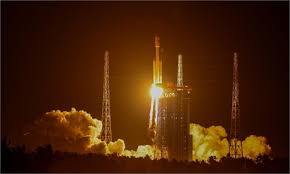
Recently, the SMILE spacecraft lifted off on a Vega-C rocket from Europe's Spaceport in French Guiana, marking the successful launch of one of the most ambitious international space science collaborations in recent years — and a landmark moment in China-Europe scientific cooperation.
What is SMILE?
SMILE stands for Solar wind Magnetosphere Ionosphere Link Explorer. It is the first mission-level, all-round, in-depth collaborative space science exploration project between the Chinese Academy of Sciences (CAS) and the European Space Agency (ESA), selected from a pool of 13 candidate missions proposed under a joint ESA-CAS call in 2015 and adopted into ESA's Science Programme in 2019.
SMILE's core objective is to study how Earth's magnetosphere — the planet's invisible magnetic shield — responds to the continuous bombardment of charged particles and radiation from the Sun, collectively called the solar wind. It will make the world's first X-ray observations of Earth's magnetic shield and use an ultraviolet camera to watch the northern lights non-stop for 45 hours at a time.
Orbit and Technical Specifications
SMILE will be placed in a highly inclined 73-degree, highly elliptical orbit, reaching approximately 121,000 km above the North Pole at apogee — about a third of the distance to the Moon. This vantage point allows continuous, uninterrupted observation of the magnetosphere's entirety during each orbit. Following launch, SMILE will spend around one month travelling to its operational orbit, with scientific data collection expected to officially begin in September 2026. The spacecraft weighs approximately 2,300 kg and has a nominal mission lifetime of three years.
Four Scientific Instruments
The mission carries four complementary instruments operating across X-ray and ultraviolet wavelengths, combining both remote sensing and in situ measurements:
- Soft X-ray Imager (SXI) — developed by ESA (University of Leicester/UKSA): It detects X-rays produced when heavy ions in the solar wind collide with neutral particles in Earth's exosphere through a process called solar wind charge exchange (SWCX), yielding the first global X-ray images of Earth's magnetosphere.
- Ultraviolet Aurora Imager (UVI) — jointly contributed by ESA and CAS: captures continuous ultraviolet imagery of auroral activity across polar regions.
- Light Ion Analyser (LIA) — developed by CAS: measures properties and behaviour of solar wind ions in situ near Earth.
- Magnetometer — developed by CAS: records magnetic field variations along SMILE's orbit.
Why It Matters: Space Weather and Civilisational Risk
Earth's magnetosphere is not merely a scientific curiosity — it is the essential shield that makes life possible. Without it, solar radiation would strip away the atmosphere and irradiate the surface. Understanding its dynamics has urgent practical implications: geomagnetic storms triggered by intense solar activity can disrupt power grids, satellite communications, GPS navigation, and aviation systems — risks that grow as human civilisation becomes more technologically dependent.
Barda Wildlife Sanctuary
- 20 May 2026
In News:
With the 16th Asiatic Lion Census (May 2025) recording 891 lions in Gujarat — a 32% rise from 674 in 2020 — conservation attention has sharply shifted to Barda Wildlife Sanctuary as India races to establish a second, genetically secure habitat for Panthera leo persica, the world's last surviving population of wild Asiatic lions.
The Single-Point-of-Failure Problem
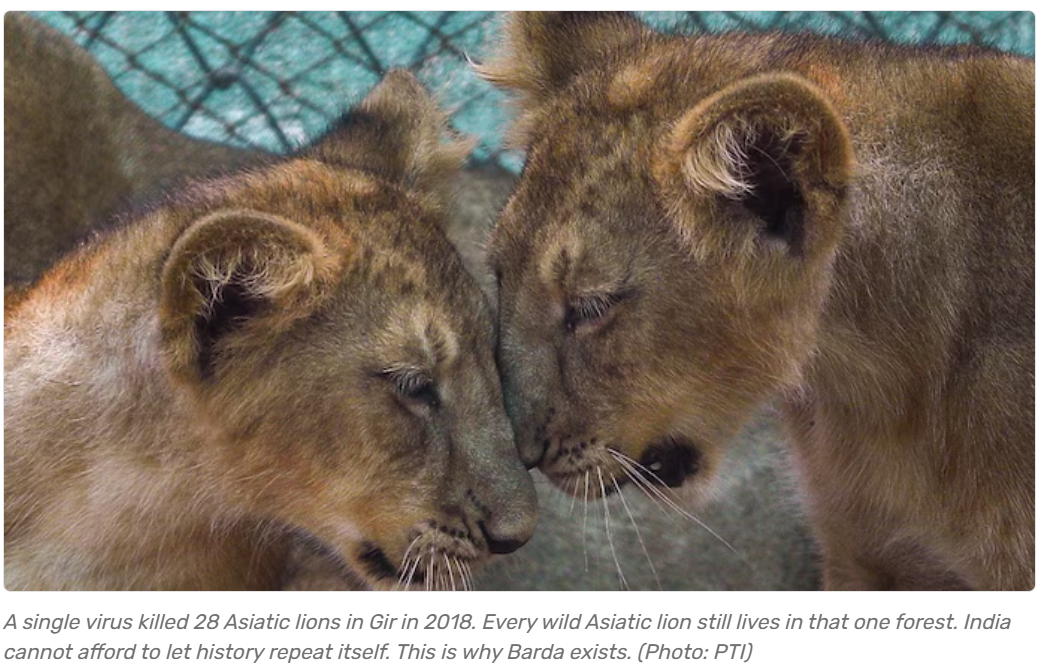
Every wild Asiatic lion on Earth inhabits a single forest — Gir, Gujarat. This geographic concentration represents one of conservation science's most dangerous configurations: a single point of failure. The consequences became starkly visible in 2018, when Canine Distemper Virus, spread by feral dogs on Gir's periphery, killed 28 lions within weeks. Had the outbreak spread further, it could have triggered a species-level extinction event.
Gir covers just 1,412 sq km. Of the 891 lions counted in 2025, over 507 now live outside the Gir Protected Area — on farmland, near open wells, and along railway tracks — creating dangerous human-wildlife conflict. Population growth, paradoxically, has amplified vulnerability rather than reduced it.
About Barda Wildlife Sanctuary
- Located in the Barda Hills of Gujarat, approximately 100 km west of Gir near the coastal city of Porbandar, Barda Wildlife Sanctuary spans 192.31 sq km of rugged, semi-arid terrain in the Saurashtra region.
- Known locally as Jam Barda, it was historically a private hunting ground for the royal families of Jamnagar and Porbandar. The sanctuary is drained by the Bileshvary and Joghri rivers, with Khambala and Fodara dams within its landscape. Local communities including Maldharis, Bharvads, Rabaris, and Gadhvis inhabit surrounding areas.
- Its flora encompasses approximately 650 plant and tree species including Babul, Bamboo, Amli, and Jamun, alongside medicinal plants. Fauna includes leopards, wolves, sambar deer, chinkara, hyenas, nilgai, and diverse avifauna such as crested serpent eagles.
Conservation Milestones
Lions had been absent from Barda since 1879 — a silence of 143 years. The Gir-Barda Project was initiated in 1979 to restore the sanctuary as a satellite lion habitat. After sustained ecological restoration, a male lion walked in independently in 2023. Five lionesses were subsequently translocated under scientific supervision, bred naturally, and produced 11 cubs. The 2025 census recorded 17 lions at Barda.
It has since been designated Satellite Population 8 under Project Lion — PM Modi's ?2,927 crore national conservation programme — making Barda the first fully protected satellite lion habitat in Gujarat.
Scientific Interventions
Prey base restoration was the immediate priority. Early surveys found only 119 chital (spotted deer) across Barda. The Gujarat Forest Department employed the Boma technique — an African method using funnel-shaped canvas enclosures to gently herd animals — to translocate chital from Gir (where population exceeds 90,000), avoiding the risks of capture myopathy associated with chemical tranquilisers.
Genetic vulnerability poses an equally serious long-term threat. Historical hunting reduced Asiatic lions to fewer than 50 individuals in the early 20th century, causing severe genetic bottlenecks. Scientists are now deploying satellite telemetry and targeted relocations to maximise genetic diversity within Barda's pride, strengthening disease resistance and reproductive viability.
On World Lion Day 2025, Gujarat announced ?180 crore for Barda's development, including a ?75 crore safari park.
Broader Policy Context
India is hosting the first-ever IBCA (International Big Cat Alliance) Summit in New Delhi on 1–2 June 2026, underscoring the global significance of big cat conservation. Union Environment Minister Bhupender Yadav recently reiterated the scientific consensus: one forest is categorically insufficient to secure the species' future.
Jaggery Production
- 20 May 2026
In News:
The Ministry of Food Processing Industries (MoFPI) recently highlighted India's dominant position in global jaggery production, underscoring the sector's nutritional, economic, and export significance through a PIB release titled "The Superfood Sweetener."
India's Global Leadership
- India accounts for over 70% of global jaggery production, cementing its status as the world's largest natural sweetener producer. Nearly 20–30% of the country's total sugarcane output — estimated at 444.9 million tonnes in 2024–25 — is diverted towards jaggery making. The sector supports approximately 2.5 million rural livelihoods through decentralised cottage industries, low-cost processing, and small-scale entrepreneurship.
- In terms of state-wise production, Uttar Pradesh leads with 48.5% of total output, followed by Maharashtra (24.1%) and Karnataka (10.5%), with other contributors including Gujarat, Tamil Nadu, Bihar, and Uttarakhand.
What is Jaggery?
- Commonly known as gur, jaggery is a traditional, unrefined natural sweetener produced by concentrating sugarcane juice without chemical refining. Unlike white sugar, it retains essential minerals — calcium, magnesium, potassium, phosphorus, sodium, iron, zinc, copper, and manganese — along with trace vitamins including folic acid, B-complex, and vitamins A, C, D, and E. A good-quality jaggery contains over 70% sucrose, with approximately 5% mineral content.
- Its iron content (10–13 mg per 100 g) supports haemoglobin levels, making it valuable in addressing anaemia — a critical public health challenge in India.
- Its history dates to the Vedic period (1400–1000 BCE), with the word "sugar" itself derived from the Sanskrit sarkara, reflecting deep civilisational roots.
Export Performance
Jaggery exports have recorded impressive growth — rising by 106.5% in value (from USD 197 million in 2015–16 to USD 406.8 million in 2024–25) and 61.2% in volume. Major export destinations include Indonesia, the USA, the UAE, Nigeria, and Nepal. During April–January 2025–26, exports further grew by 15.9% in value year-on-year, reflecting strong and sustained international demand for natural sweeteners.
Government Policy Support
Several central schemes promote the jaggery sector:
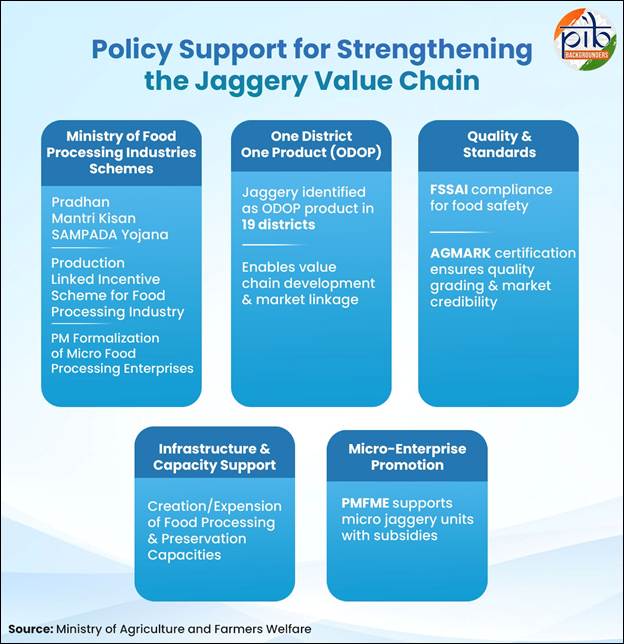
- Pradhan Mantri Kisan SAMPADA Yojana (PMKSY): Five jaggery processing units approved with grants-in-aid of ?17.07 crore.
- PM Formalization of Micro Food Processing Enterprises (PMFME) Scheme: 3,528 jaggery-based micro units supported with subsidies totalling ?102.31 crore, including 50% branding and marketing assistance to FPOs, SHGs, and cooperatives.
- One District One Product (ODOP): Jaggery identified as an ODOP product in 19 districts, facilitating value chain development.
- AGMARK Certification: Ensures quality standardisation, market credibility, and export readiness.
GI-Tagged Jaggery Varieties
India's rich regional diversity is reflected in its Geographical Indication (GI)-tagged jaggery products: Kolhapur Jaggery (Maharashtra) — prized for golden colour and high sucrose; Muzaffarnagar Gur (Uttar Pradesh) — export-oriented, made from high-quality cane; and Marayoor and Central Travancore Jaggery (Kerala) — recognised for purity, medicinal value, and traditional processing methods.
India-Italy Special Strategic Partnership
- 20 May 2026
In News:
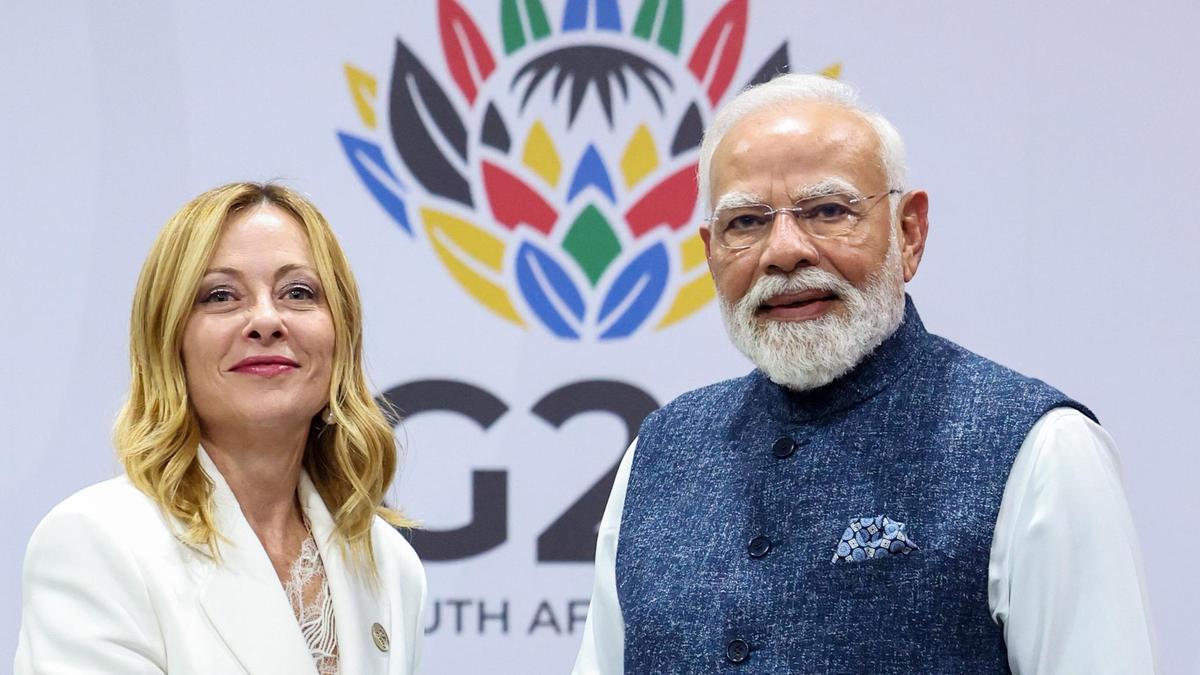
Prime Minister Narendra Modi and Italian Premier Giorgia Meloni, during Modi's official visit to Italy, co-authored a joint op-ed titled "A Strategic Partnership for the Indo-Mediterranean", outlining an expanded roadmap for bilateral cooperation. The two nations formally elevated their relationship to a Special Strategic Partnership — a significant diplomatic milestone grounded in shared democratic values and complementary economic strengths.
The Indo-Mediterranean: A New Strategic Concept
The joint op-ed introduced the geopolitical concept of the "Indo-Mediterranean" — a corridor linking the Indian Ocean to Europe through trade, technology, energy, data, and ideas. Both nations occupy strategic positions at the intersection of two globally critical economic hubs: India in the Indo-Pacific and Italy in the Mediterranean. The leaders argued these regions must no longer be viewed as separate spheres but as increasingly interconnected spaces shaping global dynamics.
Key Pillars of Cooperation
- Trade and Economy: India and Italy have set an ambitious target of exceeding €20 billion in bilateral trade by 2029. Priority sectors include defence and aerospace, clean technologies, machinery, automotive components, chemicals, pharmaceuticals, textiles, agri-food, and tourism. The ongoing EU-India Free Trade Agreement negotiations provide an enabling multilateral framework for this goal. Currently, over 1,000 businesses from each country operate in the other's territory.
- Digital Infrastructure and AI: India's Digital Public Infrastructure (DPI) model has found resonance globally, particularly in the Global South. Italy and India committed to responsible, human-centred AI development — combining India's digital scale with Italy's ethical and industrial expertise. Both leaders underscored that technology must not undermine fundamental rights or manipulate democratic processes. This commitment aligns with the outcomes of the AI Impact Summit 2026 held in New Delhi and Italy's ongoing G7 Presidency.
- Defence, Space, and Energy: Cooperation was outlined in security of critical maritime routes, renewable energy, hydrogen technologies, smart grids, and resilient infrastructure. Both nations also affirmed collaborative participation in key India-led multilateral initiatives — the International Solar Alliance (ISA), the Coalition for Disaster Resilient Infrastructure (CDRI), and the Global Biofuels Alliance (GBA).
- IMEC: India and Italy reaffirmed commitment to the India-Middle East-Europe Economic Corridor (IMEC), announced at the G20 Summit in New Delhi in September 2023, as a transformative connectivity project linking the regions through transport, digital networks, energy systems, and supply chains.
Civilisational Resonance
The leaders drew a cultural parallel between India's VasudhaivaKutumbakam ("The world is one family") and Italy's humanist Renaissance tradition — both emphasising human dignity and the unifying power of culture. This civilisational alignment reinforces the depth of the partnership beyond mere transactional diplomacy.
National One Health Mission
- 20 May 2026
In News:
The Fifth Meeting of the Scientific Steering Committee (SSC) on the National One Health Mission (NOHM) was held at Kartavya Bhavan, New Delhi, under the chairmanship of Prof. Ajay K. Sood, Principal Scientific Adviser (PSA) to the Government of India.
About the National One Health Mission
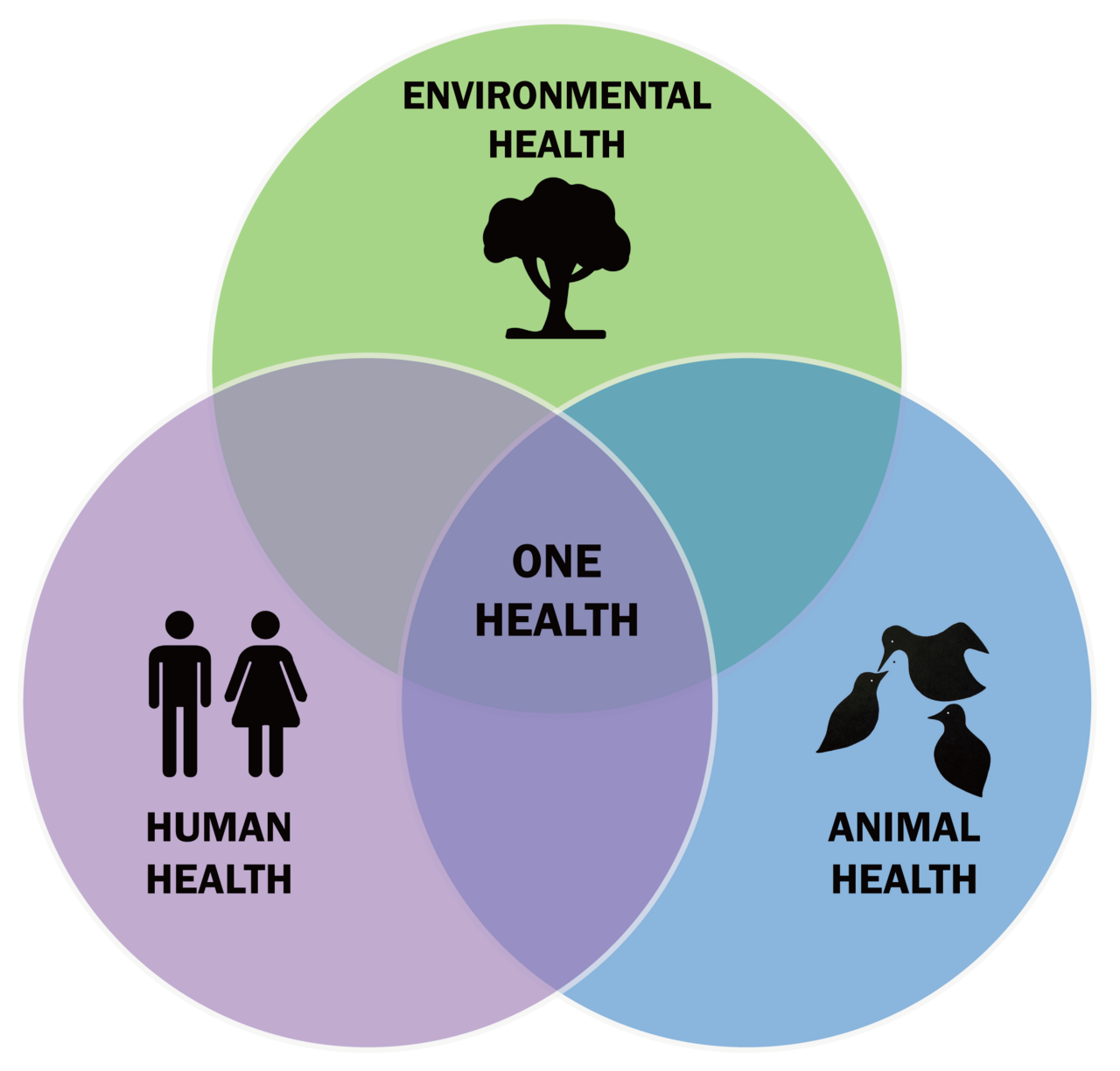
- Established with Cabinet approval in February 2024, following the recommendation of the 21st PM-STIAC (Prime Minister's Science, Technology and Innovation Advisory Council), the NOHM represents India's most ambitious attempt at building an integrated disease control and pandemic preparedness architecture. The mission adopts a collaborative, multidisciplinary approach — uniting human, animal, and environmental health systems under one coordinated framework.
- The nodal implementing agency is the Indian Council of Medical Research (ICMR) under the Department of Health Research (DHR), while strategic oversight rests with the Office of the Principal Scientific Adviser (OPSA). The mission currently engages more than 16 Central Ministries and Departments, including the Ministries of Health, Environment, Earth Sciences, Agriculture, and Ayush.
Governance Structure
The mission operates through a two-tiered governance model:
- The Executive Committee, chaired by the Minister of Health and Family Welfare with the PSA as Vice-Chair, provides overall policy guidance. Member (Health), NITI Aayog serves as a permanent invitee, while secretaries of stakeholder departments and two states (on a rolling basis) are members.
- The Scientific Steering Committee, chaired by the PSA, provides scientific direction and oversight. It includes Secretaries and Directors General of all stakeholder departments alongside two rotating state representatives.
Key Outcomes of the Fifth SSC Meeting
- The Committee released proceedings of two major events: the National One Health Assembly (November 2025) and the Workshop on Operational Frameworks for One Health held at Nagpur, which brought together States and Union Territories to align governance structures with NOHM objectives.
- Discussions covered short-, medium-, and long-term One Health priorities, with emphasis on integrated surveillance, laboratory strengthening, AI-enabled pathogen detection, cross-sectoral data sharing, and development of medical countermeasures.
- Updates were also presented by key advisory work streams, including those on BSL-3/4 Laboratories, Technology-Enhanced Surveillance, Data Integration, and Medical Countermeasures. Notably, India is developing a national network of high-security laboratories — currently 22 BSL-3/4 facilities — with a new BSL-4 facility foundation-laid in Gujarat in January 2026.
Significance and Global Linkages
The mission aligns with the One Health Joint Plan of Action (OH JPA) 2022–2026 of the Quadripartite alliance — FAO, UNEP, WHO, and WOAH — reflecting India's commitment to global health security norms. It also complements the existing National One Health Programme for Prevention and Control of Zoonoses (NOHP-PCZ) under the NCDC umbrella scheme.
India's first State/UT engagement workshop (June 2025, New Delhi) saw participation from 27 States and UTs — underscoring the federal dimension of health governance.