
Prambanan Temple

- 10 Jul 2026
In News:
The Prime Minister of India, along with the President of Indonesia, recently visited the Prambanan Temple, a UNESCO World Heritage Site, in Yogyakarta, Indonesia, highlighting the centuries-old civilizational and cultural links between India and Southeast Asia.
About Prambanan Temple
The Prambanan Temple is the largest Hindu temple complex in Indonesia, located in Sleman Regency, Yogyakarta, on the island of Java. Known locally as Roro Jonggrang (Temple of the Slender Virgin), it is one of the finest examples of Hindu temple architecture in Southeast Asia.
Constructed during the 9th century CE by the Sanjaya Dynasty, the temple symbolizes the flourishing of Hindu culture in ancient Java. It is dedicated to the Hindu Trimurti—Lord Shiva (the Destroyer), Lord Vishnu (the Preserver), and Lord Brahma (the Creator).
Recognising its outstanding cultural value, UNESCO inscribed Prambanan as a World Heritage Site in 1991.
Architectural Features
Prambanan reflects a remarkable fusion of indigenous Javanese architectural traditions and the South Indian Pallava style, illustrating the spread of Indian cultural influences across Southeast Asia.
The temple complex comprises 240 temples, with the central sacred compound containing eight principal temples and eight smaller shrines built on a raised platform.
Among these, the Shiva Temple is the largest and most prominent, rising to a height of 47 metres, making it one of the tallest Hindu temples in Southeast Asia. The other principal temples are dedicated to Vishnu and Brahma.
The galleries surrounding the temples are adorned with beautifully carved bas-reliefs depicting episodes from the Ramayana, showcasing the enduring influence of Indian epics on Southeast Asian art and culture.
Although primarily a Hindu religious complex, the Prambanan region also contains several Buddhist temples, reflecting the harmonious coexistence of Hinduism and Buddhism in ancient Java.
TribeX Platform
- 10 Jul 2026
In News:
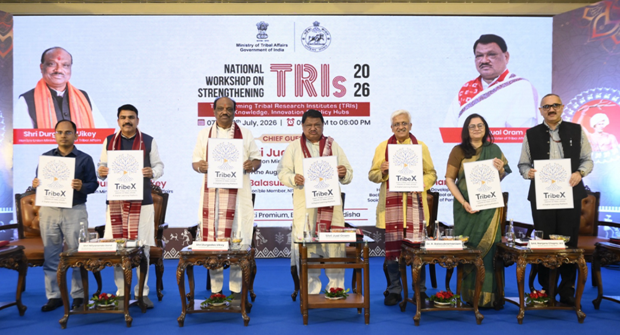
The Ministry of Tribal Affairs has launched TribeX, India's first dedicated digital learning platform for preserving, promoting and disseminating tribal arts, languages, culture, traditional knowledge and indigenous skills through technology-enabled education.
What is TribeX?
TribeX is a first-of-its-kind digital learning and knowledge platform designed to document, preserve and promote India's rich tribal heritage. It serves as a comprehensive digital ecosystem that combines education, skill development and cultural preservation by offering structured academic programmes alongside a digital repository of tribal knowledge.
The platform has been developed to safeguard India's diverse tribal traditions while making them accessible to learners, researchers and the wider public through digital technologies.
Key Features
TribeX functions as an integrated digital learning platform, offering free certificate courses and UGC-recognised Post Graduate Diploma programmes in tribal languages, traditional art forms, handicrafts, handloom, indigenous knowledge systems and cultural practices.
It currently provides 20 free certificate courses covering a wide range of tribal crafts, paintings, artefacts, handloom traditions and traditional musical instruments, thereby promoting skill development and cultural awareness.
A major component of TribeX is its Digital Repository, which documents and preserves tribal languages, oral traditions, performing arts, cultural practices and indigenous knowledge systems for future generations.
The platform also incorporates a Learning Management System (LMS) and a Repository Management System, enabling structured learning, digital content management, learner progress tracking and secure access to educational resources.
Another important feature is the Heritage Archive, which contains more than 5,000 multimedia resources, including audio recordings, videos and literature documenting tribal festivals, folklore, socio-cultural practices and oral traditions from across India.
Indiahandmade: Digital Marketplace for India's Handloom & Handicraft Sector
- 10 Jul 2026
In News:
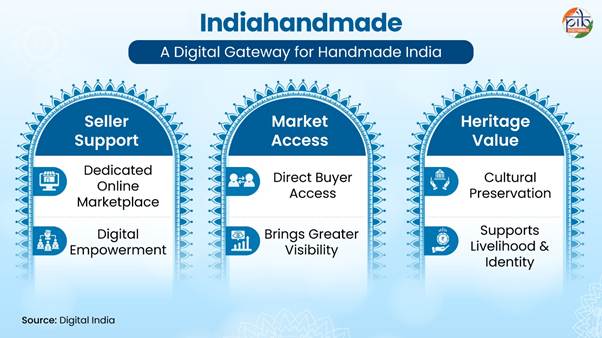
Indiahandmade is gaining attention as a flagship initiative under the Digital Indiaprogramme to digitally empower artisans and weavers by providing them with direct market access, thereby promoting traditional crafts, rural livelihoods and India's cultural heritage.
What is Indiahandmade?
Indiahandmade is a dedicated digital marketplace launched in 2023 by the Digital India Corporation under the Ministry of Textiles. The platform connects handloom weavers, handicraft artisans and producer organisations directly with buyers across the country, eliminating multiple intermediaries and enabling artisans to participate in the digital economy.
It forms an important component of the Government's efforts to strengthen Atmanirbhar Bharat, promote Digital India, and preserve India's traditional crafts through technology-enabled market access.
Need for the Platform
India possesses one of the world's largest traditional craft sectors, with nearly 64.66 lakh handloom and handicraft artisans. The sector is a major source of rural employment and women's empowerment, with women constituting about 71% of handloom weavers and 64% of total artisans.
Despite its cultural and economic importance, artisans often face challenges such as dependence on intermediaries, limited market reach, inadequate branding and low price realization. Indiahandmade seeks to bridge these gaps by creating a trusted digital marketplace connecting producers directly with consumers.
Key Features
The platform enables artisans and weavers to market a wide range of handmade products, including apparel, home décor, furnishings, paintings, furniture, jewellery, stationery, musical instruments, bags, footwear and religious items.
A distinctive feature of Indiahandmade is its promotion of Geographical Indication (GI)-tagged products and One District One Product (ODOP) items. Products showcased include Banarasi silk, Chanderi silk, Ikat, Pashmina shawls, Dokra crafts, Tangail sarees, Aipan art and terracotta products, thereby strengthening regional identity and traditional craftsmanship.
To improve consumer confidence, the platform provides secure digital payments, free shipping, purchase protection, buyer support, and a simplified onboarding process for artisans, weavers and producer organisations.
Natural History Museum (Mizoram) Declared as India's 21st Designated Repository
- 10 Jul 2026
In News:
The Ministry of Environment, Forest and Climate Change (MoEFCC), on the recommendation of the National Biodiversity Authority (NBA), has notified the Natural History Museum (NHM), Mizoram as India's 21st Designated Repository under the Biological Diversity Act, 2002.
What are Designated Repositories?
Designated Repositories are institutions officially recognized under the Biological Diversity Act, 2002 for the safe preservation, maintenance and authentication of biological specimens accessed under the provisions of the Act. They serve as permanent scientific repositories for biological materials, ensuring proper documentation, traceability and long-term availability for research, taxonomy and conservation.
These repositories also preserve voucher specimens and type specimens of newly discovered species, which serve as standard references for species identification and future scientific studies.
Natural History Museum (NHM), Mizoram
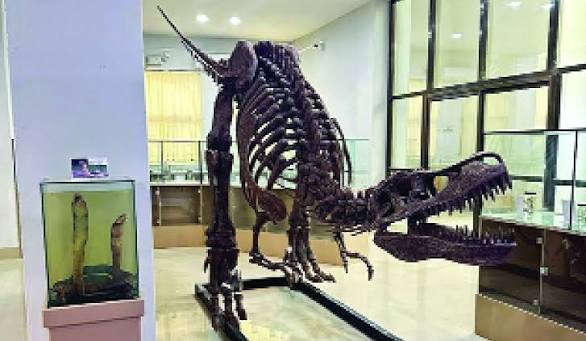
The Natural History Museum (NHM) was established in 2022 under Mizoram University, a Central University. Situated within the Indo-Burma Biodiversity Hotspot, the museum occupies a region recognized globally for its exceptional biological diversity and high level of endemism.
As a Designated Repository, NHM will preserve authenticated specimens of important plant and animal groups, including pteridophytes, macrofungi, reptiles, amphibians, freshwater fishes, moths, beetles and butterflies. It will also function as the official repository for type specimens of newly discovered species from the region, thereby strengthening taxonomic research and biodiversity documentation.
Significance
The designation of NHM as India's 21st Designated Repository strengthens the country's biodiversity governance framework by expanding scientific infrastructure for ex situ conservation. The repository will facilitate accurate species identification, long-term preservation of biological resources and ecological restoration following habitat degradation, natural disasters or species decline.
The initiative is particularly significant because Mizoram and the North-Eastern Region together support more than 7,500 species of flowering plants and over 2,000 faunal species, making the region one of India's richest biodiversity landscapes.
The notification also advances National Biodiversity Target 4 under India's National Biodiversity Strategy and Action Plan (NBSAP) 2024–2030 and contributes to the implementation of the Kunming–Montreal Global Biodiversity Framework, which emphasizes strengthening ex situ conservation alongside in situ conservation.
National Academic Depository (NAD)
- 10 Jul 2026
In News:
The National Academic Depository (NAD) is receiving renewed attention as India advances towards a secure, paperless and interoperable academic record management system, in line with the objectives of the National Education Policy (NEP) 2020 and Digital India.
What is the National Academic Depository (NAD)?
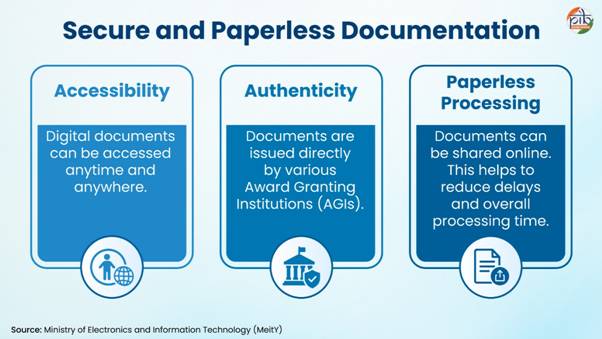
The National Academic Depository (NAD) is a nationwide digital framework for storing, issuing, verifying and authenticating academic credentials such as degrees, diplomas, certificates, marksheets and evaluation reports. It aims to replace paper-based academic records with authenticated digital credentials that can be securely accessed throughout a student's lifetime.
Since 2020, NAD has been implemented through DigiLocker, which serves as the operational platform for issuing, storing and sharing digital academic documents.
Need for NAD
India has one of the world's largest education ecosystems, comprising nearly 14.71 lakh schools, 1,420 universities, 53,583 colleges, 16,795 standalone institutions, and 280 research and development institutes. These institutions generate millions of academic records every year.
The traditional paper-based system is costly, time-consuming and prone to loss, damage, forgery and delays in verification. As educational reforms increasingly promote student mobility and flexible learning pathways, there is a growing need for a secure and interoperable digital repository that allows seamless access to verified academic records.
Objectives
The National Academic Depository seeks to:
- Provide lifelong digital access to authenticated academic credentials.
- Enable secure, paperless storage and sharing of academic records.
- Facilitate instant verification by educational institutions, employers, banks and government agencies.
- Eliminate fake certificates and reduce document forgery.
- Support credit mobility and flexible learning under NEP 2020.
Governance and Institutional Framework
The Ministry of Education is the parent ministry responsible for the National Academic Depository, while the University Grants Commission (UGC) functions as the nodal agency for its implementation through DigiLocker.
NAD operates through a coordinated digital framework in which educational institutions upload verified academic records, while students retain lifelong ownership and control over their credentials.
Digital documents issued through NAD enjoy the same legal validity as physical documents under the Information Technology Act, 2000.
Integration with National Digital Education Ecosystem
NAD has been integrated with several flagship digital initiatives to promote seamless academic mobility and verification.
These include:
- DigiLocker
- APAAR (Automated Permanent Academic Account Registry)
- Academic Bank of Credits (ABC)
- e-Sanad for attestation and apostille services
This integration enables secure storage, credit transfer, verification and international authentication of academic records.
Significance
The National Academic Depository represents a major step towards digital governance in education. It simplifies academic record management, reduces administrative burden, accelerates admissions and recruitment processes, and enhances transparency by enabling instant verification of authentic documents.
The platform also supports the implementation of Multiple Entry-Multiple Exit (MEME), the National Credit Framework (NCrF) and the Academic Bank of Credits (ABC) envisioned under the National Education Policy 2020. By promoting interoperability and lifelong learning, NAD aligns India's education system with global best practices in digital credential management.
Legal Framework
The functioning of NAD is supported by a robust legal framework:
- Information Technology Act, 2000 provides legal recognition to electronic records and digital signatures.
- Digital Locker Rules, 2016 ensure that digital documents are shared only with the explicit consent of the user.
- National e-Authentication Framework enables secure identity verification and authentication during document access and sharing.