
India's First Geothermal Wells at Puga Valley
- 22 Jul 2026
In News:
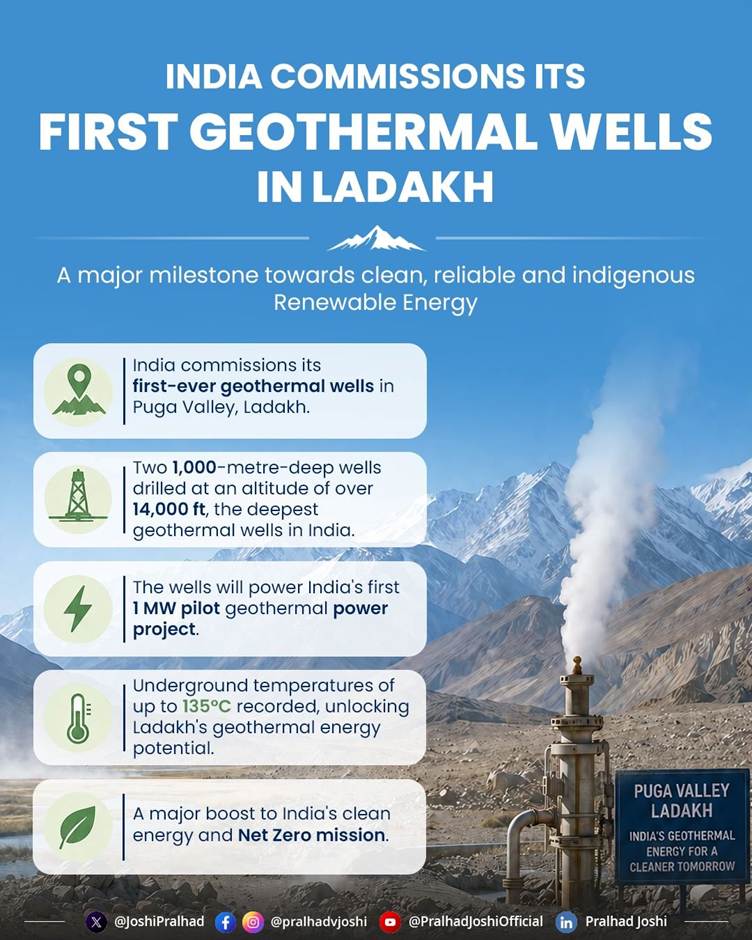
India has commissioned its first and deepest geothermal wells at Puga Valley in Ladakh, marking a major milestone in the country's renewable energy transition. The wells will support the proposed 1 MW pilot geothermal power plant, which is expected to become India's first demonstration-scale geothermal power project.
About the Project
- The project has been implemented by the ONGC Energy Centre in collaboration with the Ladakh Administration and the Ladakh Autonomous Hill Development Council (LAHDC), Leh.
- Two geothermal wells have been drilled to a depth of 1,000 metres at an altitude of over 14,000 feet in Puga Valley. During drilling, temperatures of 135°C were recorded at a depth of 400 metres, with further studies underway to assess the reservoir's commercial viability.
- The project aims to harness the Earth's internal heat to generate round-the-clock renewable electricity, offering a reliable alternative to intermittent renewable sources such as solar and wind.
What is Geothermal Energy?
Geothermal energy is the heat stored within the Earth's interior, which can be used for electricity generation, direct heating, and heating or cooling buildings. It is considered a renewable source of energybecause the Earth's internal heat is continuously replenished through residual heat and the natural decay of radioactive elements.
Geothermal energy can be harnessed from:
- Deep underground reservoirs containing hot water or steam.
- Natural hot springs and hydrothermal reservoirs located in geologically active regions.
- Shallow ground temperatures, which are utilised through geothermal heat pumps for heating and cooling.
Puga Valley
Puga Valley is situated in the Changthang region of Ladakh, about 22 km from the Salt Lake Valley. It is one of India's most promising geothermal fields and is well known for its natural hot sulphur springs, making it an ideal location for geothermal energy development.
Geothermal Potential in India
- India possesses significant untapped geothermal resources. The Geological Survey of India (GSI) has identified 381 hot springs across the country, with temperatures ranging from 35°C to 89°C.
- The country has 10 recognised geothermal provinces, including the Himalayan, Cambay Graben, Son–Narmada–Tapi, Godavari, Mahanadi, West Coast, Aravalli, South Indian Cratonic, Naga-Lusai, and Andaman & Nicobar provinces.
- Major geothermal sites include Puga and Chumathang (Ladakh), Manikaran (Himachal Pradesh), Tapoban (Uttarakhand), Bakreshwar (West Bengal), Tuwa (Gujarat), Tattapani (Chhattisgarh) and Deulajhari (Odisha).
- India's estimated geothermal power potential is around 10,600 MW.
Institutional Framework
The National Policy on Geothermal Energy, 2025 provides the framework for exploration and development of geothermal resources in India. The Ministry of New and Renewable Energy (MNRE) is the nodal ministry responsible for implementing the policy.
India's First Approved Dengue Vaccine (Qdenga®)
- 22 Jul 2026
In News:
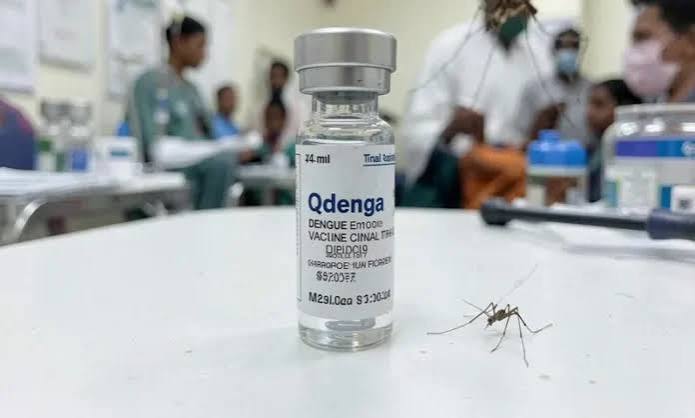
The Central Drugs Standard Control Organisation (CDSCO) has granted marketing authorization to Qdenga®, making it India's first approved dengue vaccine. The vaccine has been developed by Takeda GmbH (Germany) and will be imported and marketed in India by Takeda Biopharmaceuticals India Pvt. Ltd.
About Qdenga®
- Qdenga® is a live attenuated tetravalent dengue vaccine developed using recombinant DNA technology. It is designed to provide protection against all four serotypes of the dengue virus (DEN-1, DEN-2, DEN-3 and DEN-4) by using a dengue virus type-2 backbone with genes from the other three serotypes.
- The vaccine is approved for individuals between 4 and 60 years of age and is administered as two subcutaneous doses of 0.5 ml, given three months apart.
- The approval in India follows successful Phase III clinical trials, which demonstrated its safety and immunogenicity. The vaccine has already received WHO prequalification and regulatory approval in over 42 countries, including the European Union, the United Kingdom, Indonesia and Thailand.
About the Central Drugs Standard Control Organisation (CDSCO)
- The Central Drugs Standard Control Organisation (CDSCO) is India's national regulatory authority for drugs, vaccines, medical devices and cosmetics.
- It functions under the Directorate General of Health Services (DGHS), Ministry of Health and Family Welfare, and derives its statutory powers from the Drugs and Cosmetics Act, 1940 and the Drugs Rules, 1945.
- CDSCO is responsible for approving new drugs and vaccines, regulating clinical trials, licensing drug imports, and ensuring uniform standards for the quality, safety and efficacy of medicines across the country in coordination with State Licensing Authorities.
National Commission for Minorities
- 22 Jul 2026
In News:
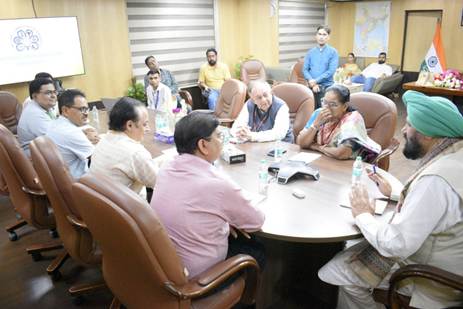
Harjit Singh Grewal assumed charge as the Chairman of the National Commission for Minorities (NCM) after the post remained vacant for over a year following the completion of the previous Chairperson's tenure in April 2025. The appointment has also sparked debate regarding the independence and autonomy of statutory rights bodies.
About the National Commission for Minorities
The National Commission for Minorities (NCM) is a statutory body established under the National Commission for Minorities Act, 1992 to safeguard the rights and interests of notified minority communities. The Commission plays an advisory and monitoring role by evaluating the implementation of constitutional and legal safeguards for minorities and addressing complaints relating to the deprivation of their rights.
The Central Government has notified six minority communities under the Act—Muslims, Christians, Sikhs, Buddhists, Parsis and Jains.
Composition
The Commission consists of a Chairperson, a Vice-Chairperson and five Members, all nominated by the Central Government. At least five members, including the Chairperson, must belong to the notified minority communities. Members hold office for three years.
Functions and Powers
The Commission monitors the implementation of safeguards available to minorities, evaluates the progress of their socio-economic and educational development, conducts research, and examines complaints regarding the violation of minority rights. While investigating a matter, it enjoys powers similar to those of a Civil Court, including summoning witnesses, calling for documents and receiving evidence on affidavits.
India's First eVTOL Aircraft (e200X)

- 22 Jul 2026
In News:
Chennai-based TheePlane Company, incubated at IIT Madras, unveiled e200X (PT-01), India's first full-scale prototype of an Electric Vertical Take-Off and Landing (eVTOL) aircraft.
What is an eVTOL Aircraft?
An Electric Vertical Take-Off and Landing (eVTOL) aircraft is a battery-powered aircraft capable of taking off and landing vertically like a helicopter and transitioning to horizontal flight like a conventional airplane. It is designed for short-distance urban and regional transport with minimal emissions and noise.
About e200X
- The e200X is India's first indigenous eVTOL prototype developed by TheePlane Company.
- It is powered by an electric propulsion system and is intended for applications such as urban air mobility, air ambulance services, airport connectivity, and logistics.
- The aircraft is designed to carry one pilot and a payload of about 200 kg (two passengers or one patient with a paramedic) with an operational range of around 110 km on a single charge.
- It employs distributed electric propulsion, where multiple electric motors provide redundancy, improving operational safety in case of motor failure.
Key Features
- Battery-powered, zero-emission aircraft.
- Vertical take-off and landing capability.
- Maximum take-off weight of around 2 tonnes.
- Carbon-fibre composite airframe for reduced weight.
- Uses multiple electric rotors for lift and forward flight.
- Equipped with advanced navigation and sensor systems.
- Designed to operate from existing helipads without requiring dedicated infrastructure.
Significance
The development of e200X represents an important step towards Advanced Air Mobility (AAM) in India.
It can:
- Promote sustainable and low-emission urban transport.
- Reduce travel time in congested cities.
- Strengthen emergency medical evacuation services.
- Encourage indigenous aerospace manufacturing under Atmanirbhar Bharat.
- Position India in the emerging global eVTOL and electric aviation ecosystem.
WTO Agreement on Fisheries Subsidies
- 22 Jul 2026
In News:
India has deposited its Instrument of Acceptance of the World Trade Organization (WTO) Agreement on Fisheries Subsidies (AFS), becoming the 123rd WTO member to join the agreement.
What is the Agreement on Fisheries Subsidies (AFS)?
- The Agreement on Fisheries Subsidies (AFS) is the first multilateral WTO agreement focused on environmental sustainability.
- It was adopted by consensus at the 12th WTO Ministerial Conference (MC12) held in Geneva in June 2022 and entered into force on 15 September 2025 after receiving acceptance from two-thirds of WTO members.
- The agreement applies only to marine wild capture fisheries and fishing-related activities at sea. It does not cover aquaculture or inland fisheries, thereby excluding these sectors from its obligations.
Key Features
The agreement seeks to curb harmful fisheries subsidies that contribute to the depletion of marine resources. It prohibits subsidies provided for:
- Illegal, Unreported and Unregulated (IUU) fishing
- Fishing of overfished stocks
According to the WTO, 37.7% of global marine fish stocks are currently overfished, compared to 10% in 1974. The problem is aggravated by nearly USD 35 billion in annual global fisheries subsidies, much of which supports large industrial fishing fleets.
Domestic Preparedness
India has already introduced several measures that complement the objectives of the agreement, including:
- Sustainable Harnessing of Fisheries in the Exclusive Economic Zone (EEZ) Rules, 2025
- Guidelines for Sustainable Harnessing of Fisheries in the High Seas by Indian-Flagged Fishing Vessels, 2025
- Capacity building and welfare initiatives under the Pradhan Mantri Matsya Sampada Yojana (PMMSY)
These initiatives strengthen sustainable fishing practices while supporting the livelihoods of fishing communities.