
Assam Floods and Flood Management in India
- 24 Jul 2026
In News:
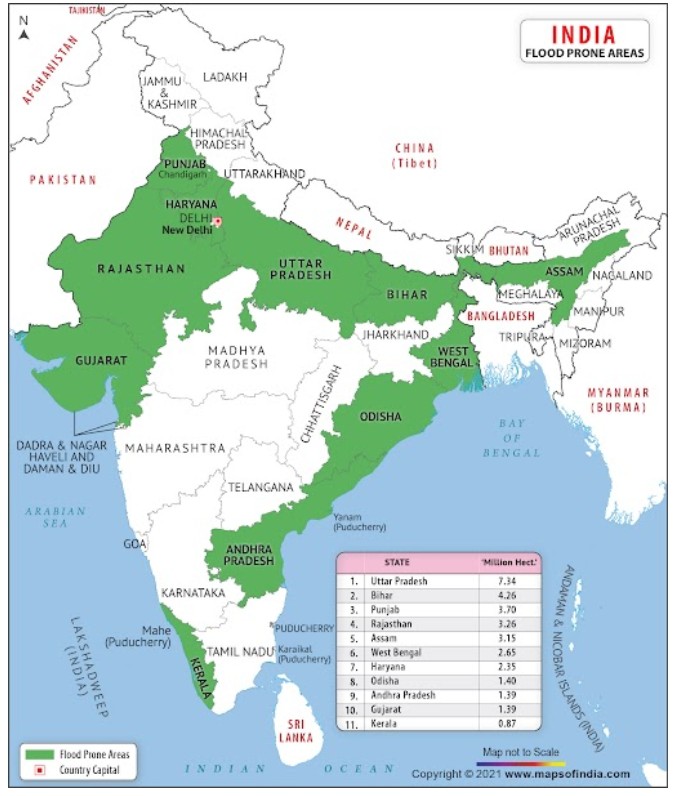
Assam has witnessed its worst floods in over 60 years, affecting more than 8 lakh people and claiming over 30 lives. The disaster has once again highlighted the growing impact of climate change and the need for scientific flood management.
Why is Assam Highly Flood-Prone?
Assam lies in the Brahmaputra and Barak river basins, making it naturally vulnerable to annual floods. The Brahmaputra, one of the world's most sediment-laden rivers, deposits large quantities of silt as it enters the plains, raising the riverbed and reducing its carrying capacity.
Heavy southwest monsoon rainfall, coupled with upstream discharge from Arunachal Pradesh and Meghalaya, frequently triggers flash floods. Continuous riverbank erosion, embankment breaches, deforestation in the catchment, and increasing extreme rainfall events due to climate change further aggravate flooding. Nearly 39.58% of Assam's geographical area is flood-prone, almost four times the national average.
Major Causes of Floods in India
Floods in India result from both natural and human-induced factors.
Natural causes include concentrated monsoon rainfall, heavy siltation of Himalayan rivers, river course changes, Glacial Lake Outburst Floods (GLOFs), and cyclones along the eastern coast.
Human-induced factors include deforestation, encroachment of floodplains and wetlands, unscientific sand mining, reservoir mismanagement, excessive reliance on embankments, and rapid urbanisation that replaces permeable surfaces with concrete, leading to urban flooding.
Flood Management Measures in India
India has adopted both structural and non-structural measures to reduce flood risks.
Structural measures include construction of embankments, drainage channels, reservoirs, and implementation of the Dam Safety Act, 2021. Reservoirs are operated using Rule Curves to maintain flood cushions during the monsoon.
Non-structural measures include flood forecasting by the Central Water Commission (CWC), weather warnings by the India Meteorological Department (IMD), catchment area treatment, floodplain zoning, and community-based disaster preparedness.
Institutional support is provided through the Disaster Management Act, 2005, Flood Management and Border Areas Programme (FMBAP), and the National Water Policy, 2012.
Challenges in Flood Management
India's flood management continues to face several challenges. Constitutional division of responsibilities between the Centre and States often hampers integrated river basin management. Delays in project implementation, weak forecasting infrastructure, inadequate reservoir operations, and poor interstate as well as transboundary coordination reduce the effectiveness of flood-control measures.
In Northeast India, dependence on upstream river flows originating in neighbouring countries, difficult terrain, fragile ecology, and limited hydrological cooperation further complicate flood management.
Way Forward
India needs to shift from flood control to flood resilience by adopting Integrated River Basin Management (IRBM), scientific reservoir operations, effective floodplain zoning, nature-based solutions such as wetland restoration, AI-enabled early warning systems, and stronger institutional coordination.
Implementing recommendations of the Rashtriya Barh Ayog (1980), R. Rangachari Committee (2003), and aligning disaster management with the Sendai Framework for Disaster Risk Reduction (2015–2030) can significantly strengthen long-term flood resilience.
NATO Ankara Summit (2026)

- 24 Jul 2026
In News:
The NATO Ankara Summit (2026) concluded with major decisions on higher defence spending, continued support for Ukraine, and strengthening Europe's defence industrial base (DIB) amid evolving global security challenges.
About the NATO Ankara Summit
- The NATO Ankara Summit is a high-level politico-military meeting where leaders of the 32 NATO member countries review the Alliance's security priorities, defence preparedness, and collective military capabilities.
- Hosted by Türkiye in Ankara, the summit built upon the commitments made at the 2025 Hague Summit, focusing on long-term defence preparedness in response to geopolitical tensions in Eastern Europe and West Asia.
Key Outcomes
- The summit reaffirmed the Alliance's commitment to Article 5 of the Washington Treaty, under which an attack on one member is treated as an attack on all.
- A major outcome was the unanimous endorsement of the 5% GDP defence spending target, requiring all NATO members to allocate at least 5% of GDP to defence by 2035.
- Leaders also reiterated their long-term military, financial, and strategic support for Ukraine, while committing to expand Europe's Defence Industrial Base (DIB) through greater investment in defence manufacturing, research, innovation, and skilled manpower.
- The summit marked a strategic shift from crisis management towards rapid industrial production, technological innovation, and sustained military readiness.
Implications for India
- The accelerated rearmament of NATO countries is expected to tighten the global defence market, with Western manufacturers prioritising orders from Alliance members.
- This may result in delays in defence supplies to India, as seen in the delayed delivery of GE Aerospace F-404 engines for the LCA Tejasprogramme.
- Growing demand for weapons and ammunition could also create shortages of precision-guided munitions, air defence systems, artillery ammunition, and advanced military technologies, affecting India's defencemodernisation plans.
- India's dependence on foreign Original Equipment Manufacturers (OEMs) for advanced platforms such as jet engines, drones, AI-enabled systems, and electronic warfare equipment highlights the need for greater self-reliance.
White-bellied Heron

- 24 Jul 2026
In News:
The proposed 1,200 MW hydropower project on the Lohit River in Arunachal Pradesh has raised concerns over its potential impact on the White-bellied Heron, one of the world's rarest and most threatened bird species.
About White-bellied Heron
- The White-bellied Heron (Ardea insignis), also known as the Imperial Heron, belongs to the family Ardeidae.
- It is the second-largest heron species in the world and among the most elusive birds globally.
- The species is strictly dependent on free-flowing, fast-flowing Himalayan rivers bordered by mature riparian forests with minimal human disturbance.
- It primarily feeds on fish in shallow river rapids, making it extremely vulnerable to hydropower dams, altered river flows, increased water turbidity, and habitat fragmentation.
- It inhabits eastern Himalayan river systems up to an elevation of about 1,500 metres above sea level.
Key Features
The White-bellied Heron possesses a long flexible neck, a sharp serrated bill for catching fish, compact body, shorter legs, and extended toes that help it maintain stability on slippery rocks in fast-flowing rivers.
Standing nearly four feet tall, it follows a distinctive hunting strategy by remaining motionless before rapidly striking at nearby fish.
Distribution
- Globally, the species occurs across the Himalayan freshwater ecosystems of Bhutan, India, Myanmar, China, and Bangladesh, covering nearly 165,000 sq. km.
- Fewer than 60 individuals survive in the wild today. Bhutan supports about 45% of the global population and is regarded as the species' last major stronghold. The bird is considered extinct in Nepal and possibly Bangladesh.
- In India, the White-bellied Heron is found only in Arunachal Pradesh, particularly in the Lohit, Anjaw, and Changlang districts, including areas around Namdapha Tiger Reserve and Kamlang Tiger Reserve.
- India has an estimated 6–9 individuals, distributed across the Noa-Dehing, Lahm, and Lohit rivers. The Lahm River basin, a tributary of the Lohit, supports nearly 70% of India's population, while Walong Cantonment near the proposed dam site is an important breeding area.
Conservation Status
- IUCN Red List: Critically Endangered
- Wildlife (Protection) Act, 1972: Schedule I
Threats
The principal threats include:
- Hydropower projects and river regulation
- Habitat loss and fragmentation
- Hunting and human disturbance
- Extremely small population and restricted distribution
Hedychium zubeengargianum

- 24 Jul 2026
In News:
Botanists from the Botanical Survey of India (BSI), Eastern Regional Centre, Shillong, have discovered a new species of ginger lily, Hedychium zubeengargianum, in Shillong, Meghalaya.
About Hedychium zubeengargianum
- Hedychium zubeengargianum is a newly identified species of ginger lily (genus Hedychium), named in honour of Meghalaya-born Assamese music legend Zubeen Garg.
- The species was identified after years of studying an unusual plant growing in the Botanical Survey of India (BSI), Eastern Regional Centre, Shillong. Although the plant had been cultivated in the institute's botanical garden since at least 2018, its original source could not be traced due to the absence of collection records.
Key Features
Popularly known as ginger lilies, species of the genus Hedychium are among the most attractive flowering plants of Northeast India.
Hedychium zubeengargianum is distinguished from its closest relative, Hedychium gracile, by several unique characteristics:
- Creamy-white, fragrant flowers
- Yellow anthers
- Densely hairy flowering stalk
- Earlier flowering season (April–May)
Distribution
India is home to about 41 taxa of Hedychium, with the majority occurring in the biodiversity-rich regions of Northeast India and the Western Ghats.
The discovery highlights the rich floral diversity of the Northeast and the importance of continued botanical exploration in the region.
Beta Pictoris d

- 24 Jul 2026
In News:
Astronomers using NASA's James Webb Space Telescope (JWST) discovered a hidden giant exoplanet, Beta Pictoris d, in the Beta Pictoris star system, located about 63 light-years from Earth.
About the Beta Pictoris System
- The Beta Pictoris system is a young planetary system, estimated to be around 23 million years old, making it an important laboratory for studying planet formation and the evolution of planetary systems.
- Located in the Milky Way Galaxy, the system is surrounded by a bright dust and debris disk, which provides valuable insights into interactions between planets and surrounding material.
- Before this discovery, the system was known to contain two directly imaged giant exoplanets—Beta Pictoris b and Beta Pictoris c. With the discovery of Beta Pictoris d, it has become the second known planetary system with at least three directly imaged exoplanets.
About Beta Pictoris d
- Beta Pictoris d is a gas giant exoplanet with an estimated mass of at least twice that of Jupiter, making it the smallest among the three known giant planets in the system.
- It orbits its host star at a distance of about 30 Astronomical Units (AU), roughly comparable to Neptune's orbit around the Sun, and has the widest orbit among the three planets.
- The planet remained undetected for years because it lies within one of the brightest known debris disks, making conventional imaging extremely difficult.
Discovery Method
- The planet was discovered using the Near-Infrared Spectrograph (NIRSpec) Integral Field Unit aboard the James Webb Space Telescope while scientists were observing Beta Pictoris b.
- Instead of direct imaging alone, researchers identified the planet through its spectroscopic chemical signature. Detection of carbon monoxide absorption lines and radial velocity analysis confirmed its planetary nature.
- Subsequent observations using JWST's Mid-Infrared Instrument (MIRI) detected water vapour and methane in its atmosphere, providing further confirmation.