
Foreign Assets of Small Taxpayers – Disclosure Scheme (FAST-DS) 2026

- 25 Aug 2026
In News:
The Central Board of Direct Taxes (CBDT) has notified the Foreign Assets of Small Taxpayers–Disclosure Scheme (FAST-DS) 2026, a one-time voluntary disclosure mechanism announced in the Union Budget 2026–27 under the Finance Act, 2026.
What is FAST-DS 2026?
FAST-DS enables eligible taxpayers to voluntarily disclose certain undisclosed foreign assets or foreign income by paying the prescribed tax/fee. The Scheme came into force on 16 August 2026 and declarations can be filed up to 31 December 2026. The valuation date for assets is 31 March 2026.
An eligible person is generally one who was resident in India in the relevant previous year. A person currently non-resident or RNOR may also qualify if they were resident in India in the relevant year of foreign income or acquisition of the foreign asset.
Two Categories under FAST-DS
Category I – Undisclosed Foreign Asset/Income:Covers foreign assets or income that were not previously offered to tax, where the aggregate value does not exceed ?1 crore.
- Tax: 30%
- Additional amount: 100% of the tax
- Effective payment: 60%
- Example: ?80 lakh declared → ?48 lakh payable.
Category II – Undeclared Foreign Asset:Covers foreign assets that were already offered to tax or acquired when the assessee was a non-resident, but were not disclosed in the relevant ITR schedule.
- Aggregate asset value: up to ?5 crore
- Fee: ?1 lakh
A declaration can be made where the taxpayer failed to file a return, omitted the foreign asset/income from a filed return, or the income/asset escaped assessment.
Valuation & Benefits
Foreign assets are generally valued at the higher of their cost of acquisition or open-market value as on 31 March 2026, with conversion into Indian rupees under prescribed foreign-exchange rules. Specific valuation methods apply to jewellery, securities, unquoted shares, immovable property, foreign bank accounts and foreign partnerships/LLPs.
A valid declaration and payment provide immunity from further tax, penalty and prosecution under the Black Money Act, 2015 for the declared asset/income. However, the declarant cannot subsequently seek rectification/revision or set-off/relief relating to the declared asset/income or amount paid.
Exclusions
FAST-DS does not cover:
- Proceeds of crime where proceedings are initiated/pending under the Prevention of Money-Laundering Act, 2002.
- Assets/income relating to assessment years for which proceedings have already been completed under the Black Money Act, 2015.
Creamy Layer Principle for SCs/STs

- 25 Aug 2026
In News:
The Union Government has opposed extending the “creamy layer” principle to Scheduled Castes (SCs) and Scheduled Tribes (STs) before the Supreme Court. The issue arose after the 2024 seven-judge Constitution Bench judgment in State of Punjab v. Davinder Singh allowed sub-classification within SC/ST reservation quotas and suggested consideration of a mechanism to prevent “elite capture” of reservation benefits.
What is the Creamy Layer Principle?
The creamy layer refers to the relatively advanced sections within a reserved category who are excluded from reservation benefits. The principle was established in Indra Sawhney v. Union of India (1992), which upheld 27% OBC reservation while directing exclusion of the creamy layer. It is currently applied to OBCs, where only Non-Creamy Layer (NCL) candidates are eligible for OBC reservation.
Historically, it has not been applied to SCs/STs, whose disadvantaged status is constitutionally linked to historical caste oppression, untouchability, social stigma and, in the case of many ST communities, geographical isolation, rather than economic deprivation alone.
Sub-Categorisation vs Creamy Layer
These are distinct mechanisms:
- Sub-categorisation: Divides an existing SC/ST quota among different sub-groups to ensure that relatively more marginalised communities receive a fair share.
- Creamy layer exclusion: Identifies relatively advanced individuals within a reserved category and excludes them from reservation benefits.
- States such as Telangana, Haryana, Punjab and Andhra Pradesh have experience with SC sub-classification, while Mizoram has sub-categorised the ST quota.
- The Centre also uses ST sub-categorisation in Eklavya Model Residential School admissions to ensure representation of PVTGs.
Why Has the Centre Opposed Creamy Layer for SC/STs?
The government argues that economic advancement does not necessarily eliminate caste-based discrimination. A financially successful SC/ST individual may continue to face social exclusion and lack of social and cultural capital.
It also raises constitutional and institutional concerns. Articles 341(2) and 342(2) provide that changes to the Presidential Lists of SCs and STs can be made only by Parliament by law. The Centre argues that judicially imposing exclusion could potentially interfere with this constitutional framework. However, the Jarnail Singh judgment (2018) held that excluding a creamy layer does not, by itself, alter the Presidential Lists.
The government has also stressed the need for empirical socio-economic data before identifying relatively advanced sections within SC/ST communities. The upcoming Census 2027, which includes caste enumeration, may provide additional data, although its results are not yet available
Parichha Dam
- 25 Aug 2026
In News:
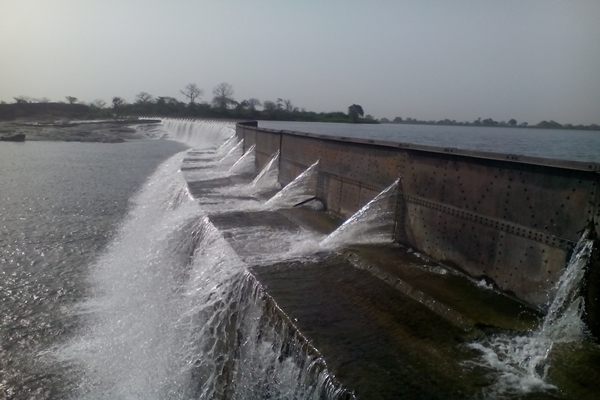
The International Commission on Irrigation and Drainage (ICID) has recognised the historic Parichha Dam in Jhansi, Uttar Pradesh, as a World Heritage Irrigation Structure (WHIS) for its engineering, historical and continuing irrigation significance.
Parichha Dam
- Parichha Dam is located on the Betwa River in Jhansi, Uttar Pradesh, and forms an important part of the Betwa Canal System, supplying irrigation water to the drought-prone Bundelkhand region.
- The structure has supported irrigation in parts of Uttar Pradesh and Madhya Pradesh for nearly 140 years.
- Historically, Captain Strachey proposed a canal system for Bundelkhand in 1855, followed by surveys. Construction of Parichha Dam began in 1881, and it became operational in 1886.
- Another ICID heritage structure in the region: The Sukwa-Dukwan Weir in Jhansi was included in the WHIS list in 2022.
International Commission on Irrigation and Drainage (ICID)
- Established in 1950, ICID is a leading scientific, technical, international, not-for-profit, non-governmental organisation working on irrigation, drainage and flood management.
- Its mission is to promote sustainable agricultural water management and contribute to a water-secure world through sustainable rural development.
- Under its World Heritage Irrigation Structures (WHIS) programme, ICID recognises historically significant irrigation and drainage structures that demonstrate important engineering achievements, historical value and continuing relevance.
WHIS – Key Criteria
A structure generally needs to be more than 100 years old and should fall within categories such as:
- Dams primarily serving irrigation purposes
- Irrigation tanks and water-storage structures
- Barrages and water-diversion structures
- Canal systems
- Traditional water-lifting devices such as old waterwheels and shadouf
- Agricultural drainage structures
- Other sites/structures functionally linked to past or present agricultural water management
India’s E20 Fuel Transition
- 25 Aug 2026
In News:
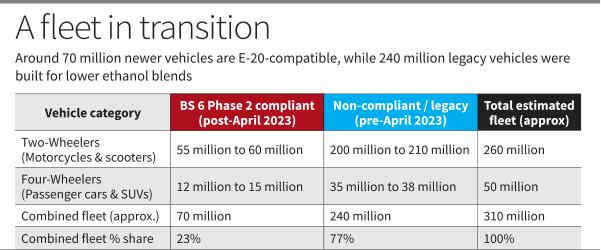
India has moved towards a nationwide E20 petrol regime—petrol blended with up to 20% anhydrous ethanol, with a minimum Research Octane Number (RON) of 95. The transition under the Ethanol Blended Petrol (EBP) Programme aims to reduce fossil-fuel dependence, improve energy security and promote domestically produced renewable ethanol. However, concerns have emerged regarding the compatibility of E20 with India’s large fleet of older vehicles.
What is E20?
E20 contains 20% ethanol and 80% petrol. Ethanol has lower energy density than petrol and is also hygroscopic, meaning it absorbs moisture. These properties can affect fuel economy and the durability of certain components in vehicles designed for lower ethanol blends.
According to the material provided, India has around 310 million petrol vehicles, of which approximately 240 million (77%) are legacy vehicles, predominantly two-wheelers, that were not factory-engineered specifically for E20.
Why is E20 being promoted?
The transition is intended to:
- Reduce crude-oil imports and foreign-exchange outflow.
- Improve energy security through greater use of domestically produced ethanol.
- Support sugarcane and grain-based ethanol industries.
- Reduce lifecycle greenhouse-gas emissions compared with fossil petrol.
- Create a domestic biofuel and rural economic ecosystem.
The government has accelerated ethanol blending ahead of the earlier 2030 target, alongside expansion of domestic distillery capacity.
Major Concerns
The key issue is legacy vehicle compatibility. Ethanol’s lower energy density can contribute to reduced mileage, while its solvent and moisture-absorbing properties may affect older fuel-system components.
Potential technical problems include phase separation, corrosion, deterioration of rubber components, fuel-filter clogging and injector problems. Water ingress into underground storage tanks can aggravate these problems.
The material also highlights concerns over fuel-quality contamination, including organic chlorides and excessive water content, which can compound the risks associated with ethanol blending.
Importantly, scientific assessments are not uniform: laboratory studies cited in the material indicate relatively limited efficiency losses, while some consumer experiences and industry data report greater mileage and component-related problems.
Policy Measures & Way Forward
The government has mandated a minimum RON 95 for E20 to improve anti-knock performance. The Society of Indian Automobile Manufacturers (SIAM) is undertaking a multi-stakeholder study on long-term vehicle compatibility.
A balanced transition should focus on:
- Clear labelling of ethanol percentage and RON at fuel stations.
- Strict fuel-quality monitoring throughout the supply chain.
- Independent, multi-year real-world fleet testing across climatic regions.
- Affordable retrofit solutions for compatible legacy vehicles.
- Consideration of lower-blend alternatives for vehicles demonstrably unsuitable for E20.
Government Notifies Sixth Positive Indigenisation List (PIL)
- 25 Aug 2026
In News:
The Ministry of Defence has notified the sixth Positive Indigenisation List (PIL) comprising 405 defence items, with an estimated business potential of ?3,070 crore. The initiative seeks to deepen Aatmanirbharta in defence by progressively replacing imported components with domestically manufactured alternatives.
The list, notified by the Department of Defence Production (DDP), covers Line Replaceable Units (LRUs), sub-systems, sub-assemblies, spares, components and raw materials used in major defence platforms. These include the Advanced Light Helicopter (ALH), Light Utility Helicopter (LUH), Chetak and Cheetah helicopters, Su-30MKI, Jaguar, MiG-29, Light Combat Aircraft (LCA) and AL-31FP engine. Once an item is successfully indigenised, its procurement is to be made exclusively from Indian industry, within the specified timeframe.
DefenceIndigenisation in India
India’s defence production reached an all-time high of ?1.78 lakh crore in FY 2025–26, registering 15.6% growth over the previous year. DPSUs and other PSUs contributed around 76%, while the private sector contributed 24%. Defence production is targeted to reach ?3 lakh crore by 2029, while India exported defence equipment to 80 countries in FY2025–26. About 65% of defence equipment is now manufactured domestically, indicating a substantial reduction in import dependence.
Major Indigenisation Measures
The government has adopted multiple mechanisms:
- DAP 2020: Gives highest priority to Buy (Indian–IDDM) — Indigenously Designed, Developed and Manufactured.
- Make Procedure:Make-I provides government funding of up to 70% of development cost, while Make-II is industry-funded with simplified eligibility.
- FDI: Up to 74% through automatic route and up to 100% through government approval in cases involving access to advanced technology.
- Defence Industrial Corridors:Uttar Pradesh and Tamil Nadu corridors promote defence manufacturing clusters and investment.
- iDEX: Supports startups, MSMEs, innovators and academia in developing defence technologies.
- Technology Development Fund (TDF): Supports defence R&D by industries, particularly startups and MSMEs, with assistance of up to ?10 crore.
- Strategic Partnership Model: Promotes long-term collaboration between Indian companies and global OEMs for technology transfer and manufacturing.
- SRIJAN Portal: Identifies imported defence items that Indian industry can develop domestically.
- DTIS: Supports creation of specialised testing and certification infrastructure.