
Software Technology Parks of India (STPI)
- 09 Jun 2026
In News:
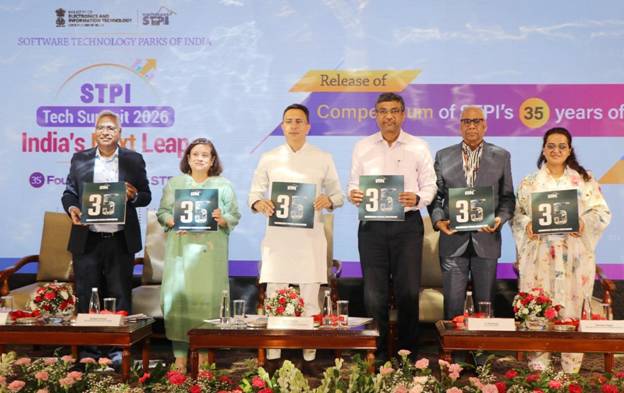
Recently, the Software Technology Parks of India (STPI) celebrated its 35th Foundation Day and organized the STPI Tech Summit 2026: India's Next Leap in New Delhi. The event highlighted STPI's contribution to India's transformation into a global information technology and innovation hub.
About STPI
- Software Technology Parks of India is a premier Science and Technology organization established in 1991 under the Ministry of Electronics and Information Technology (MeitY).
- It was created primarily to promote software exports and support the growth of India's IT and IT-enabled Services (IT/ITES) sector.
- Since its inception, STPI has played a crucial role in positioning India as a leading global destination for software development, IT services, and digital innovation.
- It implements the Software Technology Park (STP) Scheme and the Electronics Hardware Technology Park (EHTP) Scheme, which provide an enabling environment for technology enterprises engaged in exports.
Objectives and Functions
- The core objective of STPI is to facilitate and promote software and IT-enabled service exports from India.
- It acts as a single-window support system for technology companies by providing infrastructure, regulatory facilitation, and export-related services.
- STPI assists firms in software development and export activities while ensuring compliance with customs regulations, foreign exchange requirements, and other statutory obligations. Through these services, it has significantly contributed to the growth of India's IT export ecosystem.
Key Services Provided by STPI
- Infrastructure Support: STPI provides ready-to-use plug-and-play office spaces equipped with advanced IT infrastructure, enabling startups and export-oriented units to establish operations with minimal initial investment.
- Customs and Regulatory Facilitation: It facilitates duty-free import of capital goods, equipment, consumables, and other inputs required for software export activities. STPI also assists enterprises in complying with customs and export-related regulations.
- Statutory Compliance Support: The organization helps companies meet various export obligations and regulatory requirements related to foreign exchange management and international trade.
- Advisory and Consultation: STPI provides guidance on export procedures, tax incentives, regulatory compliance, and business expansion strategies for technology companies.
Role in India's Startup Ecosystem
In recent years, STPI has expanded its mandate beyond software exports and emerged as an important pillar of India's innovation ecosystem.
It promotes entrepreneurship through initiatives such as:
- Centres of Entrepreneurship (CoEs)
- Next Generation Incubation Scheme (NGIS)
These programmes support startups working in emerging technologies by providing incubation facilities, mentorship, industry linkages, funding support, and market access opportunities. Through a network of innovation centres across the country, STPI is helping nurture technology-driven startups beyond major metropolitan cities.
Jai Prakash Narayan Bird Sanctuary

- 09 Jun 2026
In News:
India recently achieved a significant milestone in wetland conservation with the designation of Jai Prakash Narayan Bird Sanctuary, popularly known as Surha Tal, as the country's 100th Ramsar Site. The recognition highlights India's growing commitment to wetland conservation and biodiversity protection under the Ramsar Convention.
About Jai Prakash Narayan Bird Sanctuary (Surha Tal)
- Located in Uttar Pradesh, Surha Tal is a natural perennial oxbow lake situated in the middle stretch of the Ganga River Basin.
- The lake was originally formed from a meander of the Ganga River and receives freshwater inflow through three channels.
- The wetland comprises a mosaic of floodplains, marshes, seasonally inundated areas, and rice paddies, creating a highly productive ecosystem that supports rich biodiversity. Owing to its ecological importance, it serves as a crucial wintering and stopover habitat for migratory birds travelling along the Central Asian Flyway.
- The sanctuary is renowned for its avifaunal diversity and attracts a large number of resident and migratory bird species every year.
Biodiversity Significance
- Beyond birdlife, the wetland supports a diverse range of flora and fauna: 221 plant species , 66 fish species, 7 reptile species, 3 amphibian species.
- Among the notable aquatic species are Wallago attu and Bagariusbagarius, both classified as Vulnerable.
The rich biodiversity and ecological productivity of the wetland make it an important freshwater ecosystem within the Ganga basin.
Ramsar Convention on Wetlands
The Ramsar Convention on Wetlands is an international treaty dedicated to the conservation and sustainable use of wetlands.
It was:
- Adopted in 1971 in Ramsar
- Came into force in 1975
- The first intergovernmental treaty focused exclusively on a specific ecosystem—wetlands.
Three Pillars of the Convention
The Convention is based on three core principles:
- Conservation of wetlands of international importance.
- Promotion of the wise use of all wetlands.
- International cooperation on shared wetlands, river basins, and migratory species.
Currently, the Convention has 172 Contracting Parties (signatory countries).
India and the Ramsar Convention
- India became a party to the Ramsar Convention in 1982. The country's first Ramsar Sites were: Chilika Lake and Keoladeo National Park
- With the inclusion of Surha Tal, India now has 100 Ramsar Sites, reflecting the increasing emphasis on wetland conservation as part of environmental sustainability, biodiversity protection, and climate resilience strategies.
Significance of the Designation
The designation of Surha Tal as India's 100th Ramsar Site is significant because it:
- Strengthens conservation efforts in the Ganga basin.
- Enhances protection of migratory bird habitats along the Central Asian Flyway.
- Promotes sustainable management of freshwater ecosystems.
- Contributes to biodiversity conservation and climate resilience.
- Reinforces India's international commitments under the Ramsar Convention.
Jan Samarth Portal
- 09 Jun 2026
In News:
Recently, the Jan Samarth Portal completed four years of its journey as a flagship digital platform aimed at improving access to credit-linked government schemes. Launched in 2022, the portal represents a significant step towards digital governance, financial inclusion, and seamless credit delivery by integrating beneficiaries, lending institutions, and government agencies onto a single platform.
About Jan Samarth Portal
- Jan Samarth is a unique digital platform for credit-linked government schemes, conceptualized with the twin objectives of expanding the reach of government-sponsored schemes and streamlining the credit delivery process.
- It serves as a one-stop platform connecting beneficiaries, financial institutions, Central and State Government agencies, and nodal agencies.
- By bringing multiple stakeholders of the financial ecosystem together, the portal seeks to promote inclusive development, improve access to institutional finance, and enhance the ease of doing business.
Key Features
- The portal functions as a digital marketplace with a user-friendly interface integrated with multiple centralized databases, enabling end-to-end digital processing of loan applications.
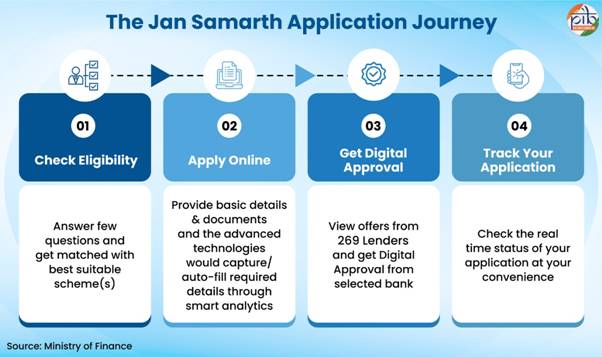
- Applicants can access the portal on a 24×7 basis, check their eligibility, submit applications online, and choose from a wide network of lending institutions.
- The system includes an inbuilt rule-based engine that automatically assesses eligibility and facilitates quicker processing of applications.
- A major feature of the platform is its single-window access to 15 credit-linked Central Government schemes and 254 Member Lending Institutions (MLIs), including all Public Sector Banks. Once an applicant submits an application, the portal checks eligibility, provides an in-principle sanction, and forwards the application to the selected bank branch.
- The portal also keeps applicants informed at every stage of the loan journey, reducing the need for repeated physical visits to bank branches.
- To ensure accessibility, it is available in eight Indian languages, making it particularly useful for rural and underserved populations.
- Additionally, Jan Samarth provides a dedicated grievance redressal mechanism for both beneficiaries and participating banks.
Significance
Jan Samarth represents an important innovation in India's digital public infrastructure for finance. By simplifying access to government-backed credit schemes, it reduces information asymmetry, enhances transparency, and improves credit penetration among individuals, entrepreneurs, students, farmers, and other eligible beneficiaries.
The portal contributes to broader national objectives such as financial inclusion, Digital India, ease of living, and inclusive economic growth. It also supports efficient delivery of welfare and development schemes by leveraging technology to connect citizens directly with institutional credit.
United Nations Security Council (UNSC)

- 09 Jun 2026
In News:
The United Nations General Assembly (UNGA) recently elected five countries as non-permanent members of the United Nations Security Council (UNSC) for a two-year term beginning on 1 January 2027. The newly elected members are Austria, Portugal, Trinidad and Tobago, Zimbabwe, and Kyrgyzstan.
- The election is particularly significant for Kyrgyzstan, which will serve on the Security Council for the first time since becoming a member of the United Nations in 1992. These countries will join Bahrain, Colombia, the Democratic Republic of Congo, Latvia, and Liberia, which were elected earlier and will continue serving through 2027.
United Nations Security Council (UNSC)
- The United Nations Security Council was established in 1945 under the United Nations Charter and is one of the six principal organs of the United Nations.
- It bears the primary responsibility for maintaining international peace and security.
- Unlike other UN organs, the Security Council possesses unique authority because its decisions are legally binding on all UN member states under the UN Charter.
Composition of the UNSC
The Security Council consists of 15 members:
- Permanent Members (P5): The five permanent members possess the power of veto: China, France, Russia, United Kingdom, and United States
- Non-Permanent Members: The remaining 10 seats are filled through elections conducted by the UN General Assembly for two-year terms.Regional distribution of non-permanent seats is as follows:
- 5 seats: African and Asia-Pacific States
- 1 seat: Eastern European States
- 2 seats: Latin American and Caribbean States
- 2 seats: Western European and Other States
Election Process
Non-permanent members are elected annually by the UN General Assembly through a secret ballot.
Key features include:
- Candidates require a two-thirds majority of members present and voting.
- The requirement applies even when a candidate is unopposed.
- Five non-permanent seats are renewed every year, ensuring continuity in the Council's functioning.
Importance of the Security Council
The UNSC performs several critical functions:
- Maintenance of international peace and security.
- Investigation of disputes and conflicts.
- Imposition of sanctions.
- Authorization of peacekeeping operations.
- Approval of military action when necessary.
- Recommendation of the UN Secretary-General to the General Assembly.
Its resolutions are binding on all member states, making it the most powerful organ within the UN system.
Immigration and Foreigners (Amendment) Rules, 2026
- 09 Jun 2026
In News:
The Ministry of Home Affairs (MHA) has notified the Immigration and Foreigners (Amendment) Rules, 2026, amending provisions of the Immigration and Foreigners Rules, 2025. The amendments aim to strengthen immigration monitoring, improve compliance by foreign nationals, and streamline administrative procedures through digital mechanisms.
Key Changes
- A major change is the removal of the earlier 14-day grace period available after the expiry of the 180-day stay limit.
- Foreign nationals seeking to stay beyond 180 days must now apply for registration or extension before the expiry of their permitted stay.
- The amendment also introduces a digital appeals mechanism, allowing foreigners to challenge immigration-related orders before the Bureau of Immigration.
- Appeals must be filed within 30 days, and authorities are required to dispose of them within 60 days, ensuring a time-bound and transparent process.
- In addition, the rules provide relief for certain mixed-nationality families by relaxing birth-reporting requirements where one parent is an Indian citizen and the child retains Indian nationality. Reporting procedures for hospitals and institutions accommodating foreign nationals have also been updated.
Significance
The amended rules seek to strengthen India's immigration management system by ensuring better tracking of foreign nationals, reducing the risk of overstays, and enhancing border security. The introduction of an online appeals system improves transparency and efficiency in immigration administration while balancing regulatory oversight with procedural safeguards.