
Navachar Mantra Initiative
- 08 Jun 2026
In News:
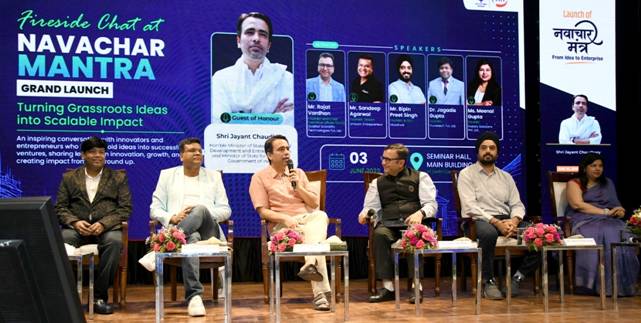
The Navachar Mantra initiative was recently launched by the Ministry of Skill Development and Entrepreneurship (MSDE) to strengthen grassroots entrepreneurship and promote innovation-led growth across India.
- It aims to identify, nurture, and scale promising innovators and early-stage entrepreneurs, particularly from Tier-2 and Tier-3 cities, aspirational districts, and underserved regions.
- The programme is being implemented by the National Institute for Entrepreneurship and Small Business Development (NIESBUD), with the Foundation for Innovation and Technology Transfer (FITT), IIT Delhi serving as the technical knowledge partner.
Key Features
- Navachar Mantra seeks to create a structured support ecosystem for innovators working in sectors such as Agritech, HealthTech, EdTech and Skilling, Climate and Sustainability, Rural Commerce, and MSME Enablement.
- Selected innovators will gain access to policymakers, industry leaders, investors, and domain experts, enabling them to strengthen business models and scale their ventures.
- The initiative includes a year-long engagement programme comprising mentorship, innovation showcases, investor interactions, and capacity-building sessions.
- Participants will also receive support in areas such as market access, intellectual property rights, regulatory compliance, fundraising, and scaling strategies.
- A major focus of the programme is inclusivity, ensuring that innovators from smaller towns and rural areas receive mentorship, visibility, and growth opportunities.
- It also aims to provide national recognition through innovation showcases, digital campaigns, and ecosystem events.
Significance
Navachar Mantra represents an important step towards strengthening India's innovation ecosystem by connecting grassroots innovators with government, academia, industry, and investment networks. By encouraging local solutions to local challenges, it seeks to contribute to the vision of an innovation-driven and entrepreneurial Viksit Bharat.
Tylosaurus rex

- 08 Jun 2026
In News:
Paleontologists have identified a new species of giant marine reptile, Tylosaurus rex, after re-examining previously misidentified fossils. Dubbed the “T. rex of the sea,” it was one of the most formidable marine predators of the Late Cretaceous Period, living around 80 million years ago.
About Tylosaurus rex
Tylosaurus rex is a species of mosasaur, a group of giant carnivorous marine reptiles that dominated the oceans during the age of dinosaurs. Although it shares the title "rex" with Tyrannosaurus rex, it lived millions of years before the land-based dinosaur evolved.
Habitat and Distribution
- Inhabited the Western Interior Seaway, a vast inland sea that divided North America during the Cretaceous Period.
- Fossils have mainly been found in Texas and Kansas.
Key Features
- Largest known specimen ("Bunker") measured 13.2 metres in length.
- Skull length reached 1.7 metres.
- Possessed fine serrated teeth adapted for slicing flesh.
- Had powerful jaws, strong neck muscles, paddle-like flippers, and a muscular tail.
- Closest living relatives are monitor lizards, including the Komodo dragon.
Evolutionary Significance
Mosasaurs evolved from small terrestrial lizards that adapted to marine life, becoming dominant ocean predators during the final 30 million years of the dinosaur age.
Importance of the Discovery
The identification of Tylosaurus rex demonstrates how re-examination of old fossil collections using modern techniques can reveal previously unknown species. As an apex predator, it provides valuable insights into the food webs, biodiversity, and ecology of prehistoric marine ecosystems.
Isobutanol
- 08 Jun 2026
In News:
Following the success of E20 petrol (20% ethanol blending), the Government of India is likely to introduce a mandate for blending isobutanol with diesel by the end of 2026. Since diesel consumption in India is nearly twice that of petrol, the move is expected to significantly enhance energy security, reduce crude oil imports, lower the import bill, and support transport-sector decarbonisation.
What is Isobutanol?
Isobutanol (Isobutyl Alcohol) is an alcohol with the chemical formula C?H??O and one of the four isomers of butanol.
Key Properties
- Colourless, flammable liquid with a characteristic odour.
- Moderately soluble in water.
- Can be produced from biomass through fermentation.
- Less corrosive and less hygroscopic than ethanol.
- Compatible with existing fuel transport and storage infrastructure.
- Suitable as a biofuel for internal combustion engines.
Uses
- Solvent in flavour, fragrance, pharmaceutical, and pesticide industries.
- Used in paints, lacquers, primers, and chemical manufacturing.
- Approved food additive.
- Renewable biofuel derived from plant sources.
Significance of Diesel–Isobutanol Blending
- Reduces dependence on imported crude oil.
- Strengthens India's energy security.
- Supports decarbonisation of the transport sector.
- Promotes biofuel production and rural economic opportunities.
- Expected to have a greater impact than petrol blending due to higher diesel consumption.
Link with Ethanol Blending Programme
India’s ethanol blending programme has expanded from about 1% a decade ago to nearly 20% (E20) today.
Key developments:
- Helped reduce crude oil imports significantly.
- Government has proposed standards for E85 (85% ethanol) and E100 (near-pure ethanol) vehicles.
- Vehicle emission norms are being amended to facilitate higher ethanol blends and alternative fuels.
Related Transport Sector Reforms
The government is simultaneously promoting:
- Electric heavy-duty vehicles through truck-trailer interchangeability and battery-swapping ecosystems.
- Hydrogen mobility, including hydrogen bus services on Delhi–Noida and Delhi–Faridabad routes.
- Multi-Lane Free Flow (MLFF) barrier-free tolling systems.
- Advanced traffic management systems to improve highway efficiency.
Yellow-Throated Marten

- 08 Jun 2026
In News:
The recent first sighting of the Yellow-Throated Marten (Martes flavigula) in Kaziranga National Park highlights the ecological richness of the protected area and reflects the success of Assam's conservation efforts. The discovery expands the known mammalian diversity of the park and indicates the presence of healthy forest ecosystems capable of supporting a wide range of wildlife.
About Yellow-Throated Marten
The Yellow-Throated Marten, also known as Kharza, is the largest of the Old World martens and belongs to the Mustelidae family, which includes otters, badgers, ferrets, and wolverines.
Distribution and Habitat
- Found across the Himalayas, Northeast India, China, Russia, the Korean Peninsula, Southeast Asia, and Indonesia.
- Occupies diverse habitats including coniferous forests, broad-leaved forests, montane forests, tropical forests, shrublands, swamps, and high-altitude regions.
Key Features
- Scientific Name: Martes flavigula
- Body length: 50–72 cm (adult males).
- Distinctive bright yellow or golden throat and chest.
- Dark brown to black head and tail.
- Agile, fearless, and primarily diurnal.
- Omnivorous, feeding on small mammals, birds, insects, fruits, and honey.
Conservation Status
- IUCN Red List: Least Concern (LC)
India’s First Flex-Fuel Passenger Vehicle
- 08 Jun 2026
In News:
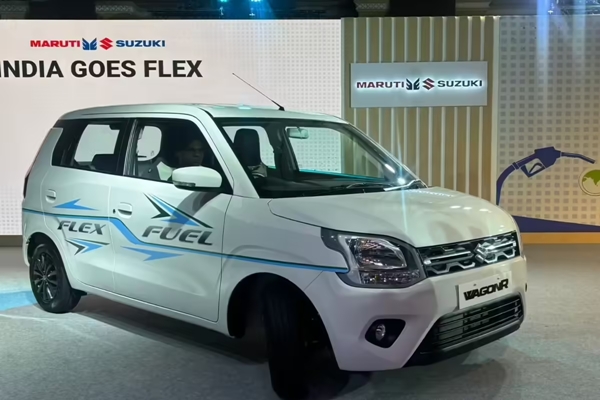
India recently marked a significant milestone in its clean mobility journey with the launch of its first flex-fuel passenger vehicle, developed by Maruti Suzuki. The initiative supports India's broader objectives of enhancing energy security, reducing crude oil imports, promoting ethanol use, and advancing sustainable transportation.
What is a Flex-Fuel Vehicle (FFV)?
A Flex-Fuel Vehicle (FFV) is equipped with an internal combustion engine capable of operating on varying blends of petrol and ethanol. Unlike conventional vehicles, FFVs can seamlessly run on fuels ranging from E20 (20% ethanol) to E100 (100% ethanol).
The vehicle uses a fuel composition sensor that continuously detects the ethanol-petrol ratio and sends this information to the Engine Control Unit (ECU). The ECU automatically adjusts fuel injection and ignition timing to ensure efficient combustion and optimal engine performance regardless of the fuel blend.
Key Features
- Compatible with ethanol-petrol blends from E20 to E100.
- E85 has been identified by NITI Aayog and Bureau of Indian Standards as the standard mono-fuel specification for FFVs.
- Ethanol-based FFVs are viewed as a cleaner alternative to conventional fossil-fuel vehicles due to lower lifecycle emissions.
- Ethanol can be produced domestically from feedstocks such as broken grains, agricultural residues, bamboo, and seaweed, reducing dependence on imported crude oil.
Supporting Ecosystem
To promote adoption, the government plans a phased rollout of FFV-compatible fuel infrastructure, beginning with key corridors such as Delhi-NCR and Mumbai–Pune–Nagpur. The network is expected to expand significantly over the next few years through dedicated ethanol dispensing facilities and supportive policy measures.
Significance
The launch of India's first flex-fuel passenger vehicle represents an important step in the country's energy transition strategy. It complements the Ethanol Blending Programme, supports rural income generation through biofuel production, reduces greenhouse gas emissions, and contributes to the vision of an Atmanirbhar Bharat by promoting domestically produced alternative fuels.