
US Attacks on Ships with Indian Crew
- 16 Jun 2026
In News:
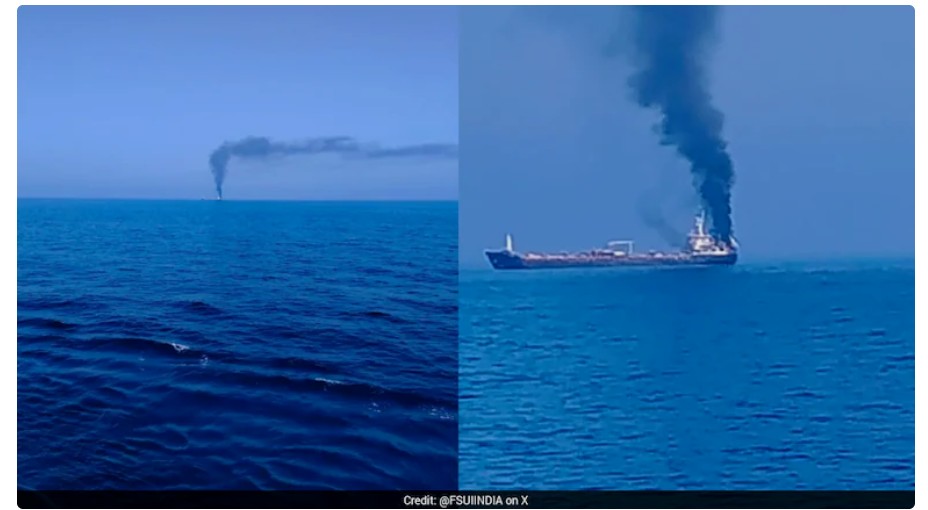
India has strongly condemned a series of military strikes by the US Central Command (CENTCOM) on commercial oil tankers carrying Indian seafarers in the Gulf of Oman and the Strait of Hormuz. Following the death of three Indian nationals in one of the attacks, India summoned the US Chargé d'Affaires to lodge a strong diplomatic protest and called for an immediate cessation of attacks on commercial shipping.
What Happened?
The attacks are linked to the US enforcement of a maritime blockade targeting vessels allegedly transporting Iranian oil in violation of US sanctions.
Three merchant vessels with Indian crew were attacked:
|
Vessel |
Details |
Outcome |
|
MT Marivex |
Oil tanker with 24 Indian seafarers targeted south of the Strait of Hormuz. |
Vessel caught fire; all crew members were rescued. |
|
MT Settebello |
Palau-flagged tanker allegedly carrying Iranian oil. |
Attack resulted in the death of three Indian seafarers and evacuation of the remaining crew. |
|
M/T Jalveer |
Guinea-Bissau-flagged tanker transporting oil through the Gulf of Oman. |
CENTCOM admitted firing two Hellfire missiles into the engine room after alleging non-compliance with its directions. All 20 Indian crew members were reported safe. |
International Maritime Law
The incidents have renewed debate over the legality of using force against commercial shipping.
- Freedom of Navigation (UNCLOS): The United Nations Convention on the Law of the Sea (UNCLOS) guarantees freedom of navigation and the right of innocent passage for commercial vessels through international waters and strategic straits such as the Strait of Hormuz, subject to international law.
- Sanctions vs. Use of Force: While countries may enforce sanctions through inspections, interception or other lawful measures, the use of lethal military force against neutral civilian merchant vessels raises complex issues under international maritime and humanitarian law.
- Diplomatic Demarche: Summoning a foreign diplomat is a formal diplomatic mechanism used to register strong protest while maintaining diplomatic engagement.
Implications for India
The incidents underscore India's growing vulnerability to geopolitical tensions in West Asia, where thousands of Indian seafarers serve aboard international merchant vessels.
- Creates diplomatic challenges in balancing the India–US strategic partnership with the protection of Indian nationals overseas.
- Heightens security risks for Indian seafarers operating in the Gulf of Oman and Strait of Hormuz.
- May discourage recruitment of seafarers, leading to workforce shortages and higher operating costs.
- Escalates war-risk insurance premiums, freight charges and global energy transportation costs, affecting India's energy security and import bill.
- Reinforces the need for secure Sea Lines of Communication (SLOCs) and freedom of navigation in the Indo-Pacific.
Way Forward
India is likely to continue pursuing diplomatic engagement, strengthening maritime safety mechanisms, and coordinating with regional partners to safeguard its seafarers and commercial interests. At the international level, ensuring respect for UNCLOS, protecting civilian shipping, and promoting dialogue remain essential for preserving stability in one of the world's most critical maritime corridors.
Supreme Court Invokes Article 142 to Quash POCSO Conviction
- 16 Jun 2026
In News:
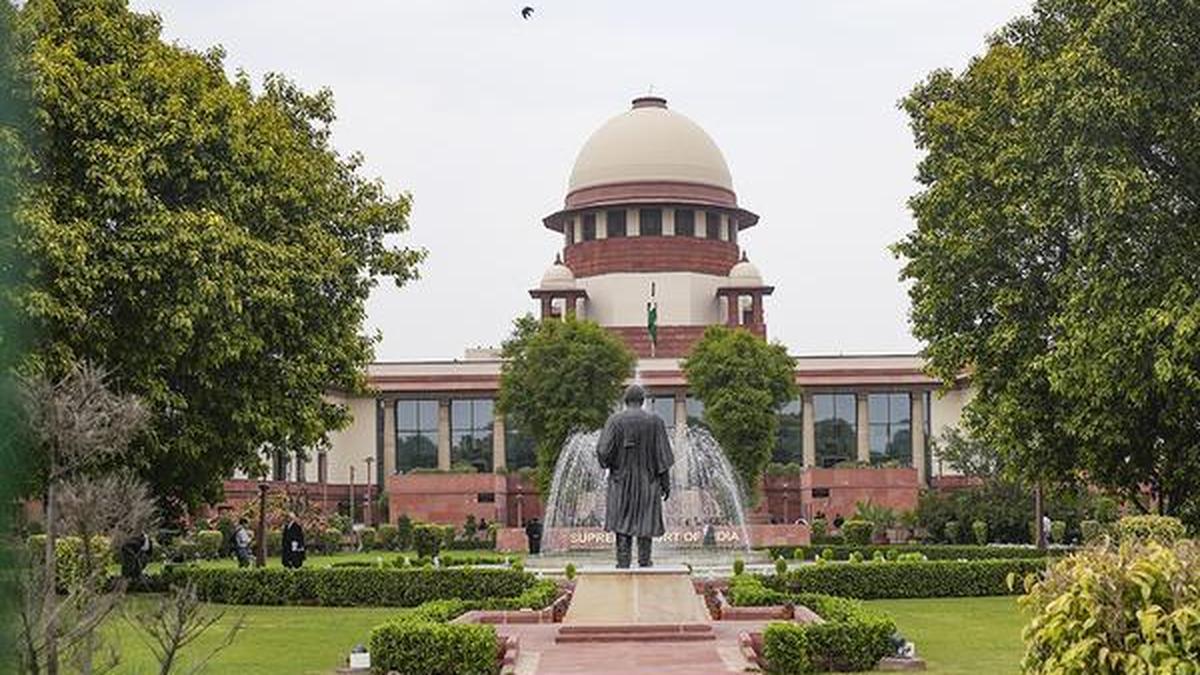
The Supreme Court invoked its extraordinary powers under Article 142 of the Constitution to set aside the conviction of a man under the Protection of Children from Sexual Offences (POCSO) Act, 2012, noting that the victim had subsequently attained majority, married him, and the continuation of the conviction would not serve the ends of justice.
The Court clarified that the decision was based on the peculiar facts of the case and should not be treated as a precedent for similar cases.
Article 142 of the Constitution
- Article 142 empowers the Supreme Court to pass any decree or order necessary for doing "complete justice" in any matter pending before it. Such orders are binding throughout India and are enforceable in the same manner as decrees of a civil court.
- While Article 142 grants wide discretionary powers, the Court has consistently held that these powers cannot ordinarily override substantive statutory provisions and must be exercised sparingly and in exceptional circumstances to ensure justice.
Protection of Children from Sexual Offences (POCSO) Act, 2012
The POCSO Act, 2012 is a comprehensive legislation enacted to protect children below 18 years from sexual assault, sexual harassment, and pornography, while ensuring child-friendly procedures for reporting, investigation, and trial. The Act was enacted following India's obligations under the UN Convention on the Rights of the Child (UNCRC), ratified in 1992.
Key Features of the POCSO Act
- Gender-neutral legislation: Protects both boys and girls from sexual offences.
- Child-friendly justice system: Provides special procedures for recording statements, investigation, evidence, and trial to minimise trauma.
- POCSO Rules, 2020: Strengthen implementation through institutional safeguards, reporting mechanisms, and victim support services.
- Confidentiality of identity:Section 23 prohibits disclosure of any information that may reveal the identity of the child victim, including by the media.
- Mandatory reporting:Sections 19–22 make it mandatory for any person having knowledge or reasonable suspicion of an offence to report it to the authorities.
- Stringent punishments: Prescribes graded penalties depending on the gravity of the offence. The Protection of Children from Sexual Offences (Amendment) Act, 2019 introduced harsher punishments, including the death penalty for certain aggravated penetrative sexual assaults.
Significance of the Judgment
The judgment highlights the Supreme Court's constitutional responsibility to balance strict statutory mandates with the broader objective of doing complete justice in exceptional cases. At the same time, the Court reaffirmed that POCSO is a welfare legislation enacted to protect children and that the exercise of powers under Article 142 cannot dilute the legislative intent or undermine child protection. By emphasizing that the ruling is confined to the unique facts of the case, the Court sought to preserve the deterrent purpose and integrity of the POCSO framework.
Delimitation of Parliamentary Constituencies

- 16 Jun 2026
In News:
The Economic Advisory Council to the Prime Minister (EAC-PM) has released a working paper proposing a targeted approach to the next delimitation exercise. Instead of relying solely on population, it recommends using multiple demographic and electoral indicators while broadly retaining the existing proportion of Lok Sabha seats among large States.
What are the Recommendations?
The EAC-PM paper suggests that the upcoming delimitation should move beyond a uniform population-based formula and adopt a multi-factor methodology to improve representational equity.
The study analysedLok Sabha election data (2009–2024) and found that constituency size alone does not adequately explain representation. It recommends that the Delimitation Commission consider five additional compositional features while deciding whether a constituency should be split:
- Urban population share
- Scheduled Caste (SC) population share
- Scheduled Tribe (ST) population share
- Linguistic polarisation
- Linguistic diversity
According to the paper, delimitation should be undertaken only after:
- A fresh booth rationalisation exercise,
- Publication of 2027 Census data, and
- Availability of gender-disaggregated electoral statistics to improve accuracy.
The proposed model also indicates that all major States could witness nearly a 50% increase in Lok Sabha seats while broadly preserving the existing inter-state proportion of representation.
What is Delimitation?
Delimitation is the process of redrawing the boundaries of Lok Sabha and State Legislative Assembly constituencies to ensure that each constituency represents a nearly equal population, thereby upholding the democratic principle of "one person, one vote, one value." It also involves the allocation of seats among States based on constitutional provisions.
Constitutional and Legal Framework
|
Provision |
Details |
|
Article 82 |
Parliament shall enact a Delimitation Act after every Census for readjustment of Lok Sabha seats. |
|
Article 170 |
Provides for readjustment of seats and constituencies in State Legislative Assemblies. |
|
Delimitation Commission |
Independent statutory body appointed by the Central Government. |
|
Composition |
Chairperson (Serving/Retired Supreme Court Judge), Chief Election Commissioner (or nominee), and State Election Commissioners of the concerned States. |
|
Nature of Orders |
Have the force of law, cannot be challenged in any court, and cannot be modified by Parliament or State Legislatures. |
History of Delimitation
- India has constituted the Delimitation Commission four times—1952, 1963, 1973, and 2002.
- The 42nd Constitutional Amendment Act, 1976 froze the allocation of Lok Sabha seats among States based on the 1971 Census to ensure that States successfully implementing population control measures were not disadvantaged through reduced parliamentary representation.
- The 84th Constitutional Amendment Act, 2001 extended this freeze until the first Census conducted after 2026. Consequently, while the 2002 Delimitation Commission redrew constituency boundaries using the 2001 Census, the inter-state allocation of Lok Sabha seats continues to be based on the 1971 Census.
Great Nicobar Island Project
- 16 Jun 2026
In News:
The Andaman and Nicobar Islands Administration has notified the Rehabilitation and Resettlement (R&R) Census for families likely to be affected by the trunk infrastructure component of the Great Nicobar Island Project, marking the commencement of the project's implementation phase.
About the Great Nicobar Island Project
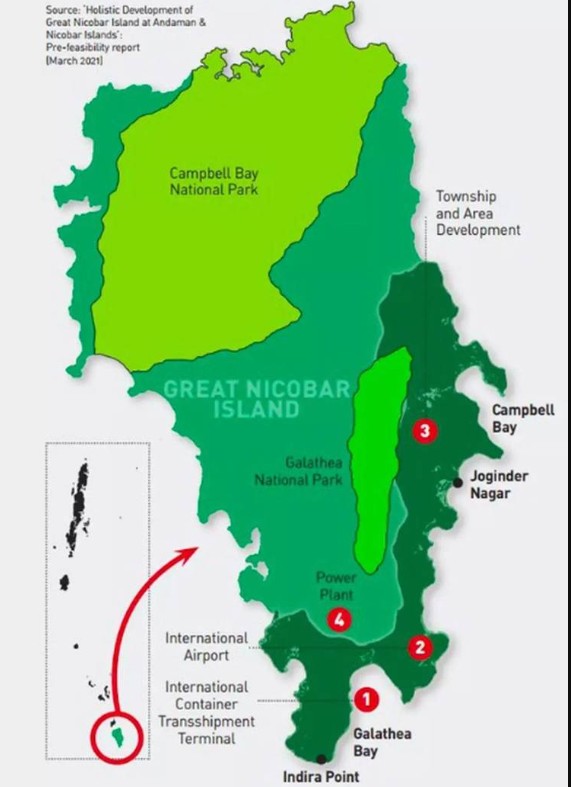
The Great Nicobar Island Project is a flagship infrastructure initiative aimed at transforming Great Nicobar Island into a strategic economic and maritime hub in the Bay of Bengal. Estimated at ?92,000 crore, the project has a long-term implementation timeline extending up to 2050. It seeks to combine economic development with enhanced maritime security and regional connectivity in the Indo-Pacific.
The trunk infrastructure, comprising the main road network and associated public utilities, constitutes the first phase of the project. The ongoing R&R Census aims to identify and verify families affected by this component to facilitate rehabilitation and resettlement in accordance with applicable laws.
Major Components
- International Container Transhipment Port
- Greenfield International Airport
- Power Generation Infrastructure
- Greenfield Township with tourism and urban infrastructure
- Defence and strategic infrastructure
Strategic Significance
The project is envisioned as a model of frontier infrastructure development in ecologically sensitive and strategically important regions. Located near the Malacca Strait, one of the world's busiest Sea Lines of Communication (SLOCs), Great Nicobar occupies a critical position in the Indo-Pacific. The project is expected to:
- Strengthen India's maritime security and naval logistics.
- Enhance India's role in regional transhipment and global supply chains.
- Boost connectivity under the SAGAR (Security and Growth for All in the Region) vision.
- Promote economic development and employment through tourism and port-led growth.
Concerns
Despite its strategic benefits, the project has generated significant environmental and social concerns:
- Potential displacement and livelihood impacts on the Nicobarese and the Shompen, particularly the vulnerable Shompen Tribal Reserve.
- Ecological risks to one of India's richest biodiversity hotspots, including tropical rainforests, mangroves, coral reefs and endemic species.
- Concerns regarding deforestation, habitat fragmentation and increased human intervention in a fragile island ecosystem.
- In 2024, the Public Investment Board (PIB) observed that the proposed transhipment port lacked clearly defined strategic objectives; however, the Ministry of Defence subsequently reaffirmed the project's strategic importance for national security and regional development.
Way Forward
The project's long-term success will depend on balancing strategic infrastructure development with ecological conservation and the constitutional rights of indigenous communities. Transparent rehabilitation, rigorous environmental safeguards, continuous stakeholder consultation, and sustainable development practices will be essential to ensure that national security objectives are achieved without compromising the island's unique ecological and cultural heritage.
Credit Guarantee Scheme for Micro Finance Institutions 2.0
- 16 Jun 2026
In News:
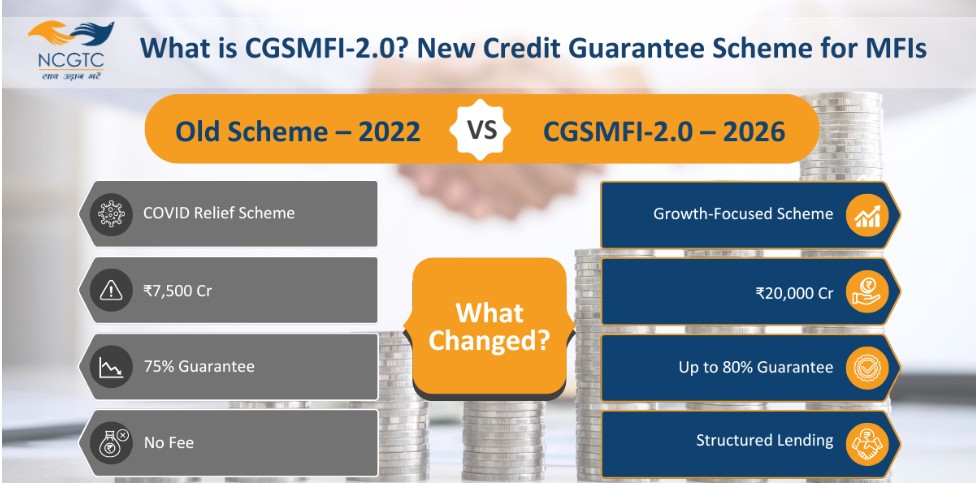
The Government of India has extended the Credit Guarantee Scheme for Micro Finance Institutions (CGSMFI-2.0) till 31 August 2026 or until guarantees worth ?20,000 crore are issued, whichever is earlier. It has also increased the maximum loan limit for large NBFC-MFIs/MFIs from ?300 crore to ?1,000 crore (subject to 20% of AUM). As of now, ?770 crore of loans have been sanctioned under the scheme.
About CGSMFI-2.0
Launched in March 2026, CGSMFI-2.0 is a government-backed credit guarantee scheme that provides guarantee coverage to Member Lending Institutions (MLIs) for loans extended to NBFC-MFIs and other eligible MFIs. These institutions, in turn, provide microcredit to eligible borrowers as per the RBI's microfinance norms. The scheme is implemented through the National Credit Guarantee Trustee Company Ltd. (NCGTC) using an automatic approval mechanism, reducing the credit risk for lenders and encouraging greater flow of institutional finance to the microfinance sector.
Key Features
- Extended till 31 August 2026 or guarantee issuance of ?20,000 crore, whichever is earlier.
- Funds can be used only for incremental lending to eligible microfinance borrowers.
- Loans must be disbursed within three months and have a maximum tenure of three years, including a one-year moratorium.
- To ensure balanced credit distribution, MLIs must allocate at least 5% of total loans to small MFIs and 10% to medium MFIs.
Differential Guarantee Coverage
|
Category |
AUM |
Guarantee Coverage |
|
Small MFI |
Less than ?500 crore |
80% |
|
Medium MFI |
?500 crore to < ?2,000 crore |
75% |
|
Large MFI |
?2,000 crore and above |
70% |
The earlier scheme provided a uniform 75% guarantee, whereas CGSMFI-2.0 offers higher protection to smaller institutions to improve credit access in underserved areas.
Loan Limits
|
Category |
Maximum Loan Limit |
|
Small MFI |
?100 crore |
|
Medium MFI |
?200 crore |
|
Large MFI |
?1,000 crore (revised from ?300 crore), subject to 20% of AUM |
Microfinance Institutions (MFIs)
MFIs are financial intermediaries that provide small, collateral-free loans and financial services to low-income households, particularly in rural and semi-urban areas, thereby promoting financial inclusion, livelihood generation, and women’s empowerment. They function primarily as NBFC-MFIs or cooperative/NGO-led institutions.
Key features include:
- Target beneficiaries: Low-income households, women, small entrepreneurs, and informal workers.
- Loan size: Generally ?5,000–?1,00,000.
- Delivery models: Joint Liability Groups (JLGs) and Self-Help Groups (SHGs).
- Regulation:RBI regulates NBFC-MFIs, while NABARD supports and refinances the SHG-Bank Linkage Programme.