
Typhoon Bavi

- 13 Jul 2026
In News:
Typhoon Bavi, a powerful tropical cyclone in the Western Pacific, has put Japan's southwestern Sakishima Islands and Taiwan on high alert as it moves across the East China Sea towards China's eastern coast.
About Typhoon Bavi
Typhoon Bavi (designated Tropical Cyclone 09W by the Joint Typhoon Warning Center) is one of the largest tropical cyclones to form in the Western Pacific in recent decades. According to the source, it measures nearly 1,000 km in width and covers a storm area of about 940,000 sq. km.
It formed over the open Pacific Ocean and initially impacted Guam and the Northern Mariana Islands, before moving towards Japan's Sakishima Islands, Taiwan, and the eastern coast of China.
Formation of Typhoon Bavi
The system originated as a tropical disturbance east-southeast of Kwajalein on 25 June 2026. It rapidly intensified over the Philippine Sea due to highly favourable atmospheric and oceanic conditions:
- Sea Surface Temperature (SST): 29°C–30°C
- Very low vertical wind shear: 5–10 knots
- High mid-level atmospheric humidity
These conditions provided abundant heat and moisture, enabling the cyclone to strengthen into a severe typhoon.
Naming of Typhoon Bavi
The name "Bavi" was contributed by Vietnam to the World Meteorological Organization (WMO) Typhoon Committee's list of tropical cyclone names.
The name refers to the Ba Vì Mountain Range, a biodiversity-rich mountain range located near Hanoi, Vietnam.
Bintang Adipurna

- 13 Jul 2026
In News:
Prime Minister Narendra Modi was recently conferred 'Bintang Adipurna' (First Class of the Star of the Republic of Indonesia), Indonesia's highest civilian honour, in recognition of his contribution to strengthening the strategic partnership and bilateral relations between India and Indonesia.
About Bintang Adipurna
The Bintang Adipurna is the highest civilian honour of the Republic of Indonesia, conferred by the President of Indonesia. It is awarded to individuals who have rendered exceptional service towards the unity, continuity and prosperity of Indonesia.
In the case of foreign dignitaries, the award recognizes their outstanding contribution to promoting friendship, mutual respect and cooperation between Indonesia and other nations.
Salient Features
The insignia of the award carries important national symbols that reflect Indonesia's identity and values.
- Consists of a shining gold star with multiple rays symbolisingexcellence, honour and distinguished service.
- The centre bears the Garuda Pancasila, the national emblem of Indonesia, representing the country's sovereignty and the Five Principles (Pancasila).
- It is worn with a ceremonial red-and-white sash, representing the national colours of Indonesia.
- A star badge is also worn during official state ceremonies.
Vikramshila University Set for Revival in Bihar

- 13 Jul 2026
In News:
After the revival of Nalanda University, another renowned ancient centre of learning, Vikramshila University, is set to be revived in Bihar. The Archaeological Survey of India (ASI) is developing the archaeological site to promote heritage tourism, while the Bihar Government has identified 202.14 acres at Antichak village (Bhagalpur) for establishing a Central University. The project was approved by the Centre in 2015 with an initial outlay of ?500 crore, but was delayed due to land acquisition issues.
About Vikramshila University
- Vikramshila University was established by King Dharmapala of the Pala Dynasty during the late 8th–early 9th century AD.
- Situated on the banks of the River Ganga in present-day Bhagalpur, Bihar, it emerged as one of the great Mahaviharas (Buddhist universities) of ancient India and became an internationally renowned centre of higher learning.
- The university was founded to restore excellence in Buddhist education and soon gained prominence as the foremost centre of Vajrayana (Tantric) Buddhism, complementing the broader academic tradition of Nalanda University.
Salient Features
Vikramshila attracted over 1,000 students and around 100 teachers from different parts of Asia, reflecting its global academic reputation. It also produced eminent scholars such as Atisa Dipankara, whose teachings played a significant role in the spread of Buddhism in Tibet.
Some important features include:
- Built around a central stupa surrounded by 208 monastic cells.
- Possessed a library with a unique water-based cooling system to preserve manus.
- Offered education in philosophy, theology, grammar, logic, metaphysics and tantras.
- The university was headed by a Kulpati (Mahasthavir).
Decline
Vikramshila University was destroyed by Muhammad Bin Bakhtiyar Khalji around 1203 AD, the same invasion that led to the destruction of Nalanda University, bringing an end to one of India's greatest centres of Buddhist learning.
Greater One-Horned Rhinoceros
- 13 Jul 2026
In News:
The Central Government has approved a landmark conservation initiative to establish a DNA-based indexing system for the Greater One-Horned Rhinoceros (Indian Rhinoceros). The initiative aims to strengthen wildlife conservation by creating a genetic database to combat poaching, enable scientific monitoring, and improve long-term management of rhino populations.
What is DNA-Based Indexing?
DNA-based indexing involves creating a genetic profile of individual rhinos using DNA samples. This genetic database helps authorities:
- Identify individual rhinos with precision.
- Trace the origin of seized rhino horns and wildlife products.
- Strengthen anti-poaching investigations and support prosecution.
- Monitor genetic diversity, breeding patterns, and population health.
- Assist in scientific conservation planning and habitat management.
About the Greater One-Horned Rhinoceros
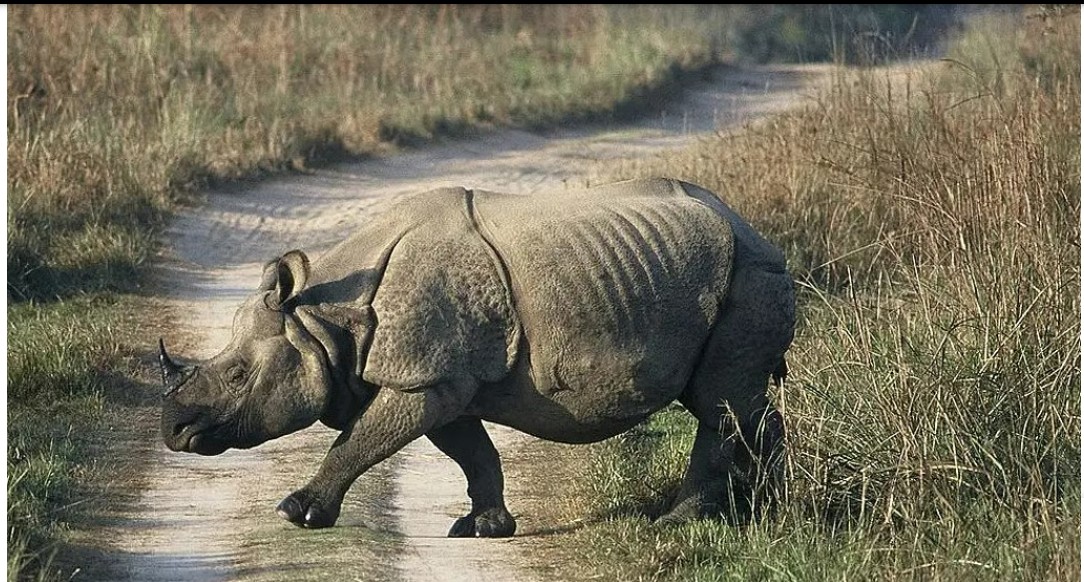
- The Greater One-Horned Rhinoceros (Rhinoceros unicornis), also known as the Indian Rhinoceros, is the largest of the three Asian rhinoceros species and is one of India's flagship conservation success stories.
- It inhabits semi-aquatic ecosystems, including grasslands, swamps, riverine forests, floodplains, and areas near mineral licks.
- Historically, the species ranged across the Indus, Ganga, and Brahmaputra river floodplains, but its distribution is now restricted mainly to India and Nepal, particularly in the foothills of the Himalayas.
- Kaziranga National Park (Assam) supports the largest population of the Greater One-Horned Rhinoceros in the world.
Key Features
- The species is distinguished by its single black horn and grey-brown skin with prominent folds, giving it an armour-plated appearance.
- It is generally solitary, except for females accompanied by calves, while adult males maintain loosely defended territories.
- Being herbivorous, it feeds on grasses, leaves, fruits, branches, aquatic vegetation, and occasionally cultivated crops.
Threats
Despite significant recovery in population, the Greater One-Horned Rhinoceros continues to face several threats:
- Poaching for its horn remains the biggest threat.
- Habitat loss and fragmentation.
- Human–wildlife conflict.
- Floods and invasive species in protected habitats.
Conservation Status
- IUCN Red List: Vulnerable
- CITES: Appendix I
- Wildlife (Protection) Act, 1972: Schedule I
Global Liveability Index 2026

- 13 Jul 2026
In News:
The Global Liveability Index 2026, released by the Economist Intelligence Unit (EIU), ranked New Delhi at 120th among 173 cities worldwide, making it the highest-ranked Indian city in this year's index.
What is the Global Liveability Index?
The Global Liveability Index is an annual report that assesses the quality of everyday living conditions in cities across the world. Unlike indices based on economic performance or tourism, it evaluates how suitable a city is for residents by measuring various aspects of urban life.
The index covers 173 cities and evaluates them using 30 qualitative and quantitative indicators, assigning each city a score on a scale of 1–100.
Assessment Parameters
The overall liveability score is based on five broad categories:
- Stability – 25%
- Culture & Environment – 25%
- Healthcare – 20%
- Infrastructure – 20%
- Education – 10%
Key Highlights of the 2026 Report
- The global average liveability score remained unchanged at 76.1, indicating stable living conditions across major cities despite geopolitical and economic challenges.
- Among all assessment categories, healthcare recorded the highest year-on-year improvement, with an average increase of 0.74 points.
- Copenhagen (Denmark) emerged as the world's most liveable city, replacing Vienna, followed by Vienna (Austria) and Melbourne (Australia).
India's Performance
Among Indian cities, New Delhi ranked 120th, followed by Mumbai (121st), Chennai (123rd) and Bengaluru (127th).
The rankings reflect improvements in certain urban services but also highlight persistent challenges related to infrastructure, traffic congestion, pollution, housing, public transport and urban governance, which continue to affect the overall liveability of Indian cities.