
RBI Surplus Transfer to the Government & Economic Capital Framework (ECF)
- 21 Jun 2026
In News:
The Reserve Bank of India (RBI) approved a record surplus transfer of ?2.87 lakh crore to the Union Government for FY 2025–26, the highest ever, surpassing the previous record of ?2.11 lakh crore. The transfer has renewed debate on the RBI's expanding fiscal role, central bank independence, and fiscal federalism.
What is RBI Surplus Transfer?
- The Reserve Bank of India earns income from interest on government securities, foreign exchange reserves, liquidity management operations, and returns on its investments.
- After meeting its operational expenses and maintaining the prescribed risk buffers under the Economic Capital Framework (ECF), the remaining surplus is transferred to the Government of India as non-tax revenue.
- Traditionally, annual transfers ranged between ?30,000 crore and ?65,000 crore. However, following the adoption of the revised Economic Capital Framework in 2019, surplus transfers have increased substantially, reaching ?2.11 lakh crore in FY24 and ?2.87 lakh crore in FY26.
Economic Capital Framework (ECF)
- The Economic Capital Framework (ECF) was recommended by the Bimal Jalan Committee and adopted by the RBI in 2019. It provides a transparent and rule-based mechanism for determining the level of capital and risk buffers the RBI should maintain before transferring surplus to the government.
- The framework seeks to balance financial stability with the government's fiscal requirements by ensuring that the RBI retains adequate resources to absorb potential financial, monetary, and exchange rate risks.
Major Components of the ECF
|
Component |
Provision |
|
Contingent Risk Buffer (CRB) |
4.5%–7.5% of the RBI balance sheet to absorb monetary and financial stability risks. |
|
Contingency Fund (CF) |
5.5%–6.5% of the balance sheet to meet unforeseen losses; surplus beyond this can be transferred. |
|
Economic Capital (including CGRA) |
20.8%–25.4% of the balance sheet, covering capital, reserves, and revaluation balances. |
|
Review Cycle |
Every five years; first review undertaken in 2025. |
Why has the Surplus Increased?
The sharp increase reflects the rapid expansion of the RBI's balance sheet, which grew by 20.6% to ?91.97 lakh crore by March 2026. Higher income from foreign exchange reserve management, government securities, and gold and foreign asset rebalancing significantly boosted the central bank's earnings, enabling a larger surplus transfer while remaining within the ECF-prescribed risk buffer limits.
Significance
The record dividend strengthens the Union Government's fiscal position by providing substantial non-tax revenue, thereby supporting fiscal consolidation and reducing dependence on market borrowings. Lower government borrowing helps moderate Government Security (G-Sec) yields, easing financing costs across the economy. It also creates fiscal space to sustain capital expenditure on infrastructure while adhering to Fiscal Responsibility and Budget Management (FRBM) targets.
Energy Transition Index (ETI) 2026

- 21 Jun 2026
In News:
India improved its position by two places to rank 70th in the Energy Transition Index (ETI) 2026, released by the World Economic Forum (WEF), reflecting progress in balancing energy security, sustainability, and affordability while advancing towards a cleaner energy system.
What is the Energy Transition Index (ETI)?
The Energy Transition Index (ETI) is an annual global assessment published by the World Economic Forum (WEF) to evaluate how effectively countries are progressing towards secure, sustainable, equitable, and resilient energy systems. Besides measuring the current performance of a country's energy system, the index also assesses the readiness of its policy, financial, institutional, and infrastructure ecosystem to support the energy transition.
The ETI score is calculated on a 0–100 scale, where 100 represents the highest level of performance.
Methodology
The index is based on two broad sub-indices:
- System Performance (60%), which assesses the current energy system across three equally weighted dimensions:
- Energy Security
- Environmental Sustainability
- Energy Equity (Affordability and Access)
- Transition Readiness (40%), which evaluates a country's preparedness to accelerate the energy transition through:
- Core Enablers: Regulation, political commitment, finance and investment.
- Enabling Factors: Innovation, infrastructure, education, and human capital.
Key Findings of ETI 2026
The Nordic countries continued to dominate the rankings, with Sweden, Finland, and Denmark retaining the top three positions globally owing to their advanced clean energy systems and supportive policy frameworks.
Among major economies, Singapore registered one of the largest improvements by climbing 10 places to 42nd, driven by stronger regulatory reforms and political commitment towards clean energy.
Six G20 economies featured among the global top twenty:
- Germany – 9th
- France – 10th
- United Kingdom – 11th
- China – 14th
- Brazil – 17th
- United States – 19th
India improved its ranking from 72nd to 70th, reflecting gradual progress in expanding renewable energy, improving energy access, and strengthening the policy framework supporting the clean energy transition.
Drunix Platform

- 21 Jun 2026
In News:
The National Payments Corporation of India (NPCI) has launched Drunix, an enterprise-grade Distributed Ledger Technology (DLT) platform to support large-scale deployment of blockchain-based applications, digital assets, and tokenization ecosystems.
What is Drunix?
Drunix is an enterprise-grade private blockchain framework developed by NPCI to enable organizations to build, deploy, and scale tokenization platforms, digital asset ecosystems, and multi-organization blockchain networks.
Built as a high-performance enhanced fork of Hyperledger Fabric, Drunix is designed to deliver high scalability, low latency, and optimized performance, making it suitable for enterprise applications as well as public digital infrastructure. The platform aims to facilitate secure, interoperable, and large-scale blockchain adoption across sectors.
Key Features
Drunix has been developed with a focus on enterprise deployment and offers:
- High scalability for large-volume transactions and enterprise networks.
- Support for tokenization of digital and real-world assets.
- Creation of multi-organization blockchain ecosystems with secure data sharing.
- Optimized performance for public infrastructure and financial applications.
- Enterprise-grade security and interoperability.
- Built on an enhanced version of Hyperledger Fabric, an open-source blockchain framework developed under the Linux Foundation.
What is Blockchain Technology?
Blockchain, also known as Distributed Ledger Technology (DLT), is a decentralized digital ledger that records transactions across multiple computers, ensuring transparency, security, and tamper resistance without relying on a central authority.
Instead of maintaining a single centralized database, every participating node maintains a synchronized copy of the ledger, making records highly secure and verifiable.
Key Features of Blockchain
- Distributed Ledger: Data is stored simultaneously across multiple nodes in a peer-to-peer network.
- Immutability: Once recorded, data cannot be altered easily due to cryptographic hashing.
- Security: Transactions are protected using cryptography, hashing, and digital signatures.
- Consensus Mechanism: Transactions are validated only after agreement among participating nodes.
- Decentralization: No single entity exercises complete control over the network.
The Dancing Girl of Mohenjo-daro

- 21 Jun 2026
In News:
The National Council of Educational Research and Training (NCERT) announced that it will replace a retouched image of the iconic 'Dancing Girl' of Mohenjo-daro in its new Class 9 Art textbook, following criticism from historians and archaeologists regarding the alteration of a significant cultural artifact.
About the Dancing Girl of Mohenjo-daro
The Dancing Girl is one of the finest surviving examples of Indus Valley (Harappan) art and among the most celebrated archaeological discoveries from the Bronze Age. The bronze statuette, measuring about 10.5 cm (4 inches) in height, depicts a slender young female figure and is regarded as an enduring symbol of the artistic excellence and metallurgical skills of the Harappan Civilization.
The figurine was discovered in 1926 during excavations at Mohenjo-daro (present-day Sindh, Pakistan) by John Marshall, who named it the "Dancing Girl" because its posture resembled that of contemporary nautch dancers. It is generally dated to around 2500 BCE (approximately 2700–2100 BCE).
Today, the original artifact is preserved in the National Museum, New Delhi.
Key Features
The sculpture is notable for its remarkable realism and artistic sophistication.
Its distinctive features include:
- A natural contrapposto posture, with body weight resting mainly on one leg, giving the figure a dynamic and lifelike appearance.
- The right hand is placed on the hip, while the left arm hangs freely by the side.
- The left arm carries about 24 bangles, whereas the right arm bears only four bangles and a bracelet, reflecting asymmetrical ornamentation.
- A cowry-shell necklace adorns the neck.
- Hair is arranged in a coiled bun at the back of the head.
- The upward-tilted face conveys confidence and individuality.
Artistic and Historical Significance
The statuette is an outstanding example of the lost-wax (cire perdue) casting technique, demonstrating the advanced metallurgical knowledge of the Harappans. Crafted from a copper-tin bronze alloy, it reflects sophisticated understanding of alloy preparation and bronze casting.
Unlike the majority of Harappan human figurines, which were made of terracotta, the Dancing Girl is a free-standing bronze sculpture, making it unique within the corpus of Indus Valley art.
Although traditionally identified as a dancer, scholars have also interpreted the figure as representing a warrior, a young woman, or an individual of particular social or ethnic identity, indicating that its precise cultural significance remains open to interpretation.
Bharat Climate Observation Network
- 21 Jun 2026
In News:
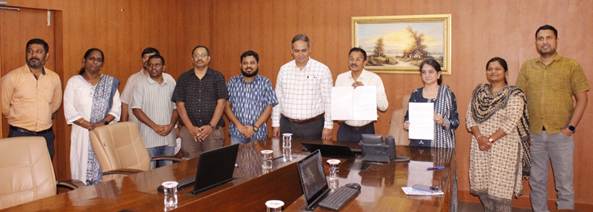
The Indian Institute of Tropical Meteorology (IITM), Pune and the Aryabhatta Research Institute of Observational Sciences (ARIES), Nainital have signed a long-term Memorandum of Understanding (MoU) to establish a climate observation station in the Himalayan region under the Bharat Climate Observation Network (BCON).
What is the Bharat Climate Observation Network (BCON)?
The Bharat Climate Observation Network (BCON) is a national climate observation initiativeconceptualised and implemented by the Indian Institute of Tropical Meteorology (IITM) under the Ministry of Earth Sciences (MoES). It aims to establish a high-precision, long-term climate monitoring network across India to generate reliable observational data for climate research, modelling, and policymaking.
The proposed Himalayan observation station will strengthen climate monitoring in one of the world's most climate-sensitive regions and improve understanding of mountain ecosystems and regional climate variability.
Key Functions
BCON is designed to create a comprehensive observational framework by monitoring multiple components of the Earth's climate system. It will:
- Monitor meteorological parameters such as temperature, rainfall, humidity, wind, and pressure.
- Measure climate-active trace gases, including greenhouse gases (GHGs) and Short-Lived Climate Forcers (SLCFs).
- Observe atmospheric chemistry and soil moisture, enabling a better understanding of climate processes.
- Develop a national climate database for detecting long-term climate trends and supporting evidence-based policymaking.
Significance
The high-quality datasets generated through BCON will serve as an important scientific resource for climate change research, enabling more accurate assessment of India's changing climate.
The network will also provide critical observational data for the validation and benchmarking of Earth System Models (ESMs), including India's first indigenous Earth System Model (IITM-ESM). Improved model validation will enhance simulations of the Indian climate, strengthen future climate projections, and support disaster risk reduction, climate adaptation, and sustainable development planning.
The establishment of observation stations in ecologically sensitive regions such as the Himalayas is particularly significant, as these regions are highly vulnerable to climate change and influence India's monsoon, river systems, and water security.