
Bharat Maritime Insurance Pool
- 20 Apr 2026
In News:
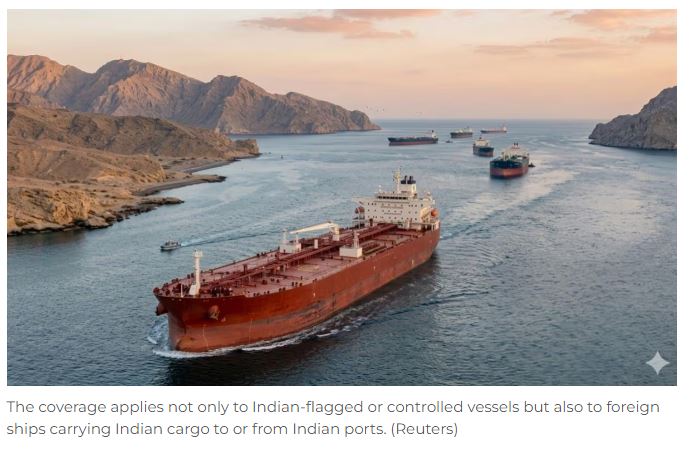
In a strategic move to insulate its seaborne trade from the volatility of global geopolitics, the Union Cabinet has approved the creation of the Bharat Maritime Insurance Pool (BMI Pool). With a substantial financial backing of ?12,980 crore, this domestic safety net is designed to ensure that India's supply chains remain resilient, even when international insurance markets become restrictive or volatile.
The Need for a Domestic Insurance Pool
Global maritime trade is frequently subjected to disruptions, ranging from regional conflicts in the Red Sea and the Strait of Hormuz to international sanctions. Traditionally, Indian shipping has been heavily dependent on global insurance conglomerates, particularly the International Group of P&I Clubs. During crises, these entities may hike premiums or withdraw coverage for "high-risk" zones, leaving Indian trade vulnerable. The BMI Pool serves as a sovereign-backed alternative to mitigate such external dependencies.
Key Features of the BMI Pool
1. Financial and Sovereign Backing: The pool is supported by a sovereign guarantee of ?12,980 crore. This government backing provides the necessary financial credibility to honor large-scale claims, which is essential for building trust among shipowners and international trade partners.
2. Scope of Coverage: The BMI Pool is comprehensive in its risk assessment. It covers:
- Hull and Machinery: Insurance for the physical structure and equipment of the ship.
- Cargo Insurance: Protection against the loss or damage of goods being transported.
- Protection and Indemnity (P&I): Coverage for third-party liabilities.
- War Risk Insurance: Critical coverage for vessels navigating through active conflict zones or volatile maritime routes.
3. Eligibility and Tenure: The scheme is inclusive of:
- Indian-flagged vessels.
- Indian-controlled ships.
- International vessels carrying cargo specifically destined for or originating from Indian ports.
The initiative is set for an initial duration of 10 years, with a provision for a five-year extension based on performance and necessity.
Strategic Significance for India
1. Enhancing Strategic Autonomy: By creating a domestic pool, India reduces its reliance on Western-dominated insurance markets. This is particularly vital when navigating trade routes impacted by unilateral sanctions or regional instabilities, ensuring that India's energy security and export-import (EXIM) trade are not held hostage to global market fluctuations.
2. Strengthening Domestic Expertise: The BMI Pool will serve as a catalyst for developing homegrown expertise in maritime underwriting and claims management. Currently, a significant portion of insurance premiums flows out of the country; this initiative aims to retain that capital while building a robust domestic financial services ecosystem in the maritime sector.
3. Ensuring Trade Continuity: During global disruptions, the pool guarantees "uninterrupted and affordable" coverage. This prevents sudden spikes in freight costs, which otherwise lead to inflationary pressures on the Indian economy.
Pradhan Mantri Gram Sadak Yojana-III (PMGSY-III)
- 20 Apr 2026
In News:
In a significant move to bolster rural infrastructure and economic resilience, the Union Cabinet has approved the continuation of the Pradhan Mantri Gram Sadak Yojana-III (PMGSY-III) beyond its initial deadline of March 2025. The scheme has now been extended until March 2028, with a revised financial outlay of ?83,977 crore. This extension underscores the government’s commitment to "Viksit Bharat 2047" by ensuring that the last-mile connectivity in rural India is not just established but modernized to meet contemporary socio-economic needs.
Core Framework of the PMGSY Initiative
Launched on December 25, 2000, PMGSY is a flagship rural development program under the Ministry of Rural Development. Its primary mandate is to provide single, all-weather road connectivity to eligible unconnected habitations.
Eligibility and Population Thresholds (Based on 2001 Census):
- Plain Areas: Habitations with a population of 500 or more.
- Special Category Areas: In North-Eastern states, Himalayan states, and Himalayan Union Territories, the threshold is reduced to 250 or more due to difficult terrain and strategic importance.
PMGSY-III: A Shift Toward Consolidation
While the earlier phases of PMGSY focused on new connectivity, Phase III represents a strategic shift toward the consolidation of the existing rural road network. It prioritizes the upgradation of Through Routes and Major Rural Links that connect habitations to critical social and economic hubs:
- Gramin Agricultural Markets (GrAMs): Enhancing the farmer-to-market linkage.
- Higher Secondary Schools: Ensuring better access for rural students to pursue higher education.
- Hospitals: Facilitating timely medical interventions in remote areas.
Key Cabinet Decisions and Revised Timelines
The 2026 Cabinet approval introduced several vital adjustments to ensure the scheme's objectives are fully met:
- Extended Deadlines:
- March 2028: For the completion of roads and bridges in plain areas and road works in hilly regions.
- March 2029: Specifically for the completion of complex bridges in hilly areas.
- Financial Revision: The total outlay has been increased from the original ?80,250 crore to ?83,977 crore to account for pending works and cost escalations.
- Special Provisions for Bridges: Approval has been granted for 161 Long Span Bridges (LSBs), estimated at ?961 crore, which are essential for completing sanctioned road alignments.
- Operational Flexibility: Works sanctioned before March 31, 2025, which remained un-awarded, are now permitted to proceed to the tendering and award stage.
Institutional Mechanism for Implementation
The program follows a decentralized implementation structure:
- State Level: State Governments/UT Administrations designate Executing Agencies to oversee the broader program.
- District Level: Implementation is managed by Programme Implementation Units (PIUs), staffed by technical personnel.
- Financial Flow: Funds are released to District Rural Development Agencies (DRDAs), ensuring local administrative involvement in progress monitoring.
Socio-Economic Impact and Significance
The extension of PMGSY-III is poised to deliver a multi-dimensional impact on the rural landscape:
- Economic Empowerment: Reduced transportation costs and time significantly improve rural incomes by providing better market access for both farm and non-farm products.
- Human Capital Development: Reliability in all-weather connectivity directly correlates with improved school attendance and healthcare accessibility in underserved regions.
- Employment Generation: The scheme acts as a catalyst for job creation, offering direct employment in construction and indirect growth through the emergence of rural enterprises.
- Sustainable Development: By bridging the rural-urban divide, the scheme fosters inclusive growth, ensuring that remote habitations are integrated into the national development narrative.
Tehri Lake
- 20 Apr 2026
In News:
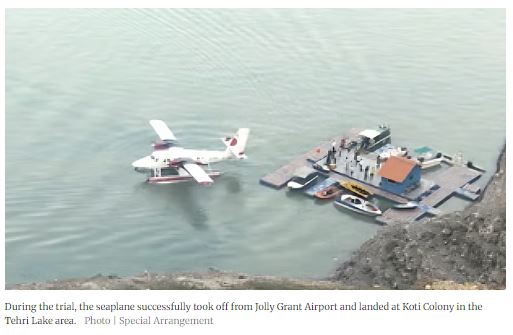
Uttarakhand achieved a historic milestone in its aviation and tourism sectors as a 19-seater seaplane successfully completed trial landings on Tehri Lake. Conducted by Sky Hop Private Limited, the trial saw the aircraft fly from Dehradun’s Jolly Grant Airport to Koti Colony on the lake's reservoir. This development marks the beginning of a transformative era for regional connectivity, utilizing India’s water bodies as natural runways to bypass the logistical challenges of Himalayan terrain.
Geographical Profile of Tehri Lake
Tehri Lake is not just a scenic reservoir but a marvel of modern engineering and geography:
- Scale and Origin: One of the largest man-made lakes in Asia, it covers approximately 42 square kilometers. It was formed by the impoundment of the Bhagirathi River by the Tehri Dam, leading to the submergence of Old Tehri town.
- Location: Situated in the Tehri Garhwal district at an altitude of 1,700 meters, the lake is cradled by the Himalayan foothills.
- Hydrological Source: The reservoir is primarily fed by the confluence of the Bhagirathi and Bhilangna rivers, collecting glacial meltwater and monsoon runoff.
- Hydro-geology: As a deep-water reservoir, it maintains the year-round water volume and surface stability necessary for both massive power generation and safe seaplane operations.
The Strategic Significance of the Seaplane Project
The introduction of seaplane services is a cornerstone of Uttarakhand’s Adventure Tourism Policy and the broader national goal of regional air connectivity (UDAN).
1. Revolutionizing Connectivity
- Time Efficiency: Seaplanes drastically reduce travel time from Dehradun and Rishikesh to the remote Tehri region, facilitating easier access for tourists and pilgrims.
- Disaster Management: Beyond tourism, these aircraft can play a critical role in rapid medical evacuations and disaster relief in the fragile Himalayan ecosystem, where road blockages are frequent.
2. Socio-Economic and Sustainable Development
- Tourism Hub: The lake already hosts jet skiing, paragliding, and kayaking. Seaplanes add a premium layer to this eco-tourism portfolio, attracting global travelers.
- Multisectoral Impact: The lake serves the 2,400 MW Tehri Dam, provides irrigation for 270,000 hectares, and supplies drinking water to millions in Delhi and Uttar Pradesh. The seaplane project complements these utilities by boosting local commerce and employment.
Governance and Institutional Support
The project aligns with the "Sustainable, Inclusive, and Climate-Resilient Tourism Development at Tehri Lake Area" initiative, supported by the Asian Development Bank (ADB) with a funding of approximately $126 million.
- Climate Resilience: The project emphasizes nature-based solutions and climate-smart infrastructure to protect the 87,000 residents and 2.7 million annual visitors.
- Integrated Management: Authorities have ensured that seaplane corridors are designed to harmonize with existing boating and fishing activities, preventing disruption to local livelihoods.
Dalma Wildlife Sanctuary
- 20 Apr 2026
In News:
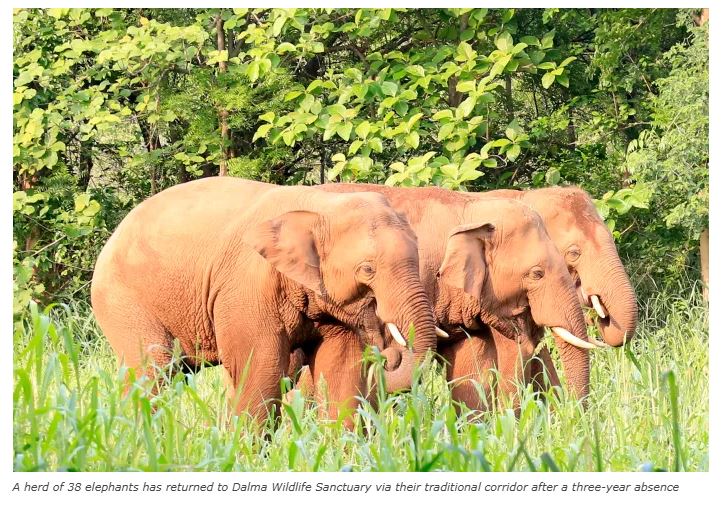
In a significant development for regional biodiversity, a herd of 38 elephants has returned to the Dalma Wildlife Sanctuary in Jharkhand after a hiatus of nearly three years. This migratory return highlights the sanctuary’s role as a critical corridor for the Asian Elephant and underscores the importance of the Chota Nagpur Plateau in India’s wildlife conservation efforts.
Geographical and Cultural Context
- The Dalma Wildlife Sanctuary is nestled within the Dalma Hills of the Chota Nagpur Plateau in Jharkhand.
- The sanctuary holds profound cultural value, deriving its name from “Dalma Mai,” a local goddess revered by the tribal communities and villagers inhabiting the fringes of the forest.
- The sanctuary’s landscape is characterized by a rugged, hilly, and rocky terrain, interspersed with dense forest canopies and sprawling grasslands. This diverse topography provides a variety of ecological niches for a wide range of flora and fauna.
Hydro-Geology and Ecosystem
The sanctuary serves a vital hydrological function as the entire forest area falls within the catchment of the Subarnarekha River. The presence of water is a defining feature of the sanctuary, which is home to two prominent waterfalls: Sitaguldi and Dassam. These water sources are essential for the survival of the resident megafauna, particularly during the dry months.
Flora and Vegetation
The vegetation in Dalma is classified primarily under two categories:
- Dry Peninsular Sal: Dominated by Shorea robusta, these forests are hardy and well-adapted to the plateau's climate.
- Northern Dry Mixed Deciduous Forest: This type supports a high variety of plant species that shed their leaves seasonally.
The sanctuary is also a repository of botanical wealth, particularly medicinal plants. Species such as Anantmula, Satawari, and Sarpgandha (Rauvolfia serpentina) are found in abundance. Additionally, the ecosystem supports various orchids, climbers, herbs, and shrubs, contributing to a complex and resilient forest structure.
Fauna: Beyond the Elephant
While Dalma is most famous as a terminal for elephant migration, it supports a diverse array of wildlife. The return of the elephant herd indicates a healthy habitat, but the sanctuary also protects:
- Mammals: Barking deer, wild boar, giant squirrel, and sloth bears.
- Unique Species: The sanctuary provides a refuge for the Indian pangolin and porcupines, species that are increasingly under threat due to habitat loss and poaching.
India’s Startup Revolution
- 20 Apr 2026
In News:
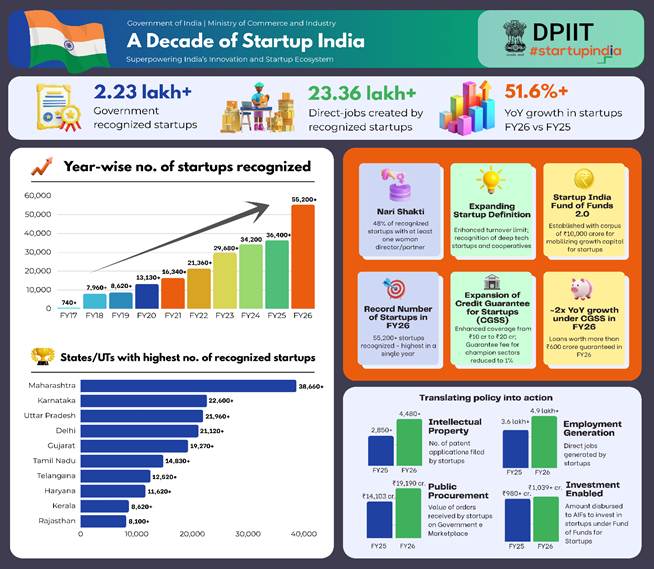
The Financial Year 2025–26 has emerged as a watershed moment for India’s entrepreneurial landscape. According to the latest data from the Department for Promotion of Industry and Internal Trade (DPIIT), the Startup India initiative witnessed its strongest performance since its inception in 2016. With over 55,200 startups recognized in a single year—a 51.6% year-on-year increase—India is rapidly cementing its position as a global innovation hub, transitioning from a job-seeking to a job-creating economy.
Key Performance Indicators (FY 2025–26)
The scale of growth in the startup ecosystem is reflected in several record-breaking metrics:
- Total Ecosystem Strength: The total number of recognized startups has crossed 2.23 lakh.
- Employment Generation: Startups have generated over 23.36 lakh direct jobs to date. In FY 2025-26 alone, direct job creation rose by 36.1%, adding nearly 5 lakh jobs in a single year.
- Women Empowerment: Demonstrating inclusive growth, approximately 48% of total recognized startups (over 1.07 lakh) have at least one-woman director or partner.
- Intellectual Property: Innovation is peaking, with patent filings by startups jumping from 2,850 in the previous year to over 4,480 in FY 2025–26.
Geographical Spread and Competitive Federalism
The startup movement is no longer confined to traditional tech hubs but has reached every State and Union Territory. However, five regions lead the charge in concentration and employment:
- Maharashtra: 38,660 startups; 4.13 lakh jobs.
- Karnataka: 22,600 startups; 2.46 lakh jobs.
- Uttar Pradesh: 21,960 startups; 2.11 lakh jobs.
- Delhi: 21,120 startups; 2.36 lakh jobs.
- Gujarat: 19,270 startups; 2.14 lakh jobs.
To sustain this momentum, the States’ Startup Ranking Framework (SRF) promotes competitive federalism, evaluating states on policy implementation and classifying them into categories like "Best Performers" and "Top Performers."
The Support Pillars: Flagship Schemes
The government provides a multi-layered financial and regulatory support system to nurture startups throughout their lifecycle:
- Fund of Funds for Startups (FFS): To address the funding gap, FFS 1.0 has disbursed over ?7,000 crore to Alternative Investment Funds (AIFs), which in turn invested over ?26,900 crore in startups. Building on this, FFS 2.0 has been notified with a fresh corpus of ?10,000 crore.
- Startup India Seed Fund Scheme (SISFS): Focuses on early-stage needs like proof of concept and prototyping. The entire ?945 crore corpus has been committed, supporting over 3,400 startups through 219 incubators.
- Credit Guarantee Scheme (CGSS): Facilitates collateral-free loans. In FY 2025–26, the guarantee cover was doubled from ?10 crore to ?20 crore per borrower to enhance capital mobilization.
- Government e-Marketplace (GeM): Startups are increasingly participating in public procurement. Over 38,600 startups are onboarded on GeM, with the total value of orders placed reaching ?19,190 crore in the current fiscal year.
Institutional Mechanisms for Mentorship
Beyond capital, the ecosystem emphasizes "ease of doing business" through digital integration:
- MAARG Portal: (Mentorship, Advisory, Assistance, Resilience, and Growth) serves as a single-stop platform for mentorship across sectors.
- Startup India Hub: A single-window digital platform connecting founders with investors, incubators, and government bodies.
- Startup India Investor Connect: Specifically bridges the gap between high-potential founders and the global investor community.