
Maharishi Sushruta
- 27 Jun 2026
In News:
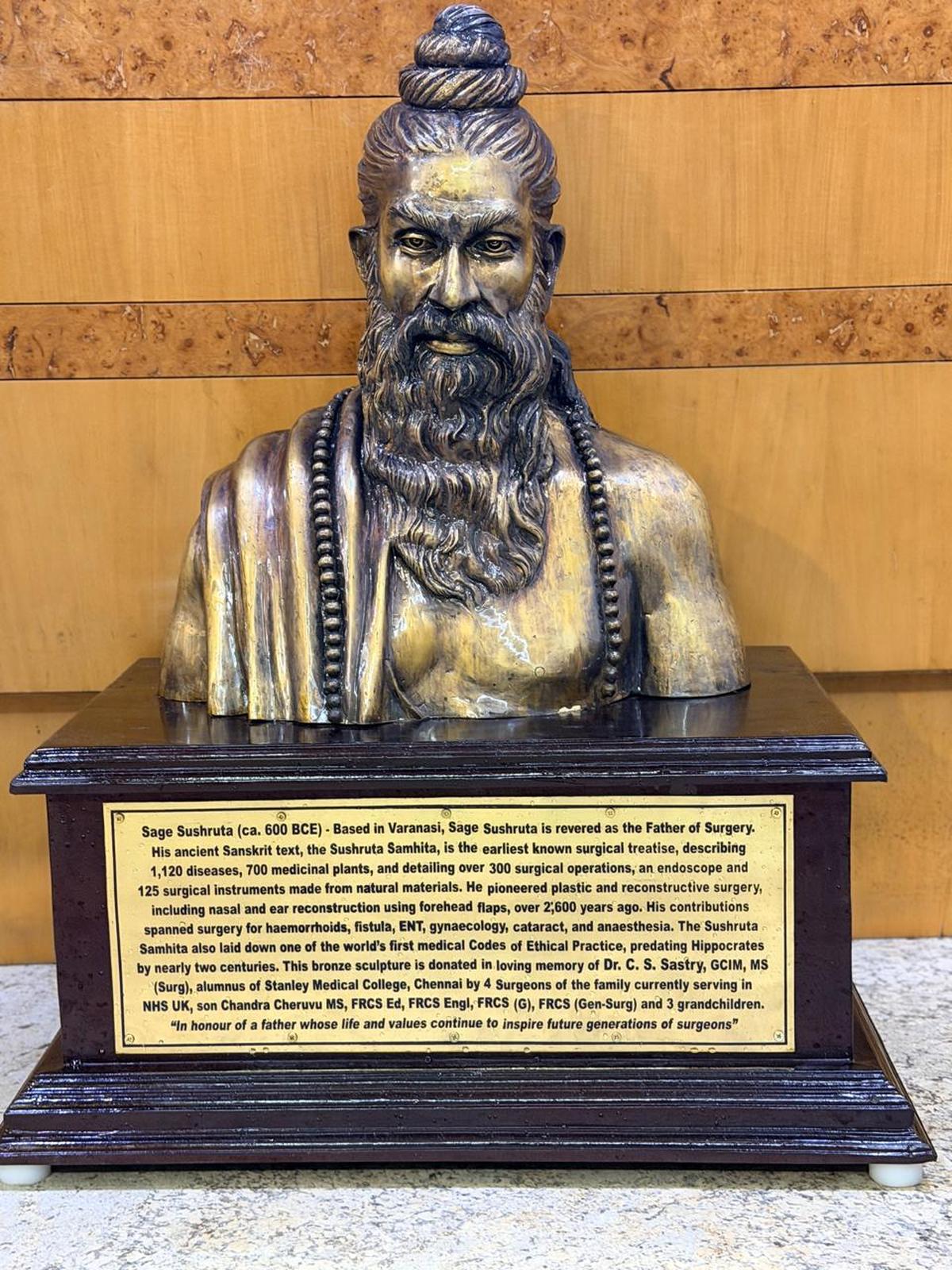
A bronze statue of Maharishi Sushruta, widely revered as the Father of Surgery, was recently unveiled at the Royal College of Surgeons of Edinburgh, United Kingdom, recognising his pioneering contributions to the development of surgery and medical science.
About Maharishi Sushruta
Maharishi Sushruta is regarded as one of the greatest physicians and surgeons of ancient India. Revered as the "Father of Surgery" and often referred to as the "Father of Indian Medicine," he made pioneering contributions to the fields of surgery, anatomy, and Ayurveda. His systematic approach to surgical practice laid the foundation for many principles that continue to influence modern medicine.
Although scholars differ regarding the exact period in which he lived, Sushruta is generally believed to have practised between 600 BCE and 1000 BCE. According to Ayurvedic tradition, he was a disciple of Lord Dhanvantari, the divine physician and the deity associated with Ayurveda. He is believed to have taught and practised medicine in Varanasi (Kashi), an important centre of learning in ancient India.
Sushruta Samhita
Sushruta's most celebrated contribution is the Sushruta Samhita, one of the foundational texts of Ayurveda and among the earliest comprehensive treatises on surgery in the world.
Composed over 2,500 years ago, the text contains 184 chapters covering various branches of medicine and surgery. It describes:
- More than 300 surgical procedures.
- Over 120 surgical instruments.
- Different types of wounds, fractures, dislocations, and their treatment.
- Detailed knowledge of toxicology, paediatrics, pharmacology, and general medicine.
- More than 100 medicinal plants, including their therapeutic properties and medicinal uses.
The text remains one of the most significant contributions to the history of medicine and Ayurveda.
Contributions to Surgery
Sushruta introduced a scientific and systematic approach to Shalya Tantra (Surgical Science), considering surgery an integral part of medical treatment.
His major contributions include:
- Development of rhinoplasty (nasal reconstruction), regarded as one of the earliest forms of plastic surgery.
- Surgical removal of bladder stones (lithotomy).
- Procedures for the removal of a dead foetus.
- Advanced methods for treating fractures, wounds, and dislocations.
- Design and use of specialised surgical instruments.
- Emphasis on cadaver dissection for understanding human anatomy.
- Use of herbal anaesthetics and systematic post-operative care.
His insistence on practical training, observation, and meticulous documentation established principles that continue to underpin surgical education.
Legacy
The influence of Maharishi Sushruta extended well beyond ancient India. His surgical techniques and medical knowledge were transmitted to other regions through translations and scholarly exchanges, contributing to the development of plastic surgery, orthopaedics, ophthalmology, and reconstructive surgery across the world.
His emphasis on scientific observation, ethical medical practice, and evidence-based treatment makes him one of the earliest pioneers of modern surgical science.
BHARATI Programme
- 27 Jun 2026
In News:
The Agricultural and Processed Food Products Export Development Authority (APEDA) has successfully concluded the first cohort of the BHARATI Programme, a flagship initiative aimed at promoting innovation and strengthening India's agri-food exports.
About BHARATI Programme
BHARATI (Bharat's Hub for Agritech, Resilience, Advancement and Incubation for Export Innovation) is a flagship startup acceleration programme launched by the Agricultural and Processed Food Products Export Development Authority (APEDA). The programme seeks to promote innovation-driven growth in India's agri-food export ecosystem by supporting technology-based startups working across the agriculture, food processing, and export value chains.
Designed as an export-focused incubation initiative, BHARATI aims to nurture 100 agri-food startups and contribute towards achieving USD 50 billion worth of exports in APEDA-scheduled products by 2030. Rather than replacing existing incubation programmes, it complements government and industry-led initiatives by helping startups become export-ready and globally competitive.
The programme is aligned with flagship national initiatives such as Atmanirbhar Bharat, Vocal for Local, Digital India, and Start-Up India.
Key Features
The BHARATI Programme focuses on promoting innovation in high-value export segments, including:
- GI-tagged agricultural products
- Organic foods
- Superfoods
- Novel processed Indian agri-food products
- Livestock products
- AYUSH products
A major emphasis is placed on the adoption of advanced technologies such as Artificial Intelligence (AI) for quality control, blockchain for product traceability, Internet of Things (IoT)-enabled cold chain management, and agri-fintech solutions. The programme also encourages innovations in sustainable packaging, logistics, and compliance with international sanitary and phytosanitary standards.
Addressing Export Challenges
BHARATI seeks to develop practical solutions to several bottlenecks affecting India's agri-food exports, including:
- Product development and value addition.
- Quality assurance and certification.
- Post-harvest losses and perishability.
- Supply chain and logistics inefficiencies.
- Export compliance and market access.
To achieve this, the programme creates a collaborative ecosystem connecting agri-food startups, technology providers, exporters, research institutions, and startups specialising in Sanitary and Phytosanitary (SPS) and Technical Barriers to Trade (TBT) standards.
Programme Structure
Selected startups undergo a three-month acceleration programme, during which they receive mentorship and support in areas such as:
- Product development.
- Export readiness.
- Regulatory compliance.
- International market access.
- Business scaling and investor engagement.
The programme equips startups with the knowledge and capabilities required to develop globally competitive export-oriented products.
Hemis Festival
- 27 Jun 2026
In News:
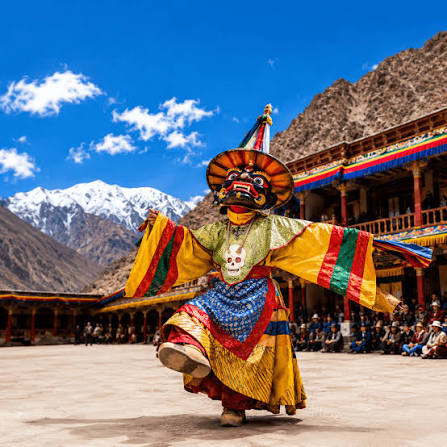
The Hemis Festival 2026 commenced with great religious fervour at the historic Hemis Monastery in the Leh district of Ladakh, drawing devotees, monks, and tourists from across India and abroad.
About Hemis Festival
- The Hemis Festival, also known as Hemis Tsechu, is one of the most important Buddhist festivals of Ladakh.
- It is celebrated annually at the Hemis Monastery on the 10th day of the Tse-Chu month according to the Tibetan lunar calendar.
- The festival commemorates the birth anniversary of Guru Padmasambhava (Guru Rinpoche), who is revered in Tibetan Buddhism as the Second Buddha for spreading Vajrayana Buddhism across the Himalayan region and subduing evil forces.
- According to local tradition, Guru Padmasambhava visited Ladakh in the 8th century and is believed to have protected the region from negative forces, making the festival an important occasion of spiritual renewal and thanksgiving.
Religious and Cultural Significance
- The Hemis Festival is a vibrant expression of Tibetan Buddhist traditions, symbolising the victory of good over evil, spiritual purification, and compassion. Besides its religious importance, the festival plays a vital role in preserving Ladakh's rich cultural heritage and monastic traditions.
Major Attractions
- The celebrations are centred around the Hemis Monastery, one of the largest and wealthiest monasteries of the Drukpa Kagyu school of Tibetan Buddhism. The monastery is adorned with colourful decorations, prayer flags, and religious ornaments during the festival.
- The principal attraction is the Cham Dance, a sacred masked dance performed by monks and lamas in elaborate costumes. Accompanied by drums, cymbals, and long horns, the dance symbolises the triumph of virtue over evil and narrates important episodes from Buddhist teachings.
Important Rituals
A distinctive ritual of the festival is the ceremonial destruction of a dough sculpture representing evil forces. At the conclusion of the ritual, the sculpture is broken into pieces and scattered in the four cardinal directions, symbolising the elimination of negativity and the purification of the soul.
As part of the local tradition, Chhang, a traditional fermented barley beverage of Ladakh, is served during the festivities.
Thangka Display
One of the most significant features of the Hemis Festival is the display of a giant Thangka (sacred Buddhist scroll painting) depicting Guru Padmasambhava.
This rare display takes place once every 12 years, during the Tibetan Year of the Monkey. The Thangka is richly decorated with semi-precious stones, pearls, and intricate embroidery, attracting thousands of pilgrims and tourists.
Intelligence Bureau (IB)
- 27 Jun 2026
In News:
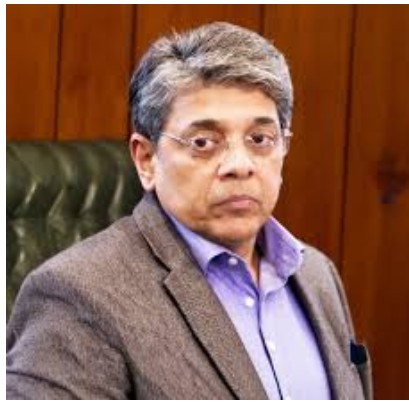
The Union Government has appointed Mahesh Dixit, a 1993-batch Indian Police Service (IPS) officer of the Andhra Pradesh cadre, as the new Director of the Intelligence Bureau (IB) for a tenure of two years. He succeeds Tapan Kumar Deka, who headed the agency for four years.
About the Intelligence Bureau (IB)
The Intelligence Bureau (IB) is India's premier domestic intelligence and internal security agency, functioning under the Ministry of Home Affairs (MHA). It is responsible for collecting, analysing, and disseminating intelligence relating to threats affecting the country's internal security and public order.
The Bureau works in close coordination with central and state intelligence agencies, law enforcement organisations, and security forces to safeguard national security.
Historical Background
The Intelligence Bureau is one of the oldest intelligence organisations in the world. Its origins are generally traced to the establishment of the Central Special Branch in 1887 during British rule. Some historical accounts also associate its beginnings with the intelligence unit established by Major General Sir Charles Metcalfe MacGregor in 1885.
Following Independence, the Intelligence Bureau became India's principal agency for internal intelligence, while the Research and Analysis Wing (R&AW) was created in 1968 to exclusively handle external intelligence.
Mandate and Functions
The Intelligence Bureau is entrusted with safeguarding India's internal security through intelligence gathering, analysis, and coordination.
Its major responsibilities include:
- Collection and dissemination of domestic intelligence.
- Counter-terrorism and counter-intelligence operations.
- Monitoring activities relating to extremism, insurgency, and secessionism.
- Assisting law enforcement agencies in preventing threats to national security.
- Protecting critical infrastructure, particularly civil aviation and other strategic installations.
- Conducting background verification for security clearances of diplomats, judges, senior government officials, and other sensitive appointments.
Composition
The Intelligence Bureau functions as a multidisciplinary organisation comprising officers drawn primarily from:
- Indian Police Service (IPS)
- Indian Revenue Service (IRS)
- Armed Forces
- Other Central and State Police Organisations
Personnel are generally inducted on deputation as well as through direct recruitment in specialised cadres.
Institutional Position
The Director of the Intelligence Bureau (DIB) is one of the country's highest-ranking intelligence officials.
The Director:
- Functions under the Ministry of Home Affairs.
- Reports directly to the Prime Minister on matters relating to national security.
- Is a member of the Strategic Policy Group (SPG).
- Serves on the Joint Intelligence Committee (JIC) under the National Security Council (NSC) framework.
Citizenship in India and Proof of Citizenship
- 27 Jun 2026
In News:
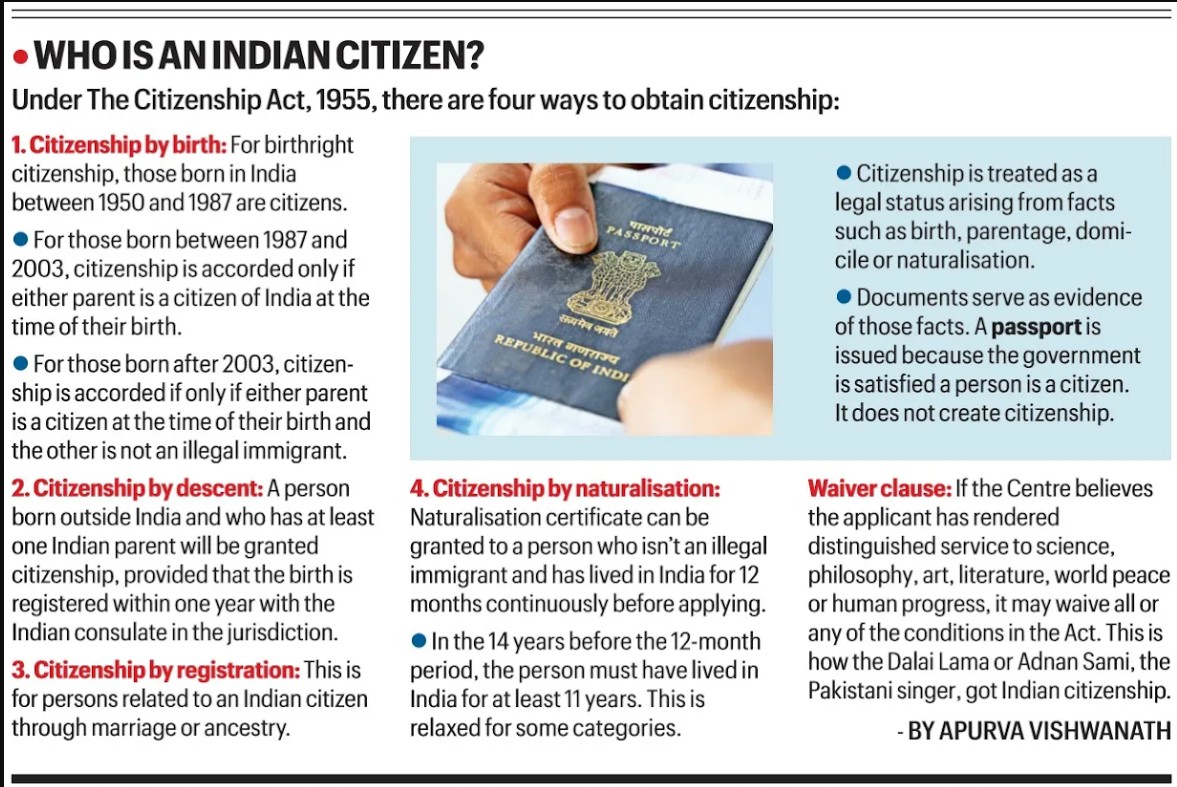
The Ministry of External Affairs (MEA) recently clarified that an Indian passport is primarily a travel document and not conclusive proof of citizenship. The clarification has gained significance in the backdrop of the ongoing Special Intensive Revision (SIR) of electoral rolls and the broader debate on citizenship verification.
Citizenship under Indian Law
- Citizenship in India is governed by the Citizenship Act, 1955, which prescribes the legal framework for acquiring, determining, and terminating citizenship.
- Unlike several countries, India does not possess a single universal document that conclusively establishes citizenship. Instead, citizenship is determined through the provisions of the Citizenship Act and established using relevant documentary evidence relating to birth, parentage, descent, registration, or naturalisation.
- The Supreme Court, in Sarbananda Sonowal v. Union of India (2005), held that the burden of proving Indian citizenship lies on the individual claiming it.
Is a Passport Proof of Citizenship?
- The Passport Manual describes an Indian passport as strong evidence of nationality, a view also recognised by the Supreme Court in Maneka Gandhi v. Union of India (1978). However, it is not conclusive proof of citizenship in the event of a legal dispute.
- Further, Section 20 of the Passports Act, 1967 empowers the Central Government to issue passports to non-citizens in public interest under exceptional circumstances. This was reflected in the 2023 Madras High Court decision permitting a stateless Sri Lankan refugee to apply for an Indian passport.
Thus, while a passport generally indicates nationality for international travel, it does not by itself conclusively determine citizenship under Indian law.
Electoral Rolls and Citizenship
- The Supreme Court, in Lal Babu Hussein v. Electoral Registration Officer (1995), held that inclusion of a person's name in the electoral roll creates a presumption of citizenship, which can be displaced only through due legal process.
- More recently, in Association for Democratic Reforms & Others v. Election Commission of India (2026), the Supreme Court upheld the constitutional validity of the Special Intensive Revision (SIR) of electoral rolls conducted by the Election Commission of India (ECI) under Article 324 of the Constitution and Section 21(3) of the Representation of the People Act, 1950.
- The Court clarified that the ECI is empowered to undertake limited citizenship inquiries only for determining electoral eligibility. Importantly, deletion of a person's name from the electoral roll does not amount to loss of citizenship, as the authority to determine citizenship rests under the Citizenship Act, 1955, and not with the Election Commission. Suspected citizenship cases must be referred to the Ministry of Home Affairs (MHA) for adjudication before elections.
Modes of Acquiring Indian Citizenship
The Citizenship Act, 1955 provides five modes of acquiring citizenship:
- By Birth
- By Descent
- By Registration
- By Naturalisation
- By Incorporation of Territory
India initially followed the principle of Jus Soli (right by birth) but gradually shifted towards Jus Sanguinis (right by blood/descent) through successive amendments.
The conditions for citizenship by birth are:
- 26 January 1950 – 1 July 1987: Every person born in India became a citizen irrespective of parents' nationality.
- 1 July 1987 – 3 December 2004: At least one parent must be an Indian citizen.
- On or after 3 December 2004: One parent must be an Indian citizen and the other must not be an illegal migrant.
Citizenship by descent applies to persons born outside India to Indian parent(s), subject to mandatory consular registration for births after 3 December 2004.
Citizenship by registration and naturalisation is available to eligible Persons of Indian Origin (PIOs), spouses of Indian citizens, and foreign nationals fulfilling prescribed residency conditions, generally 12 years. India does not permit dual citizenship.
Important Amendments
- The Citizenship (Amendment) Act, 2003 introduced stricter provisions by denying citizenship by birth where one parent is an illegal migrant and strengthened provisions relating to illegal migration.
- The Citizenship (Amendment) Act (CAA), 2019 reduced the residency requirement for acquiring citizenship by naturalisation from 11 years to 5 years for Hindu, Sikh, Buddhist, Jain, Parsi, and Christian migrants from Pakistan, Bangladesh, and Afghanistan who entered India on or before 31 December 2014 after facing religious persecution.