
Prevention of Insults to National Honour (Amendment) Bill, 2026
- 01 Aug 2026
In News:
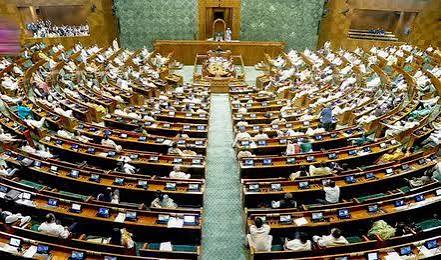
Parliament passed the Prevention of Insults to National Honour (Amendment) Bill, 2026, extending statutory protection to Vande Mataram by penalising its intentional obstruction or disrespect during official singing.
What is the Prevention of Insults to National Honour (Amendment) Bill, 2026?
The Bill amends the Prevention of Insults to National Honour Act, 1971 to bring Vande Mataram (National Song) under its legal protection, similar to the National Anthem (Jana Gana Mana).
The amendment seeks to remove the existing legal gap, as the National Song previously had no statutory protection despite its historic significance in India's freedom movement.
The Government cited the 24 January 1950 Constituent Assembly proceedings, where Dr. Rajendra Prasad stated that Vande Mataram would enjoy equal honour with the National Anthem.
Key Provisions
The Bill extends Section 3 of the 1971 Act to cover Vande Mataram, making it an offence to intentionally prevent its singing or disturb an assembly during its rendition.
The offence carries imprisonment up to 3 years, a fine, or both, while repeat offenders are liable to a minimum imprisonment of one year under Section 3A.
About the Prevention of Insults to National Honour Act, 1971
The Act protects India's national symbols from acts of intentional disrespect.
- Section 2: Prohibits insult to the National Flag and the Constitution of India.
- Section 3: Prohibits preventing or disturbing the singing of the National Anthem.
- Section 3A (2003 Amendment): Prescribes enhanced punishment for repeat offences.
About Vande Mataram
Vande Mataram, meaning "Mother, I Bow to Thee," was composed by Bankim Chandra Chattopadhyay in Sanskritised Bengali and first published in Bangadarshan (1875) before appearing in Anandamath (1882).
It was later set to music by Rabindranath Tagore and became one of the foremost symbols of India's freedom movement.
The first two stanzas were adopted as the National Song by the Congress Working Committee in 1937. On 24 January 1950, Dr. Rajendra Prasad affirmed that Vande Mataram would enjoy equal honour with Jana Gana Mana, though the Constitution does not explicitly recognise a National Song.
Role in the Freedom Struggle
Vande Mataram became the rallying cry of the Swadeshi Movement following the Partition of Bengal (1905) and inspired nationalist movements across the country.
It was first sung at the 1896 Calcutta Session of the Indian National Congress by Rabindranath Tagore. The song was repeatedly banned by the British because of its role in mobilising anti-colonial protests.
It also featured prominently in nationalist organisations and publications, including Bande Mataram led by Bipin Chandra Pal and Sri Aurobindo, and was associated with leaders such as Madam Bhikaji Cama and Madan Lal Dhingra.
MHA Protocol
The Ministry of Home Affairs prescribes that when both are performed officially, Vande Mataram should precede Jana Gana Mana.
People are expected to stand during its official rendition, though this requirement does not apply when it is played in films, documentaries, or newsreels.
The National Song may be performed during Presidential and gubernatorial functions, flag ceremonies, official cultural events, and schools are encouraged to begin the day with its community singing.
Artificial Intelligence as India's Next Digital Public Infrastructure (DPI)

- 01 Aug 2026
In News:
Public policy experts have proposed Artificial Intelligence (AI) as India's next Digital Public Infrastructure (DPI), advocating affordable AI access through open-source models, lower inference costs, and interoperable platforms inspired by Aadhaar, UPI, and DEPA.
What is Commoditising AI as India's Next DPI?
- Commoditising AI means making AI models, computing power, and inference services affordable, accessible, and interoperable like a public utility rather than an expensive commercial product.
- Building on India's successful Digital Public Infrastructure—Aadhaar (digital identity), UPI (digital payments), and DEPA (consent-based data sharing)—AI is envisioned as the next foundational digital layer that can support innovation across sectors.
- The objective is to democratise AI by reducing dependence on expensive proprietary platforms and enabling wider access for startups, researchers, educational institutions, healthcare providers, and MSMEs.
Why is AI Being Considered the Next DPI?
India has already established globally successful digital public platforms. Extending this model to AI can make advanced intelligence accessible to all while reducing reliance on foreign technology providers.
Affordable AI infrastructure would enable local-language education, rural healthcare, agriculture, governance, and innovation by lowering the cost of AI deployment.
It would also shift value creation from expensive foundational models to application development, an area where India's software ecosystem has significant strengths.
Government Initiatives
- The IndiaAI Mission, launched with an outlay of ?10,372 crore, aims to expand access to affordable computing infrastructure for researchers and startups.
- The initiative has onboarded over 38,000 GPUs, with plans to scale to 1,00,000 GPUs, offering subsidised computing resources.
- India has also launched BHASHINI, which promotes multilingual AI by developing datasets and language technologies across Indian languages.
SHANTI Framework
- 01 Aug 2026
In News:
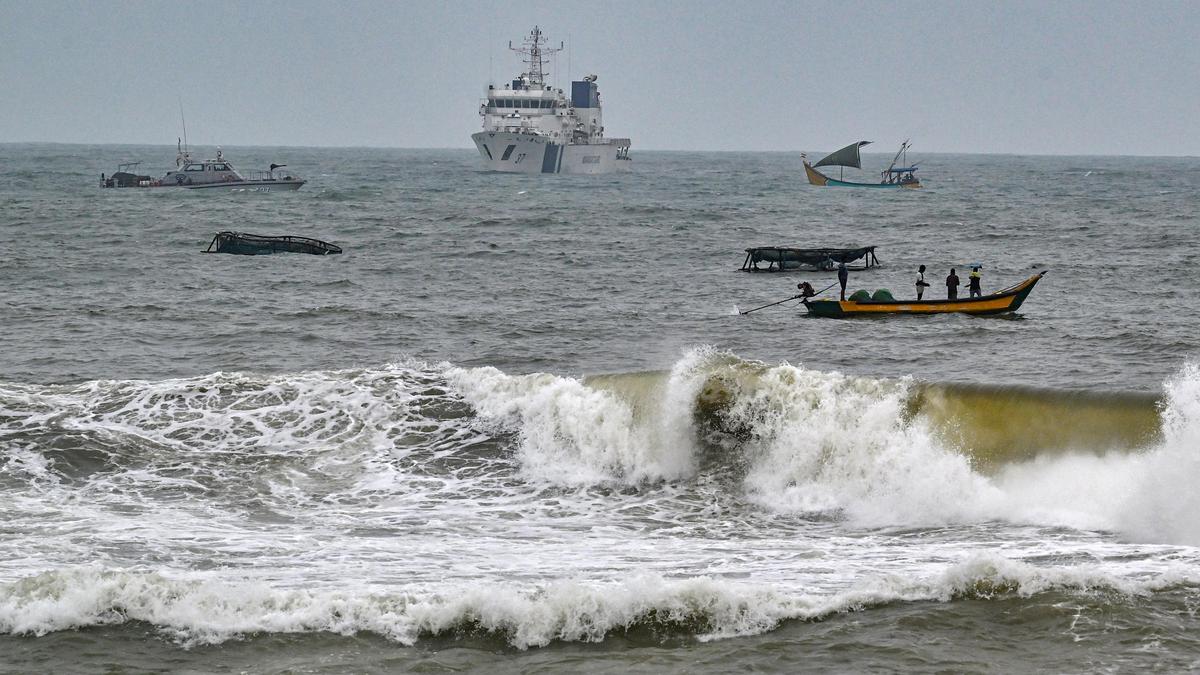
India has proposed the SHANTI (Securing Holistic Advancement through Norms, Trust and Integrity) framework while launching its candidature for the UN Security Council (UNSC) non-permanent seat (2028–29). The framework envisions the Bay of Bengal as the pilot region for promoting norms-based maritime governance before expanding across the wider Indo-Pacific.
What is the SHANTI Framework?
- SHANTI (Securing Holistic Advancement through Norms, Trust and Integrity) is India's proposed norms-based maritime governance framework aimed at strengthening cooperation in shared maritime spaces.
- It builds upon India's earlier maritime initiatives—SAGAR (Security and Growth for All in the Region) launched in 2015 and MAHASAGAR (Mutual and Holistic Advancement for Security and Growth Across Regions) announced in 2025.
- While SAGAR articulated India's maritime vision and MAHASAGAR expanded it to the wider Indo-Pacific and Global South, SHANTI seeks to operationalise this vision through practical cooperation based on Norms, Trust, and Integrity.
Significance
SHANTI marks India's transition from a security-centric maritime approach to one focused on rules-based governance of shared maritime commons. It seeks to position India as a preferred security partner and first responder, strengthen BIMSTEC, enhance Maritime Domain Awareness (MDA), promote the Blue Economy, and improve cooperation against both traditional and non-traditional maritime threats.
The framework also supports India's broader vision of a free, open, inclusive, and resilient Indo-Pacific.
Why is the Bay of Bengal the Ideal Pilot Region?
- The Bay of Bengal offers a relatively stable maritime environment compared to other parts of the Indian Ocean, making it suitable for building trust-based regional cooperation.
- It lies at the intersection of India's Act East Policy and the Indo-Pacific, while guarding the western approaches to the Strait of Malacca, one of the world's busiest maritime chokepoints.
- The region also faces common challenges such as cyclones, climate change, Illegal, Unreported and Unregulated (IUU) fishing, marine pollution, disaster management, and transnational crimes, making cooperative governance essential.
- Existing regional initiatives such as BIMSTEC, the Colombo Security Conclave, connectivity projects, defence cooperation, and Humanitarian Assistance and Disaster Relief (HADR) mechanisms provide a strong institutional foundation for implementing SHANTI.
Challenges
Operationalising SHANTI will require addressing geopolitical competition, particularly China's expanding maritime presence in the Bay of Bengal and political instability in Myanmar.
Other challenges include fragmented regional connectivity, inadequate maritime infrastructure, financing gaps, institutional weaknesses within regional organisations, trust deficits among smaller neighbours, and increasing environmental pressures arising from climate change and marine resource depletion.
Way Forward
India should strengthen Maritime Domain Awareness (MDA) through the Information Fusion Centre–Indian Ocean Region (IFC-IOR), promote implementation of the BIMSTEC Maritime Transport Cooperation Agreement (MTCA), harmonise maritime regulations, and expand Blue Economy cooperation.
Building transparent and inclusive regional institutions, enhancing HADR coordination, improving coastal resilience, and leveraging technology for maritime surveillance will help translate the SHANTI framework into an effective regional governance model.
Cloudbursts in India
- 01 Aug 2026
In News:
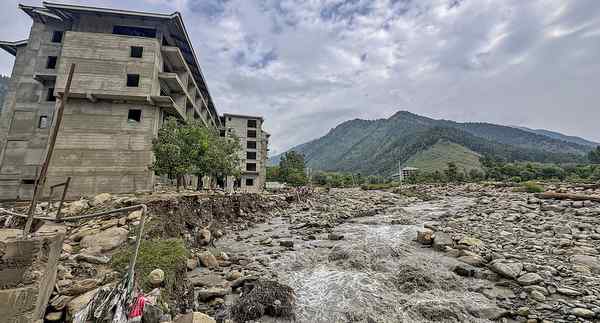
Recent heavy monsoon rainfall across Uttarakhand, Himachal Pradesh, and Jammu & Kashmir has triggered flash floods and landslides, drawing attention to the increasing occurrence of cloudbursts in the Himalayan region.
What is a Cloudburst?
- According to the India Meteorological Department (IMD), a cloudburst is an extremely localized weather event in which 100 mm (10 cm) or more rainfall occurs within one hour over an area of about 20–30 sq. km. The sudden release of such a large volume of water overwhelms the land's infiltration capacity, resulting in flash floods, debris flows, and landslides.
- Some scientists also recognize a mini-cloudburst, where around 50 mm rainfall within an hour over a similar area can cause severe damage, particularly in mountainous terrain.
How Does a Cloudburst Occur?
Cloudbursts are primarily associated with orographic rainfall. Moisture-laden monsoon winds are forced to ascend steep mountain slopes, leading to rapid cooling and condensation.
Strong updrafts within towering cumulonimbus clouds keep water droplets suspended, allowing them to accumulate. Once these updrafts weaken or the water load becomes too heavy, the entire mass of water is released suddenly over a very small area, producing intense rainfall within a short duration.
Occurrence in India
Cloudbursts occur predominantly in the Himalayan region, especially in Uttarakhand, Himachal Pradesh, Jammu & Kashmir, and Ladakh, where rugged topography and steep mountain slopes favour their formation.
Although IMD records documented around 30 cloudburst events between 1970 and 2016, experts believe the actual number is much higher due to limited rain-gauge coverage and radar blind spots in remote mountainous regions.
Climate change is expected to increase the frequency and intensity of such localized extreme rainfall events as a warmer atmosphere can hold more moisture.
Major Recent Events
Recent incidents include cloudburst-induced flash floods in Pahalgam and Anantnag (Jammu & Kashmir, 2026), Dharali and Uttarkashi (Uttarakhand, 2025), Amarnath Cave (2022), and Lahaul-Spiti and Mandi (Himachal Pradesh, 2023), causing widespread destruction of roads, bridges, settlements, and loss of lives.
Impacts
Cloudbursts trigger flash floods, debris flows, landslides, and river blockages, leading to severe damage to infrastructure, agriculture, and human settlements.
The rapid movement of water, rocks, and sediment often destroys highways, bridges, hydropower infrastructure, and villages within minutes. Temporary blockage of rivers may also create artificial lakes, whose sudden breach can generate secondary floods downstream.
Experts also caution that attributing every disaster solely to cloudbursts may divert attention from human-induced factors such as deforestation, illegal construction, poor drainage, and encroachment of river channels.
NDMA Recommendations
The National Disaster Management Authority (NDMA) recommends identifying vulnerable micro-catchments through hazard mapping and restricting construction in flood-prone and unstable areas.
It also advocates expanding Doppler Weather Radar (DWR) and Automatic Weather Station (AWS) networks under Mission Mausam, strengthening short-term nowcasting and early warning systems, improving drainage infrastructure, promoting slope stabilization through bio-engineering, and establishing community-based disaster preparedness and evacuation systems.
India's First Telecom Manufacturing Zone (TMZ)
- 01 Aug 2026
In News:
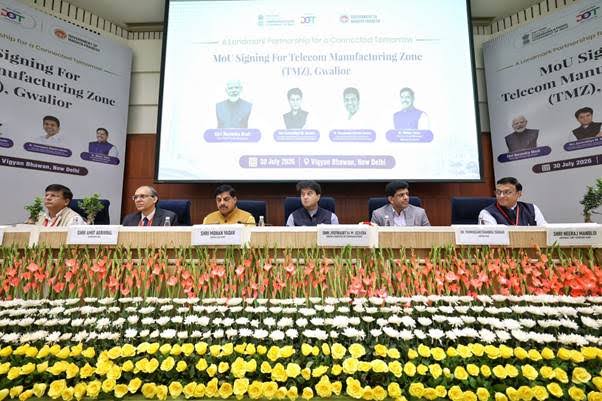
The Department of Telecommunications (DoT), Ministry of Communications, and the Government of Madhya Pradesh will sign an MoU to establish India's first Telecom Manufacturing Zone (TMZ) at Gwalior, Madhya Pradesh.
What is the Telecom Manufacturing Zone (TMZ)?
- The Telecom Manufacturing Zone (TMZ) is a dedicated industrial ecosystem aimed at promoting indigenous manufacturing, design, innovation, and research in the telecommunications sector. It seeks to strengthen India's domestic telecom manufacturing capabilities while reducing import dependence and supporting the vision of Aatmanirbhar Bharat.
- The Phase-I of the country's first Telecom Manufacturing Zone will be developed at Gwalior, Madhya Pradesh.
Key Features
- The Telecom Manufacturing Zone will provide an integrated ecosystem for telecom equipment manufacturers, technology firms, MSMEs, start-ups, and other stakeholders across the telecom value chain.
- It will focus on promoting indigenous design and manufacturing, attracting domestic and global investments, fostering innovation, and accelerating the development of next-generation telecom technologies and equipment.
- The initiative is also expected to strengthen collaboration between industry, research institutions, and technology developers to enhance India's competitiveness in the global telecom sector.