
16th India–Japan Annual Summit

- 04 Jul 2026
In News:
The 16th India–Japan Annual Summit was held in New Delhi, where both countries reviewed the progress of their Special Strategic and Global Partnership and announced several initiatives to deepen cooperation in defence, economic security, clean energy, artificial intelligence (AI), resilient supply chains, and the Indo-Pacific.
Key Outcomes of the Summit
A major highlight of the summit was the agreement in principle on the UNICORN (Unified Complex Radio Antenna) Mast, marking the first-ever India–Japan defence co-development project. Both sides also agreed to expand cooperation in defence equipment, maritime security, naval Maintenance, Repair and Overhaul (MRO), Maritime Domain Awareness (MDA), and joint military exercises, besides convening the 4th India–Japan 2 2 Ministerial Meeting later in 2026.
Economic security emerged as another key pillar of cooperation. Both countries adopted the India–Japan Joint Declaration on Economic Security Cooperation, focusing on semiconductors, critical minerals, ICT, pharmaceuticals, and clean energy while building resilient and diversified supply chains to reduce dependence on any single country. They also agreed to accelerate the review of the Comprehensive Economic Partnership Agreement (CEPA) and work towards achieving the target of ¥10 trillion in Japanese investments in India. A USD 10 billion investment package was also announced to strengthen industrial collaboration.
The summit witnessed significant progress in clean energy cooperation. The two countries adopted a Joint Statement on Energy Resilience, launched the India–Japan Cooperative Biogas for Growth (CBG) Initiative, and expanded collaboration in green hydrogen, clean ammonia, solar photovoltaic technologies and civil nuclear energy. Japan also reiterated its support for India's membership of the International Energy Agency (IEA). In the digital domain, the launch of the India–Japan AI Strategic Dialogue and the adoption of a Joint Statement on AI Cooperation marked the beginning of structured collaboration on trusted AI, resilient digital infrastructure and responsible AI governance.
Both countries reaffirmed their commitment to a Free and Open Indo-Pacific (FOIP) aligned with India's Indo-Pacific Oceans Initiative (IPOI) and MAHASAGAR vision. They pledged greater cooperation through the Quad, ASEAN and BIMSTEC, supported freedom of navigation under UNCLOS, backed UN Security Council reforms, and announced a new India–Japan–Philippines 1.5 Track Dialogue to strengthen maritime security cooperation.
India–Japan Relations
India and Japan share centuries-old civilisational ties rooted in Buddhism, while diplomatic relations were established in 1952. Bilateral ties have steadily evolved through the Global Partnership (2000), Annual Summit mechanism (2006), Comprehensive Economic Partnership Agreement (2011), and the Special Strategic and Global Partnership (2014). Today, cooperation spans defence, trade, infrastructure, technology, connectivity and people-to-people exchanges. Japan is India's fifth-largest source of FDI and its largest bilateral development partner through Official Development Assistance (ODA), supporting projects such as the Mumbai–Ahmedabad High-Speed Rail, Delhi Metro and North-East connectivity. The two countries also collaborate in emerging technologies, semiconductors, AI, and the ISRO–JAXA Lunar Polar Exploration (LUPEX) mission.
Challenges
Despite growing strategic convergence, bilateral trade remains below potential, infrastructure projects continue to face implementation delays, and Indian exports encounter non-tariff barriers in Japan. Differences over Russia, language barriers affecting skilled workforce mobility, and constraints on defence technology transfer have also limited the pace of cooperation.
Significance
The 16th India–Japan Annual Summit reflects the transformation of bilateral ties into a comprehensive strategic partnership anchored in defence cooperation, trusted technology, resilient supply chains, clean energy and Indo-Pacific security. As both countries seek to address emerging geopolitical and economic challenges, their partnership is poised to play an increasingly important role in promoting a free, open and rules-based Indo-Pacific, strengthening India's Atmanirbhar Bharat vision, and contributing to regional stability and sustainable economic growth.
VIJAY Roadmap

- 04 Jul 2026
In News:
The Chief of the Army Staff (COAS), General Dhiraj Seth, recently unveiled the "VIJAY" Roadmap for the modernization of the Indian Army. Aligned with the Ministry of Defence's "Decade of Transformation" (2023–2032), the roadmap seeks to build a digitised, technology-driven, self-reliant, and multi-domain capable force to meet future security challenges.
About the VIJAY Roadmap
The VIJAY Roadmap is a comprehensive strategic blueprint for transforming the Indian Army from a conventional force into a modern, network-centric military capable of operating across land, cyber, space, electronic and hybrid warfare domains. It emphasizes rapid capability development, integration of advanced technologies, and greater synergy among the armed forces.
The roadmap draws inspiration from the Prime Minister's vision that "JAI leads to VIJAY", with "Jai Hind" and "Jai Bharat" serving as its guiding ethos. It also builds upon the broader objectives of Atmanirbhar Bharat and Viksit Bharat 2047.
Five Pillars of the VIJAY Roadmap
The roadmap is structured around five interconnected pillars:
- V – Vigilance: Focuses on maintaining high operational readiness and continuous surveillance along India's borders through advanced sensors, night-vision systems and rapid response capabilities.
- I – Innovation and Transformation: Promotes the adoption of emerging technologies such as Artificial Intelligence (AI), drones, satellites, digital networks and electronic warfare systems, alongside modern military doctrines to enhance combat effectiveness.
- J – Jointness and Integration: Strengthens coordination among the Army, Navy and Air Force, while promoting integrated theatre commands and a Whole-of-Nation approach involving civil and military institutions.
- A – Atmanirbharta: Reinforces self-reliance in defence by prioritising indigenous research, development and procurement under the principle of "Winning Our Wars with Indigenous Solutions."
- Y – Yodha First: Places soldiers at the centre of reforms through improved training, technological skilling, welfare measures, healthcare, career development, and enhanced support for Agniveers, veterans and Veer Naris.
Key Features
The roadmap envisages the integration of drones, satellites, battlefield sensors, communication networks and AI-enabled systems into a common operational framework, enabling faster decision-making and enhanced situational awareness.
It also aims to accelerate force restructuring, replace obsolete military equipment with next-generation indigenous technologies, strengthen multi-domain operational capabilities, and deepen collaboration with India's growing defence industrial ecosystem.
About the Decade of Transformation (2023–2032)
The Decade of Transformation (2023–2032) is the Ministry of Defence's long-term vision to modernise India's armed forces through technological advancement, organisational reforms, jointness among the services, indigenous defence manufacturing, and capability enhancement to address emerging security challenges.
Delegation of Financial Powers to DRDO (DFP-2026)
- 04 Jul 2026
In News:
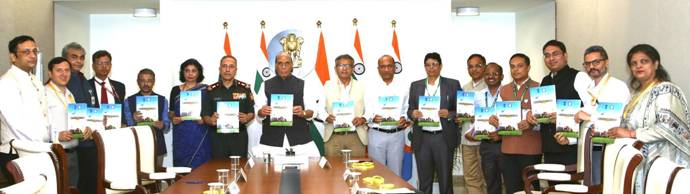
The Ministry of Defence has released the Delegation of Financial Powers to DRDO (DFP-2026) to provide greater financial autonomy to the Defence Research and Development Organisation (DRDO), with the objective of accelerating indigenous defence research, development and innovation.
About DFP-2026
The Delegation of Financial Powers to DRDO (DFP-2026) is a revised financial governance framework that empowers DRDO with enhanced financial decision-making authority for defence research and development projects. It aims to reduce procedural delays, improve project execution, and facilitate the timely development and induction of indigenous defence technologies.
The framework seeks to strengthen India's Atmanirbhar Bharat vision in the defence sector by enabling faster approvals, greater operational flexibility, and improved financial efficiency.
Key Features
DFP-2026 provides greater financial autonomy to DRDO laboratories and project authorities, allowing quicker approval and execution of research and development programmes.
Its major features include:
- Enhanced Financial Delegation: Higher financial powers for faster approval and implementation of defence R&D projects.
- Dedicated Funding for Trials: Separate financial provisions for testing, evaluation and user trial campaigns of defence systems.
- Support for Early-Stage Research: Funding for pre-project research activities to encourage innovation before formal project sanction.
- Separate Funding Streams: Independent financial schedules for Extra-Mural Research Projects (EMRPs) and Defence Innovation Accelerator–Centres of Excellence (DIA-CoEs) to strengthen collaboration with academia, industry and startups.
- Improved Financial Governance: Simplified procedures with greater accountability and transparency in utilisation of research funds.
About DRDO
The Defence Research and Development Organisation (DRDO) is India's premier defence research agency functioning under the Ministry of Defence.
Established in 1958, DRDO is responsible for the design, development and evaluation of defence technologies and systems required by the Indian Armed Forces. It works across diverse domains including missiles, aeronautics, combat vehicles, naval systems, electronics, cyber technologies, artificial intelligence, life sciences and advanced materials.
Significance
The DFP-2026 framework is expected to significantly reduce administrative delays in defence research by providing greater financial flexibility to DRDO. By supporting early-stage innovation, dedicated testing infrastructure and stronger collaboration with academia, startups and industry, it will accelerate the development of indigenous defence technologies, strengthen the domestic defence industrial ecosystem, and contribute to the objectives of Atmanirbhar Bharat and enhanced national security.
SHE-LEAPS Platform
- 04 Jul 2026
In News:
The Government of India recently launched the SHE-LEAPS Platform to strengthen women-led rural entrepreneurship and accelerate the Lakhpati Didi initiative through digital monitoring and data-driven enterprise development.
About SHE-LEAPS Platform
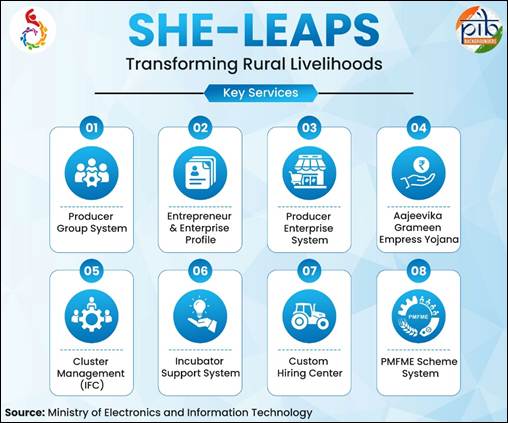
SHE-LEAPS stands for Self-Help Entrepreneur–Livelihoods and Enterprise Application for Prosperity and Sustainability. It is a digital platform designed to empower women associated with Self-Help Groups (SHGs) by supporting enterprise creation, monitoring, and performance tracking.
Launched during the Rashtriya Gramin Vikas Sammelan, the platform aims to strengthen women-led rural enterprises by providing real-time data for better governance, planning, and policy interventions. It supports both farm and non-farm enterprises, thereby promoting diversified livelihood opportunities and sustainable rural economic growth.
The mobile application has been developed by the Digital India Corporation and is being implemented under the LokOS platform. Its nationwide rollout will cover all 34 States and Union Territories, supporting the State Rural Livelihood Missions (SRLMs) in promoting women entrepreneurship.
Objectives
The platform seeks to:
- Empower women entrepreneurs associated with Self-Help Groups across rural India.
- Strengthen women-led enterprises and support the Lakhpati Didi initiative.
- Integrate rural producers with formal value chains and markets.
- Enhance financial inclusion of SHG households.
- Promote data-driven entrepreneurship and evidence-based policymaking.
Key Features
SHE-LEAPS enables real-time monitoring of women-led enterprises by capturing operational data across different sectors and tracking the complete livelihood journey of beneficiaries.
Its major features include:
- Real-time tracking of enterprise performance and livelihood outcomes.
- Support for both farm-based and non-farm rural enterprises.
- Digital monitoring to improve transparency and governance.
- Data analytics for better planning, targeted interventions, and policy formulation.
- Integration with existing rural livelihood ecosystems to strengthen market linkages and enterprise sustainability.
About Lakhpati Didi Initiative
The Lakhpati Didi Initiative is a flagship programme under the Deendayal Antyodaya Yojana–National Rural Livelihoods Mission (DAY-NRLM) aimed at enabling women Self-Help Group members to achieve an annual household income of at least ?1 lakh through diversified livelihood activities, entrepreneurship, skill development, and financial inclusion.
Centralised IT-Enabled System (CITES) Project
- 04 Jul 2026
In News:
The Employees' Provident Fund Organisation (EPFO) recently completed a nationwide database consolidation under its Centralised IT-Enabled System (CITES) project, marking a major step towards modernising EPFO's digital service delivery.
About Centralised IT-Enabled System (CITES)
The Centralised IT-Enabled System (CITES) is EPFO's flagship digital transformation initiative aimed at creating a unified, technology-driven platform for provident fund services. Designed by the Centre for Development of Advanced Computing (C-DAC), the project seeks to automate service delivery, simplify claim processing, and improve efficiency through rule-based digital workflows.
The project replaces multiple regional databases with a single national database, enabling seamless access to EPFO services across the country.
Key Features
CITES introduces a centralized architecture that integrates all EPFO records into a single platform, allowing members to access services from any EPFO office irrespective of their place of employment.
Some of its major features include:
- Single National Database: Consolidates all EPFO records into one centralized system.
- Online Service Delivery: Enables digital KYC updates, member profile management, and various EPFO services through an online interface.
- Faster Claim Processing: Simplifies PF transfers, maintains accurate service history, and facilitates quicker claim settlements.
- Anywhere Service: Members and beneficiaries can approach any EPFO office across India for grievance redressal and assistance.
- Universal Account Number (UAN) Integration: Existing UAN and password remain valid for accessing the new platform.
- Unified Member Records: Displays all previous Member IDs linked to a single Aadhaar-based UAN, ensuring continuity of employment records.
- Electronic Claim Management: EPFO offices can process claims and communicate queries electronically, reducing paperwork and delays.
About Employees' Provident Fund Organisation (EPFO)
The Employees' Provident Fund Organisation (EPFO) is a statutory body under the Ministry of Labour and Employment responsible for administering India's social security schemes for organised sector workers.
It was established in 1952 under the provisions of the Employees' Provident Funds and Miscellaneous Provisions Act, 1952.
EPFO administers three major social security schemes:
- Employees' Provident Fund (EPF) Scheme, 1952
- Employees' Pension Scheme (EPS), 1995
- Employees' Deposit Linked Insurance (EDLI) Scheme, 1976