
Printed Circuit Boards (PCB)
- 29 Apr 2026
In News:
In April 2026, the global electronics industry faced a severe shock as the conflict in the Middle East intensified, leading to a dramatic 40% surge in the price of Printed Circuit Boards (PCBs). This crisis underscores the fragility of high-tech supply chains and the critical dependence of the modern digital economy—especially the burgeoning AI sector—on specific raw materials sourced through volatile trade routes.
The Anatomy of a Crisis: Why Prices Scalated
The primary driver behind the price hike is the disruption of maritime trade and the supply of specialized raw materials.
- PPE Resin Shortage: High-purity Polyphenyleneether (PPE) and epoxy resins are the foundational "glue" of PCB laminates. The disruption in West Asia has choked the supply of these chemical precursors, which are essential for high-frequency circuit boards.
- Shipping Bottlenecks: As a vital transit point for global trade, the instability in the Middle East has forced rerouting, increasing freight costs and lead times for other components like copper foil and glass fiber.
What is a Printed Circuit Board (PCB)?
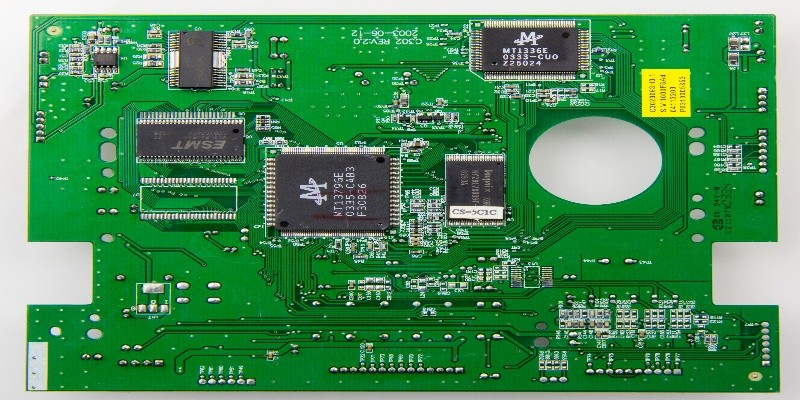
Often referred to as the "nervous system" of electronic devices, a PCB is a rigid or flexible substrate used to electrically connect and mechanically support electronic components. It utilizes conductive pathways, known as traces, which are etched from copper sheets laminated onto a non-conductive base.
Critical Raw Materials and Their Economics
- Copper Foil: The most expensive element, typically accounting for 60% of total raw material costs. It provides the conductive paths necessary for electricity to flow.
- Resins (PPE/Epoxy): These act as the insulating base. In advanced high-speed applications like AI, specialized resins like PPE are non-negotiable for maintaining signal integrity.
- Glass Fiber: Integrated into the substrate to provide mechanical strength, structural durability, and electrical insulation.
The Manufacturing Process: From Substrate to Circuit
The production of high-end PCBs is a high-precision engineering feat involving several stages:
- Lamination: Intense heat and pressure bond the resin and glass fiber to create a solid substrate.
- Etching: A chemical process removes excess copper, leaving behind the precise "roads" (conductive pathways) required for the circuit to function.
- Multi-layering: For complex hardware, such as AI servers, manufacturers stack multiple layers of circuitry. These high-end boards can cost thousands of dollars per square meter due to their complexity.
Global Impact and Applications
The current price surge affects the entire spectrum of technology, from household gadgets to national infrastructure:
- AI and Data Centers: Cloud service providers are seeing increased costs for the massive AI servers that power large language models and neural networks.
- Consumer Tech: Smartphones, laptops, and wearables are facing upward price pressure as manufacturers pass on the 40% increase in component costs to consumers.
- Industrial Automation: Semiconductors produced by giants like Nvidia, AMD, Samsung, and SK Hynix rely on these boards as the essential interface for their chips. Without stable PCB supplies, factory automation and large-scale manufacturing equipment face significant delays.
Holocene Fossil Discovery in Thoothukudi
- 29 Apr 2026
In News:
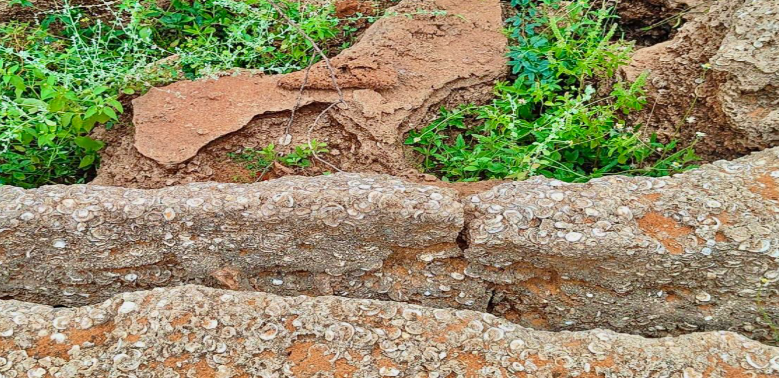
In a landmark paleontological discovery, a significant fossil bed dating back to the middle-to-late Holocene period (approximately 8,000 to 12,000 years ago) has been unearthed in the Panaiyur area of Thoothukudi district, Tamil Nadu. This discovery, revealed in late 2025 and scientifically validated in early 2026, marks the first documented fossil bed in the Thoothukudi region and a vital addition to India’s Quaternary fossil record.
The Discovery and Scientific Response
The site was initially exposed by torrential rains in 2023, which caused significant soil erosion and revealed buried sedimentary layers.
- Identification: Following a request from the local administration, the Zoological Survey of India (ZSI) conducted a swift and thorough field survey between January 5 and 10, 2026.
- Findings: Scientists collected 104 fossil specimens, primarily comprising marine invertebrate organisms such as bivalves (clams, oysters) and gastropods (snails).
- Geological Context: The fossils are embedded in sedimentary formations consisting of condensed sandstones and lateritic red soils. The presence of features like submarine canyons and water channels within these layers suggests a complex coastal history.
The Holocene Epoch: Context and Characteristics
The Holocene is the current geological epoch, the second part of the Quaternary Period (which also includes the preceding Pleistocene).
- Timeline: It spans roughly the last 11,700 years, beginning after the Earth’s last major ice age.
- Post-Glacial Transition: This epoch is defined by the melting of massive ice sheets, leading to a global sea-level rise (estimated at 35 meters in its early phase) and the stabilization of a warmer, tropical climate.
- The Anthropocene Link: Often associated with the rise of modern wildlife and the flourish of human agriculture and permanent settlements, the Holocene represents the environmental stage upon which human civilization developed.
Scientific Significance of the Panaiyur Discovery
This discovery is of immense value for reconstructing India’s paleoclimatic and biological past.
1. Paleoenvironmental Reconstruction: The marine fossils discovered are located 5 to 7 kilometers inland from the current coastline. This serves as critical evidence of past sea-level fluctuations, indicating that the area was once submerged. The assemblage points toward a shallow-marine to estuarine setting with warm, tropical temperatures and moderate water circulation.
2. Environmental Continuity: The species found in the fossil bed show a striking similarity to modern marine fauna in the Gulf of Mannar. This suggests a high degree of environmental continuity over the last 12,000 years, helping scientists understand how regional ecosystems remained stable or responded to historical climate shifts.
3. Enhancing the Quaternary Record: Quaternary fossil sites in southern India are relatively rare. The Panaiyur find fills a significant gap in the national inventory, providing high-resolution data on Holocene sedimentology, including bioturbation (organism burrowing) and cross-stratification (layering by currents).
Lake Issyk-Kul
- 29 Apr 2026
In News:
In a major archaeological breakthrough in 2026, underwater explorers discovered a hidden city beneath the waters of Lake Issyk-Kul in Kyrgyzstan. Divers followed a trail of ancient, preserved brickwork to reveal a lost civilization dating back seven centuries. This discovery adds a profound layer of historical depth to a lake already renowned for its unique geological and ecological characteristics.
Geographical and Geological Profile
Situated in northeastern Kyrgyzstan, Lake Issyk-Kul is cradled by the snowcapped Tian Shan (Heaven’s Mountains). Its formation dates back approximately 25 million years, making it one of the oldest lakes on the planet.
- Endorheic Basin: The lake is an endorheic system, meaning it has no outflow to rivers or oceans. This isolation has contributed to its unique chemical composition.
- Physical Dimensions: Located at an altitude of 1,600 meters, it is the world’s second-largest high-mountain lake, surpassed only by Lake Titicaca in South America. It spans 182 km in length, 61 km in width, and covers a surface area of 6,280 sq. km.
- Depth and Ranking: With a maximum depth of 668 meters and an average depth of 280 meters, it ranks as the seventh deepest lake globally.
The "Hot Lake": Why It Never Freezes
Despite being surrounded by frigid alpine peaks, Lake Issyk-Kul remains unfrozen throughout the winter. Its name, "Issyk-Kul," literally translates to "Hot Lake." This phenomenon is driven by a combination of factors:
- High Salinity: It is the world’s second-largest saline lake after the Caspian Sea. Its brackish waters have a lower freezing point than freshwater.
- Heat Storage: Its immense depth allows it to act as a heat reservoir.
- Geothermal Activity: The presence of underwater warm springs further prevents ice formation.
Archaeological Significance: The Submerged City
The 2026 discovery of the 700-year-old city confirms long-standing local legends of ancient settlements swallowed by the rising waters. The submerged brickwork suggests a sophisticated urban center that was part of the silk road trade routes before being inundated.
The site serves as a "time capsule," offering insights into the medieval architecture and daily life of Central Asian civilizations that were previously lost to history. Scholars believe fluctuations in the lake's water levels, caused by tectonic shifts or climatic changes, likely led to the city's eventual submergence.
Ecological and Environmental Importance
Lake Issyk-Kul is not just a geological wonder but a vital biological sanctuary.
- Biodiversity: The lakeshore is remarkable for its rapid succession of landscape types, ranging from subtropical zones to tundra, all occurring within a close geographic span.
- Ramsar Site: In 1976, the lake was designated a wetland of international importance under the Ramsar Convention. It serves as a crucial stopover for migratory birds and supports diverse endemic fish species.
Google AI Data Hub
- 29 Apr 2026
In News:
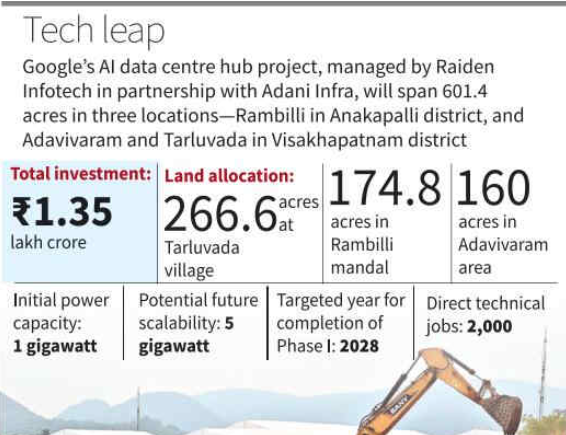
In a landmark move for India’s digital economy, the foundation stone for Google’s $15 billion AI Data Centre Hub was laid near Visakhapatnam, Andhra Pradesh. This project, executed through Google’s subsidiary Raiden Infotech in partnership with Adani Infra, represents one of the largest Foreign Direct Investment (FDI) inflows in India’s technology sector to date.
Project Overview and Geographical Footprint
The Google AI Data Hub is a large-scale, artificial intelligence-driven data centre campus. Its strategic location spans across:
- Tarluvada and Adavivaram in the Visakhapatnam district.
- Rambilli in the Anakapalli district.
The selection of Andhra Pradesh’s coast leverages the state’s maritime advantage for submarine cable connectivity, making it a critical node for global data traffic.
Core Features and Technical Specifications
The hub is engineered to be a cornerstone of India’s high-capacity digital infrastructure. Key technical pillars include:
- Gigawatt-Scale Capacity: The campus is planned with a massive capacity of 1 gigawatt (GW), positioning it among the most significant data centre installations in the country.
- Global Connectivity: The facility will house high-capacity submarine cable landing stations. These, combined with dedicated fibre networks, will provide low-latency international connectivity, essential for real-time AI processing.
- Advanced AI & Cloud Operations: Beyond simple data storage, the hub is designed for complex cloud computing, cybersecurity operations, and global AI-driven services.
Strategic Significance for India and Andhra Pradesh
1. Economic and Employment Catalyst: The project is set to be a major engine for regional growth. It is expected to generate thousands of high-value employment opportunities in specialized fields such as:
- Data Science and Artificial Intelligence.
- Cybersecurity and Network Engineering.
- Cloud Infrastructure Management.
2. Fostering a 6.5 GW Digital Ecosystem: This investment aligns with Andhra Pradesh’s ambitious vision to develop a 6.5 GW digital ecosystem. The data hub will act as an anchor, drawing in allied sectors including renewable energy (to power the high-energy demands of the hub) and advanced manufacturing.
3. Strengthening "Digital India" and FDI Profile: By establishing its first major AI-focused data centre campus in India, Google is signaling confidence in India’s digital infrastructure. This reinforces India’s standing as a preferred global destination for large-scale tech investments, moving the country closer to becoming a global hub for cloud computing.
India–New Zealand Free Trade Agreement
- 29 Apr 2026
In News:
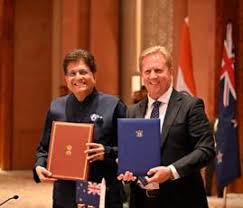
India and New Zealand signed a landmark Free Trade Agreement (FTA) at Bharat Mandapam, New Delhi. Concluded in a record nine months, this pact represents India’s 9th agreement with advanced economies, covering nearly 70% of global GDP. The deal is a "next-generation" partnership aimed at doubling bilateral trade to USD 5 billion within five years, while securing a massive USD 20 billion investment commitment from New Zealand over the next 15 years.
1. Trade in Goods: Unprecedented Market Access
The FTA provides a significant competitive edge to Indian exporters, particularly in labor-intensive sectors like textiles, leather, gems, and engineering goods.
- 100% Duty-Free Access for India: New Zealand will grant immediate duty-free access to all Indian exports. This removes previous peak tariffs of up to 10% on items like ceramics, carpets, and auto components.
- Duty-Free Inputs for Manufacturing: India secures zero-duty access to key industrial inputs such as wooden logs, coking coal, and metal scrap, which will lower production costs for domestic manufacturers.
- Calibrated Access for New Zealand: India has liberalized 70.03% of its tariff lines (covering 95% of trade value). While 30% of lines see immediate duty elimination, others will undergo phased reductions over 3 to 10 years.
2. Protection of Sensitive Sectors & Agriculture
A core pillar of the agreement is the "Productivity to Prosperity" model, which balances market opening with the protection of rural economies.
- The Exclusion List: To shield domestic farmers, India has kept 29.97% of tariff lines out of the deal. This includes all dairy products (milk, cheese, yogurt), sensitive vegetables (onions, peas, corn), sugar, edible oils, and arms/ammunition.
- Tariff Rate Quotas (TRQ): For specific high-demand items like Apples, Kiwifruit, and Manuka Honey, India will allow limited imports through a TRQ system. These are tied to Agriculture Productivity Action Plans, ensuring that New Zealand provides technical support to Indian farmers in exchange for market access.
- Centres of Excellence: The pact establishes partnerships for research, better planting material, and cold-chain logistics to improve Indian orchard management and food safety.
3. Services, Talent, and Mobility
This FTA marks a "first" in many categories regarding the movement of professionals and students.
- Temporary Employment Entry (TEE): A dedicated quota of 5,000 visas (up to 3 years) has been created for Indian professionals. This specifically includes AYUSH practitioners, yoga instructors, Indian chefs, and professionals in IT, healthcare, and engineering.
- Student Mobility: New Zealand has removed numerical caps on Indian students.
- Work Rights: Students can work 20 hours per week during studies.
- Post-Study Rights: 3 years for STEM Bachelor’s/Master’s graduates and 4 years for Doctoral scholars.
- Working Holiday Visas: 1,000 young Indians (annually) can access 12-month multiple-entry visas for global skill acquisition.
4. Strategic and Regulatory Breakthroughs
- USD 20 Billion Investment: A binding commitment from New Zealand to invest in India's infrastructure, renewable energy, and startups, backed by a "Rebalancing Clause" to address any shortfalls.
- Pharma Fast-Track: Market entry for Indian pharmaceuticals is accelerated by recognizing global standards (like US FDA/EMA), reducing duplicative inspections and costs.
- Geographical Indications (GI): New Zealand will amend its laws within 18 months to protect iconic Indian GIs (like Basmati rice or Darjeeling tea) beyond just wines and spirits.
- Traditional Knowledge & AYUSH: A first-of-its-kind chapter promotes Ayurveda, Yoga, and traditional wellness systems on a global scale.
5. India–New Zealand Relations: Strategic Context
The relationship has evolved from shared Commonwealth history to a modern strategic partnership in the Indo-Pacific.
- Indo-Pacific Alignment: New Zealand is aligning with India’s Indo-Pacific Oceans Initiative (IPOI) to counter regional maritime challenges and ensure a rules-based order.
- Economic Diversification: For New Zealand, the "Opening Doors to India" policy is a strategic move to reduce economic over-reliance on China.
- Diaspora: The Indian diaspora makes up 6% of New Zealand's population, acting as a vital bridge for "Track II" diplomacy.
Challenges to Overcome
Despite the optimism, the bilateral relationship faces hurdles:
- Strategic Ambivalence: New Zealand’s heavy economic dependence on China sometimes limits its geopolitical alignment with India.
- Security Frictions: The presence of pro-Khalistan elements in New Zealand remains a point of concern for Indian sovereignty.
- Transactional Views: Transitioning the relationship from a "labor and education market" to a deep-tech and defense partnership remains a work in progress.