
Sample Registration System (SRS) Statistical Report 2024
- 31 May 2026
In News:
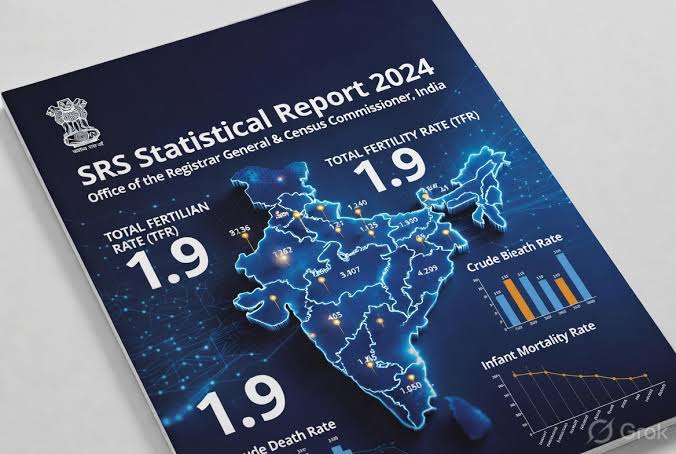
The Office of the Registrar General & Census Commissioner, under the Ministry of Home Affairs, has released the Sample Registration System (SRS) Statistical Report 2024, which reveals that India's Total Fertility Rate (TFR) has declined to 1.9, falling below the replacement level of 2.1 for the first time. The report highlights significant improvements in maternal and child health while also signalling the beginning of a new demographic challenge marked by population ageing and regional disparities.
About the Sample Registration System (SRS)
- The Sample Registration System (SRS) is India's largest continuous demographic survey and serves as the country's most reliable source of annual estimates on fertility and mortality.
- Conducted by the Office of the Registrar General & Census Commissioner under the Ministry of Home Affairs, the survey provides annual estimates of the Birth Rate, Death Rate, Infant Mortality Rate (IMR), Under-Five Mortality Rate (U5MR), Total Fertility Rate (TFR) and other demographic indicators between two Census operations.
- The 2024 report is based on the 2011 Census sampling frame and covers nearly 8.9 million individuals across 8,839 sample units, making it the principal macro-level demographic database for policy formulation.
India's Demographic Profile: Major Findings
- The report indicates that India has entered an advanced stage of demographic transition. The Total Fertility Rate (TFR) has declined to 1.9, significantly below the replacement level of 2.1, suggesting that Indian families are opting for fewer children. This decline is accompanied by a continuous fall in the Crude Birth Rate (CBR) from 21.0 in 2014 to 18.3 in 2024, while the Crude Death Rate (CDR) has stabilised at 6.4.
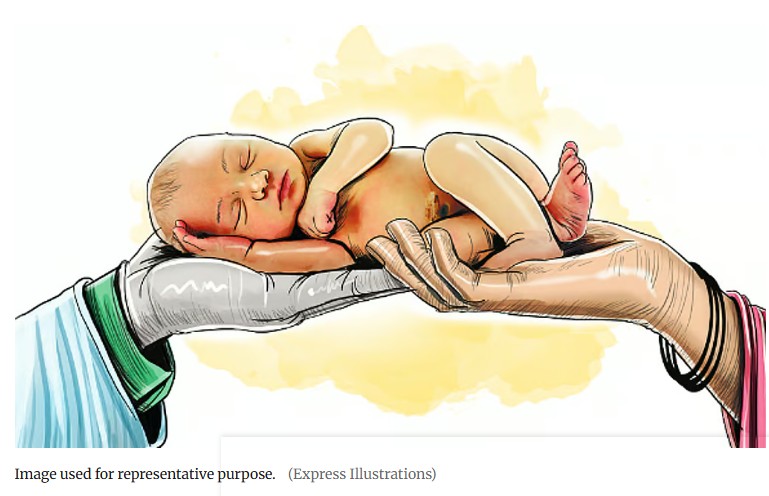
- The report also reflects substantial progress in public health outcomes. The Infant Mortality Rate (IMR) has fallen to 24 deaths per 1,000 live births, compared to 30 in 2019, while the Under-Five Mortality Rate (U5MR) has declined to 28 per 1,000 live births. These improvements are largely attributed to expanded immunisation coverage, institutional deliveries, improved neonatal care and better access to healthcare facilities.
- A notable achievement is the expansion of institutional healthcare, with 95.4% of all deliveries now taking place in hospitals or recognised healthcare institutions, indicating significant progress in maternal healthcare services.
- The report also reveals important demographic shifts. Children (0–14 years) now constitute 24% of the population, whereas the working-age population(15–59 years) accounts for 66.4%, reinforcing India's demographic dividend. Simultaneously, the elderly population (60 years and above) has increased to 9.7%, indicating the gradual onset of population ageing. Reflecting broader social transformation, the mean age at effective marriage for women has risen to 23.1 years, suggesting greater female educational attainment and delayed childbearing. The Sex Ratio at Birth (2022–24 average) has marginally improved to 918 females per 1,000 males, though it remains below the natural level.
What Do These Trends Indicate?
The findings indicate that India is progressing through the late stage of the Demographic Transition Model (DTM), characterised by low birth rates, low death rates and slowing population growth. Unlike previous decades when population explosion dominated policy discourse, India is now gradually shifting towards concerns related to ageing, labour force sustainability and social security.
The expansion of the working-age population presents a valuable demographic dividend. If complemented with quality education, skill development and employment generation, it can significantly accelerate economic growth and improve productivity. However, this demographic advantage is time-bound and requires effective policy intervention before the population begins ageing rapidly.
The report also reflects the positive outcomes of investments in public health. The sharp increase in institutional deliveries and the decline in infant and child mortality demonstrate the success of initiatives such as improved maternal healthcare, immunisationprogrammes and strengthened primary healthcare infrastructure.
Emerging Challenges
Despite encouraging national averages, the report highlights considerable regional disparities. Southern states such as Kerala and Tamil Nadu have already entered an advanced demographic stage with very low fertility levels, while several northern and central states continue to record relatively higher fertility and infant mortality rates. For instance, Kerala records an IMR of only 8, whereas Chhattisgarh reports an IMR of 36, revealing significant inequalities in healthcare outcomes and human development.
The report also exposes persistent rural-urban disparities. Rural areas continue to experience higher infant mortality and comparatively lower access to quality healthcare infrastructure than urban centres, indicating the need for stronger primary healthcare systems in underserved regions.
Another emerging concern is the rapid decline in fertility. Although lower fertility reflects improved education and healthcare, sustained fertility below replacement level could eventually reduce the size of the labour force and increase the old-age dependency ratio. States such as Delhi (TFR 1.2) and Kerala (TFR 1.3) already face the prospect of accelerated population ageing.
Equally concerning is the finding that 45.5% of deceased individuals received no medical attention before death, pointing to deficiencies in geriatric care, palliative care and end-of-life healthcare services.
Sample Registration System (SRS) Statistical Report 2024
- 28 May 2026
In News:
The Sample Registration System (SRS) Statistical Report 2024 highlights a major epidemiological transition in India, with Non-Communicable Diseases (NCDs) accounting for 60% of all deaths during 2022–2024, up from 52.8% during 2015–2017. The findings indicate that chronic diseases have firmly overtaken communicable diseases as the country's principal public health challenge, reflecting patterns increasingly observed in middle- and high-income economies.
India's Epidemiological Transition
The report demonstrates a steady shift from infectious diseases towards chronic and lifestyle-related illnesses. While the combined share of communicable diseases, maternal conditions, perinatal disorders, and nutritional deficiencies declined from 22% in 2015–2017 to 19.7% in 2022–2024, deaths due to NCDs increased significantly.
This transition is driven by rapid urbanisation, changing dietary habits, sedentary lifestyles, population ageing, environmental factors, and improved control over many infectious diseases. However, India continues to face a “double burden of disease”, where communicable diseases persist alongside a rapidly growing NCD burden.
Cardiovascular Diseases: The Biggest Killer
Among all NCDs, cardiovascular diseases (CVDs) emerged as the leading cause of mortality, accounting for 32.1% of all deaths, compared to 27.1% in 2015–2017. The situation is particularly concerning in the economically productive 30–69 years age group, where cardiovascular diseases account for 37.3% of deaths.
Health experts have noted a worrying increase in heart-related illnesses among adults in their thirties and forties. This trend has significant economic implications because it affects a large segment of the workforce, leading to productivity losses, rising healthcare costs, and increased social dependency.
Other major causes of death include:
- Cancer and other neoplasms
- Chronic respiratory diseases
- Digestive diseases
- Respiratory infections
Each of these contributes more than 5% of total mortality.
Demographic Dividend Under Pressure
The report raises concerns about the impact of premature mortality on India's demographic advantage. While 69.3% of deaths occur among individuals aged 55 years and above, the 30–44 years age group accounts for 19.5% of all deaths.
This trend assumes greater significance as India's Total Fertility Rate (TFR) continues to decline, with several states already below the replacement level of 2.1 children per woman. Premature deaths among working-age adults can undermine economic growth and reduce the benefits of the country's demographic dividend.
Rural, Urban and Gender Dimensions
NCDs remain more prevalent in urban areas, where they account for 64.8% of all deaths, compared to 58.8% in rural areas. Similarly, NCDs account for 62.3% of deaths among men and 56.9% among women.
However, the report reveals that NCDs are increasingly becoming the dominant cause of death even among rural populations and women, indicating the deep penetration of lifestyle-related risk factors beyond urban centres.
Mental Health Concerns Among Youth
A particularly alarming finding is that suicide remains the leading cause of death among the 15–29 years age group. Suicides accounted for 19% of deaths in this cohort, up from 16.3% in 2015–2017.
The rise reflects growing mental health challenges linked to unemployment, academic pressure, financial stress, social isolation, and changing societal dynamics. The trend underscores the need for stronger mental health services, awareness campaigns, and community-based interventions.
Regional Variations
The report highlights significant regional disparities. In the Empowered Action Group (EAG) States and Assam—comprising Bihar, Jharkhand, Madhya Pradesh, Chhattisgarh, Odisha, Rajasthan, Uttar Pradesh, Uttarakhand, and Assam—NCDs account for 53.9% of all deaths. In contrast, non-EAG states record a much higher NCD mortality share of 63.5%.
These differences largely reflect varying levels of urbanisation, healthcare access, socioeconomic development, and demographic ageing across regions.
Government Response: National Programme for Prevention and Control of NCDs
Recognising the growing challenge, the Government of India launched the National Programme for Prevention and Control of Non-Communicable Diseases (NP-NCD) in 2010 across 100 districts in 21 states during the Eleventh Five-Year Plan. The programme was subsequently expanded and integrated into the National Health Mission (NHM) in 2013–14.
The programme focuses on:
- Prevention and early detection of NCDs.
- Screening for diabetes, hypertension, and common cancers.
- Health promotion and behavioural change.
- Strengthening healthcare infrastructure and referral systems.