
Netra Airborne Early Warning and Control (AEW&C) System
- 28 Jun 2026
In News:
India's indigenous Netra Airborne Early Warning and Control (AEW&C) system has received Final Operational Clearance (FOC), making it fully operational for deployment by the Indian Air Force (IAF).
About Netra AEW&C
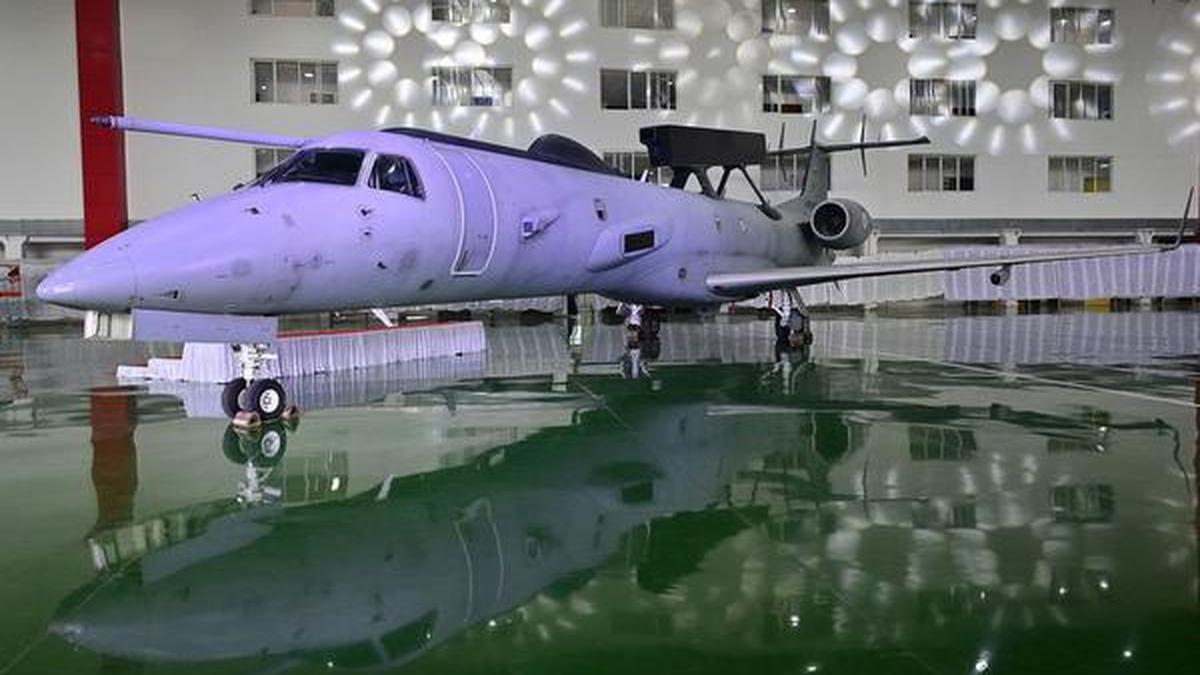
Netra is India's first indigenously developed Airborne Early Warning and Control (AEW&C) system, designed by the Centre for Airborne Systems (CABS) under the Defence Research and Development Organisation (DRDO). It serves as an airborne surveillance, command-and-control and battle-management platform, providing the Indian Air Force with real-time situational awareness during military operations.
With the development of Netra, India became the fifth country, after the United States, Russia, Israel and China, to possess an indigenous AEW&C capability.
How It Works
The system is mounted on the Embraer EMB-145I aircraft and functions as an "eye in the sky." Its Active Electronically Scanned Array (AESA) radar continuously scans the surrounding airspace to detect, identify and track hostile aircraft, missiles and selected maritime targets over long distances. The information is processed onboard and transmitted securely to fighter aircraft, air-defence systems and ground command centres, enabling rapid operational decision-making.
Key Features
Netra is equipped with an AESA radar, Identification Friend or Foe (IFF) system, Electronic Support Measures (ESM), Communication Support Measures (CSM), mission computers, secure communication links and self-protection systems. Together, these systems enable long-range surveillance, target tracking, electronic intelligence and airborne command-and-control during combat operations.
Operational Importance
Netra acts as a force multiplier by providing early warning of aerial threats, enhancing situational awareness and supporting network-centric warfare. It coordinates fighter aircraft, guides interception missions, strengthens air-defence operations and significantly improves India's ability to monitor its airspace without depending solely on ground-based radars.
Background
India's airborne surveillance programme began in the 1980s under Project Guardian, which used a modified HS-748 Avro aircraft. The programme suffered a setback following the 1999 Arakkonam crash, but was revived in 2004, eventually leading to the successful development of the Netra AEW&C system.
Significance
Netra has already demonstrated its operational effectiveness during the 2019 Balakot air strikes and Operation Sindoor (2025) by enhancing surveillance, battlefield awareness and command-and-control capabilities. Since the system is developed indigenously, India retains complete control over its software, source codes and future upgrades, reducing dependence on foreign manufacturers and strengthening defence self-reliance under the Atmanirbhar Bharat initiative.
The Cabinet Committee on Security (CCS) has approved six upgraded Netra Mk-1A systems, while the upcoming Netra Mk-2, to be mounted on the Airbus A321 platform, is expected to significantly expand India's airborne surveillance capability.