
Maori Tribe and the Concept of ‘Waka’
- 15 Jul 2026
In News:
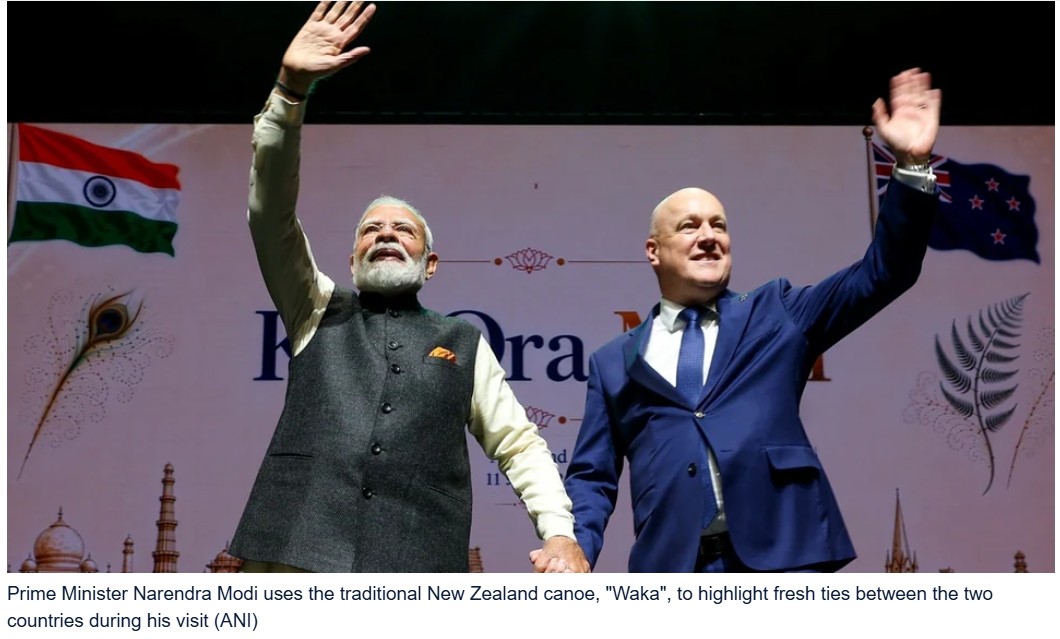
During his address to the Indian community in Auckland, the Prime Minister of India invoked the M?ori concept of "Waka" to symbolise the growing partnership between India and New Zealand, emphasising a shared journey based on trust, cooperation and common values.
Who are the M?ori?
- The M?ori are the indigenous people of New Zealand, who first settled on the islands in the early 13th century. They belong to the Polynesian ethnic group and are most closely related to the Eastern Polynesians.
- Today, M?ori constitute about one-sixth of New Zealand's population, with nearly 86% residing on the North Island.
- Despite centuries of colonial rule and displacement, the M?ori have preserved their language, traditions and cultural identity, and have witnessed a significant cultural revival in recent decades.
Language and Cultural Heritage
- The M?ori language (Te Reo M?ori) belongs to the Polynesian group of the Eastern Oceanic branch of the Austronesian language family and is one of the official languages of New Zealand. While most M?ori are fluent in English, nearly one-third continue to speak their ancestral language.
- At the heart of M?ori society is the Marae, a sacred communal space comprising meeting houses and open grounds where communities gather for ceremonies, discussions, cultural performances and social events.
- The M?ori are globally recognised for the Haka, a traditional ceremonial dance characterised by rhythmic chanting, vigorous movements and expressive facial gestures. Another distinctive cultural tradition is Ta Moko, the sacred art of facial and body tattooing, which reflects an individual's genealogy, social status, achievements and identity.
Cultural Revival
A renewed assertion of M?ori identity emerged during the civil rights movements of the 1960s. This was further strengthened by the Treaty of Waitangi Act, 1975, which enabled M?ori communities to pursue claims relating to historical injustices and reinforced efforts to preserve their language and cultural heritage.
What is ‘Waka’?
In the M?ori language, "Waka" literally means a canoe or vessel. Beyond its physical meaning, it represents a shared journey, unity, collective purpose and cooperation. Traditionally, waka symbolisedthe voyages undertaken by the ancestors of the M?ori to reach New Zealand and continues to represent solidarity and common destiny in M?ori culture.
By invoking the concept of Waka, the Prime Minister highlighted the shared aspirations of India and New Zealand to move forward together through mutual trust, partnership and collaboration.