
India’s E20 Fuel Transition
- 25 Aug 2026
In News:
India has moved towards a nationwide E20 petrol regime—petrol blended with up to 20% anhydrous ethanol, with a minimum Research Octane Number (RON) of 95. The transition under the Ethanol Blended Petrol (EBP) Programme aims to reduce fossil-fuel dependence, improve energy security and promote domestically produced renewable ethanol. However, concerns have emerged regarding the compatibility of E20 with India’s large fleet of older vehicles.
What is E20?
E20 contains 20% ethanol and 80% petrol. Ethanol has lower energy density than petrol and is also hygroscopic, meaning it absorbs moisture. These properties can affect fuel economy and the durability of certain components in vehicles designed for lower ethanol blends.
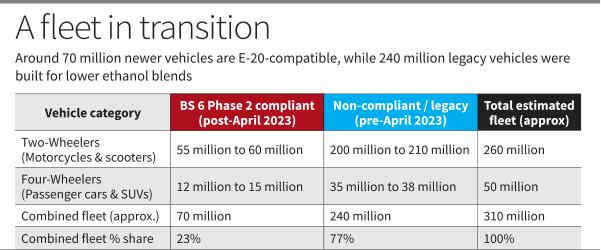
According to the material provided, India has around 310 million petrol vehicles, of which approximately 240 million (77%) are legacy vehicles, predominantly two-wheelers, that were not factory-engineered specifically for E20.
Why is E20 being promoted?
The transition is intended to:
- Reduce crude-oil imports and foreign-exchange outflow.
- Improve energy security through greater use of domestically produced ethanol.
- Support sugarcane and grain-based ethanol industries.
- Reduce lifecycle greenhouse-gas emissions compared with fossil petrol.
- Create a domestic biofuel and rural economic ecosystem.
The government has accelerated ethanol blending ahead of the earlier 2030 target, alongside expansion of domestic distillery capacity.
Major Concerns
The key issue is legacy vehicle compatibility. Ethanol’s lower energy density can contribute to reduced mileage, while its solvent and moisture-absorbing properties may affect older fuel-system components.
Potential technical problems include phase separation, corrosion, deterioration of rubber components, fuel-filter clogging and injector problems. Water ingress into underground storage tanks can aggravate these problems.
The material also highlights concerns over fuel-quality contamination, including organic chlorides and excessive water content, which can compound the risks associated with ethanol blending.
Importantly, scientific assessments are not uniform: laboratory studies cited in the material indicate relatively limited efficiency losses, while some consumer experiences and industry data report greater mileage and component-related problems.
Policy Measures & Way Forward
The government has mandated a minimum RON 95 for E20 to improve anti-knock performance. The Society of Indian Automobile Manufacturers (SIAM) is undertaking a multi-stakeholder study on long-term vehicle compatibility.
A balanced transition should focus on:
- Clear labelling of ethanol percentage and RON at fuel stations.
- Strict fuel-quality monitoring throughout the supply chain.
- Independent, multi-year real-world fleet testing across climatic regions.
- Affordable retrofit solutions for compatible legacy vehicles.
- Consideration of lower-blend alternatives for vehicles demonstrably unsuitable for E20.