
Blue Corner Notice
- 13 Dec 2025
In News:
Recently, INTERPOL issued a Blue Corner Notice to trace the missing owners of a Goa nightclub after a major fire incident. The request from India was processed through the Central Bureau of Investigation (CBI), which is India’s nodal agency for INTERPOL coordination.
What is a Blue Corner Notice?
A Blue Corner Notice (also called an Enquiry Notice) is issued to:
- Collect additional information about a person’s identity
- Establish a person’s location
- Gather details about a person’s activities related to an ongoing criminal investigation
It is generally issued before formal criminal charges are filed.
It enables police forces in different countries to share investigative information.
It is not an arrest warrant
It does not automatically require detention
About INTERPOL
INTERPOL stands for the International Criminal Police Organization. It facilitates cooperation among police forces across countries to tackle transnational crimes such as terrorism, trafficking, cybercrime, financial crimes, and organized crime.
- It has 196 member countries
- India became a member in 1949
- Headquarters is located in Lyon, France
- It is not a United Nations agency, but it has had Permanent Observer status at the UN since 1996
- INTERPOL does not have its own police force; it functions as a coordination and information-sharing platform
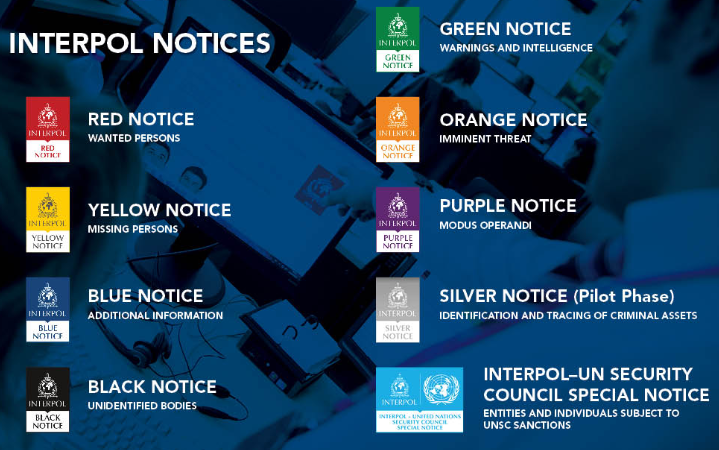
Different Types of INTERPOL Notices
- Red Notice – Issued to locate and provisionally arrest a person wanted for prosecution or to serve a sentence.
- Blue Notice – Issued to collect additional information about a person’s identity, location, or activities in relation to a criminal investigation.
- Yellow Notice – Used to help locate missing persons, often minors, or to identify persons unable to identify themselves.
- Black Notice – Issued to seek information about unidentified bodies.
- Green Notice – Warns member countries about individuals with a history of criminal behaviour who may pose a future threat.
- Orange Notice – Warns about an event, person, object, or process posing a serious and imminent threat to public safety.
- Purple Notice – Used to share information on criminal methods, devices, concealment techniques, or modus operandi.
- Silver Notice (Pilot Phase) – Helps identify and trace assets linked to criminal activities.
- INTERPOL–UN Special Notice – Issued for individuals and entities subject to UN Security Council sanctions.
Blue Corner Notice
- 04 May 2024
Why is it in the News?
The Central Bureau of Investigation (CBI) is likely to issue a Blue Corner notice against absconding Janata Dal (Secular) MP Prajwal Revanna.
What is Interpol’s Colour-coded Notices?
- A Blue or a Blue Corner notice is a part of Interpol’s elaborate system of colour-coded notices, which enable countries to “share alerts and requests for information [on wanted persons/crimes] worldwide”.
- This sharing of critical crime-related information is crucial for tackling internationally spread-out criminal activities.
- There are seven types of notices — Red Notice, Yellow Notice, Blue Notice, Black Notice, Green Notice, Orange Notice, and Purple Notice. Each has a different implication.
- Red Notice: To seek the location and arrest of persons wanted for prosecution or to serve a sentence.
- Yellow Notice: To help locate missing persons, often minors, or to help identify persons who are unable to identify themselves.
- Blue Notice: To collect additional information about a person’s identity, location or activities in relation to a criminal investigation.
- Black Notice: To seek information on unidentified bodies.
- Green Notice: To provide a warning about a person’s criminal activities, where the person is considered to be a possible threat to public safety.
- Orange Notice: To warn of an event, a person, an object or a process representing a serious and imminent threat to public safety.
- Purple Notice: To seek or provide information on modus operandi, objects, devices and concealment methods used by criminals.
- These notices are issued by Interpol’s General Secretariat at the request of a member country’s Interpol National Central Bureau and are made available for all member countries.
What is Interpol?
- Interpol, or the International Criminal Police Organization, is an intergovernmental organization that facilitates global police cooperation and crime control.
- Founded in 1923, Interpol enables member countries to share data and collaborate on investigating cross-border crimes, such as terrorism, drug trafficking, cybercrime, and human trafficking.
- Interpol is composed of a network of 194 member countries, each having a National Central Bureau (NCB) that serves as the point of contact for international investigations. Key functions of Interpol include:
- Providing a secure communication system for member countries to exchange information on criminal activities.
- Facilitating operational support and assistance for member countries in managing crime-related crises and emergencies.
- Coordinating training and capacity-building initiatives to enhance the capabilities of law enforcement agencies.
- Issuing colour-coded notices (e.g., Red Notice for wanted persons) to alert member countries about international criminals and activities.
- Providing access to databases containing vital data on known criminals, fingerprints, DNA profiles, and stolen and lost travel documents.
- Interpol functions within the framework of international law and operates in accordance with the principle of neutrality, ensuring that it does not interfere in the political, military, religious, or racial affairs of member countries.
- Its main objective is to provide a platform for international police cooperation and create a safer world for all.