
PM-WANI Scheme
- 08 Dec 2025
In News:
The PM-WANI Scheme, approved on 9 December 2020, is a national framework to expand public Wi-Fi access across India. It is implemented by the Department of Telecommunications (DoT), Ministry of Communications, and aligns with the goals of the National Digital Communications Policy (NDCP) 2018 to create robust digital infrastructure and promote affordable broadband access.
As of November 2025, over 3.9 lakh PM-WANI Wi-Fi hotspots (Public Data Offices – PDOs) have been deployed across the country, reflecting rapid expansion of decentralized public internet access.
Objective
PM-WANI aims to:
- Democratize internet access
- Bridge the digital divide, especially in rural and underserved areas
- Encourage local entrepreneurship through small-scale Wi-Fi providers
- Support digital services such as e-governance, digital payments, telemedicine, and online education
Key Concept
PM-WANI allows small shopkeepers, entrepreneurs, and establishments to provide public Wi-Fi without needing a telecom licence, spectrum, or heavy regulatory compliance. This low-entry model makes broadband delivery affordable and scalable.
Four-Tier Architecture
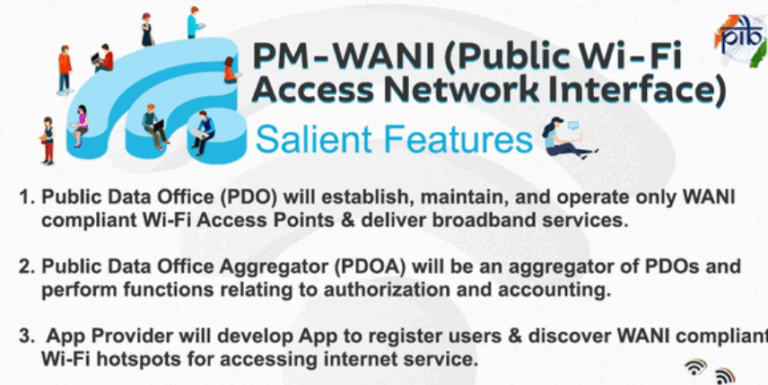
- Public Data Offices (PDOs):Local entities that set up and operate Wi-Fi hotspots to provide internet access to users.
- Public Data Office Aggregators (PDOAs):They manage authentication, authorization, and accounting functions for PDOs.
- App Providers:Provide mobile/web applications through which users discover hotspots, authenticate, and access services.
- Central Registry (maintained by C-DoT):Stores details of PDOs, PDOAs, and App Providers to ensure interoperability.
Major Reforms and Features
1. Use of FTTH Connections:PDOs can now use regular Fibre-to-the-Home (FTTH) broadband connections, reducing deployment costs.
2. Aggregation of Access Points:Multiple Wi-Fi access points can share a single backhaul connection, enabling wider hotspot coverage.
3. Integration of Existing Wi-Fi Routers:Existing home and business Wi-Fi access points can join the PM-WANI ecosystem, creating additional income streams.
4. Roaming Across Networks:Users can seamlessly switch between hotspots of different PDOAs, similar to mobile network roaming.
5. Mobile Data Offload:PDOs can collaborate with telecom service providers to offload mobile data traffic onto Wi-Fi, improving network efficiency.
6. Consent-Based Communication:PDOAs and App Providers may send promotional or informational content to users only with explicit user consent, ensuring privacy safeguards.
Affordable Broadband for PDOs (TRAI Provision)
The Telecommunication Tariff (71st Amendment) Order, 2025 mandates that retail FTTH broadband plans up to 200 Mbps must be offered to PDOs at not more than twice the tariff of equivalent consumer plans, ensuring cost-effective operations.
Technology and Compliance
Hardware and software are procured by stakeholders (PDOs, PDOAs, App Providers), but all solutions must be PM-WANI compliant and certified by C-DoT as per scheme guidelines.
Significance
PM-WANI strengthens India’s Digital Public Infrastructure ecosystem alongside Aadhaar and UPI. By enabling community-based broadband delivery, it promotes digital inclusion, entrepreneurship, and last-mile connectivity, especially in remote and low-income regions.