
Alaknanda Galaxy
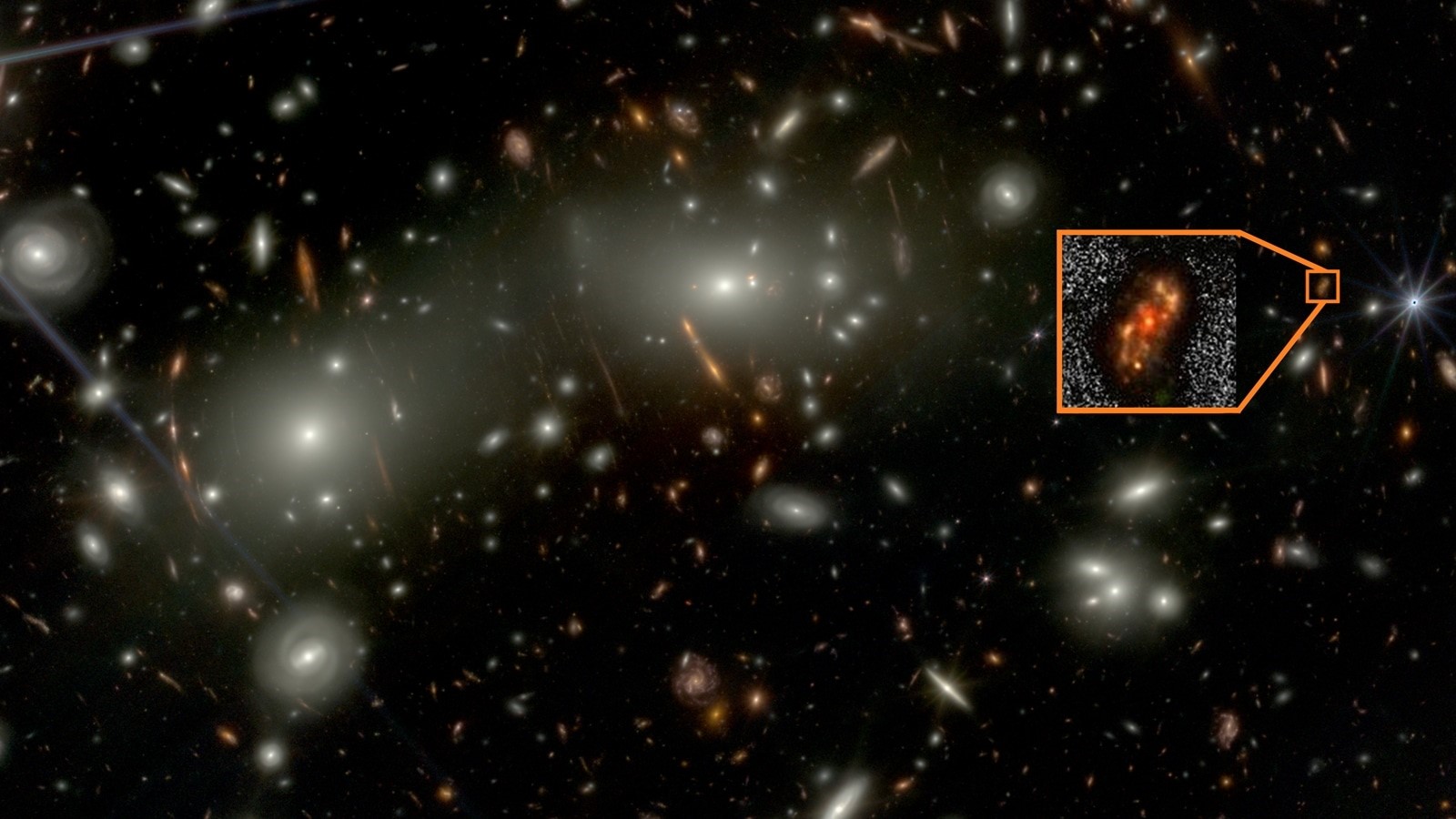
- 05 Dec 2025
In News:
Researchers from the National Centre for Radio Astrophysics (NCRA), Tata Institute of Fundamental Research (TIFR), Pune, have discovered a well-structured spiral galaxy named Alaknanda. This galaxy dates back to just 1.5 billion years after the Big Bang and was identified using NASA’s James Webb Space Telescope (JWST). The finding challenges existing theories about how early galaxies formed.
Why This Discovery is Important
Scientists believed that galaxies in the early universe were generally chaotic, clumpy, and unstable, lacking well-defined structures. Spiral galaxies like the Milky Way were thought to have developed much later. However, Alaknanda shows a mature spiral structure, indicating that complex galactic systems may have evolved far earlier than previously assumed.
Key Facts About the Alaknanda Galaxy
Alaknanda formed when the universe was only about 10 percent of its current age, roughly 1.5 billion years old. It lies approximately 12 billion light-years away from Earth. The galaxy displays a textbook spiral structure with two well-defined spiral arms and a bright central bulge. Its diameter is estimated to be around 30,000 light-years.
The name “Alaknanda” is inspired by the Alaknanda River in the Himalayas, considered the sister river of Mandakini, which is also a Hindi name for the Milky Way galaxy. The naming reflects the idea that this distant galaxy resembles a “sister” of our own galaxy.
Scientific Significance
The discovery adds to growing evidence from JWST that the early universe may have been more mature and structured than earlier models suggested. It challenges current theories of galaxy formation and indicates that organized spiral structures may have emerged earlier in cosmic history.
Future research will focus on studying the motion of gas and stars within Alaknanda to understand how its spiral arms formed. Scientists plan to use further data from JWST and the Atacama Large Millimeter/submillimeter Array (ALMA) in Chile. These studies will help determine whether the galaxy’s disk is dynamically calm or turbulent, which in turn reveals the mechanism behind its structure.
About Galaxies
Galaxies are vast systems made up of stars, planets, gas, dust, dark matter, and usually a supermassive black hole at their centre. They are held together by gravity and vary greatly in size. Some dwarf galaxies contain only a few thousand stars, while giant galaxies can contain trillions of stars and span over a million light-years.
Galaxies are commonly classified into three main types: spiral, elliptical, and irregular.
Galaxies in the Cosmic Web
Galaxies are not randomly scattered. They form groups, which can contain up to about a hundred galaxies, and clusters, which can include thousands. These clusters connect to form superclusters, which are part of the large-scale cosmic web that structures the universe.
Key Processes in Galaxy Evolution
Spiral galaxies often develop stellar bars that influence star formation. Galaxies may collide, causing gas clouds to compress and trigger new star formation. Some collisions lead to mergers, forming a single larger galaxy and altering its structure. Larger galaxies can also grow by absorbing smaller ones, a process sometimes called galactic cannibalism.
Milky Way Galaxy - Important Facts
The Milky Way is a spiral galaxy more than 100,000 light-years across. Earth lies in one of its spiral arms, roughly halfway from the galactic centre. The Milky Way is part of the Local Group, which includes more than 50 galaxies such as the Andromeda Galaxy. This group is located within the vast Laniakea Supercluster. Our solar system takes about 240 million years to complete one orbit around the Milky Way.