
PM-SETU Scheme
- 14 Mar 2026
In News:
- The Government of India has constituted a National Steering Committee (NSC) to guide the implementation of the Pradhan Mantri Skilling and Employability through Upgraded ITIs (PM?SETU) scheme.
- The committee will function as the apex body to oversee reforms aimed at modernising Industrial Training Institutes (ITIs) and improving employability outcomes across the country.
- Approved by the Union Cabinet in 2025 with an estimated outlay of ?60,000 crore, PM-SETU represents a major initiative to align India’s vocational training ecosystem with emerging industry demands and technological changes.
Objectives of PM-SETU
The scheme seeks to transform the country’s skill development framework by:
- Upgrading Industrial Training Institutes (ITIs) with modern infrastructure and technology.
- Improving employability of youth through industry-relevant training.
- Promoting industry participation in vocational education.
- Aligning skill development programmes with future sectors such as advanced manufacturing, electronics, mobility, and logistics.
A key objective is to shift the model of skill training from government-led programmes to an industry-driven ecosystem, where companies actively participate in curriculum design, training delivery, and infrastructure development.
Hub-and-Spoke Model for ITI Upgradation
A major structural reform under PM-SETU is the introduction of the hub-and-spoke model.
- Around 200 ITIs will be upgraded as “Hub” institutions with advanced infrastructure and modern training facilities.
- Each hub will mentor approximately four nearby “Spoke” ITIs, sharing resources such as specialised equipment, digital learning platforms, and technical expertise.
This model aims to create regional clusters of high-quality skill training centres, ensuring wider access to modern vocational education.
Strengthening National Skill Training Institutes
The scheme also focuses on upgrading National Skill Training Institutes (NSTIs) into global Centres of Excellence. Key NSTIs targeted under the initiative are located in:
- Bhubaneswar
- Chennai
- Hyderabad
- Kanpur
- Ludhiana
These institutions will provide advanced training, support instructor development, and promote innovation in skill training methodologies.
Governance through Special Purpose Vehicles (SPVs)
Each upgraded ITI will be managed through a Special Purpose Vehicle (SPV) formed under an industry-government partnership model.
Key features include:
- Industry partners hold 51% ownership, while the government holds 49%.
- Industry participants can receive up to 83% government funding for infrastructure and training upgrades.
- The SPV structure ensures professional management, accountability, and industry alignment.
This governance model is designed to bring corporate expertise and efficiency into vocational education management.
Industry Participation
To enhance collaboration with the private sector, the **Ministry of Skill Development and Entrepreneurship has invited Anchor Industry Partners (AIPs) through an Expression of Interest (EOI) process.
These industry partners will play a key role in:
- Designing industry-relevant curricula
- Upgrading training infrastructure
- Providing hands-on exposure and apprenticeships
- Improving placement opportunities for trainees
Modern Training Ecosystem
The Directorate General of Training has introduced 31 new-age courses under the Craftsmen Training Scheme (CTS) to address emerging industry requirements.
Training programmes will focus on high-growth sectors such as:
- Advanced manufacturing
- Electronics and semiconductor-related technologies
- Mobility and electric vehicles
- Logistics and supply chain management
These reforms aim to build a future-ready workforce equipped with modern technical skills.
PM-SETU Scheme
- 08 Oct 2025
In News:
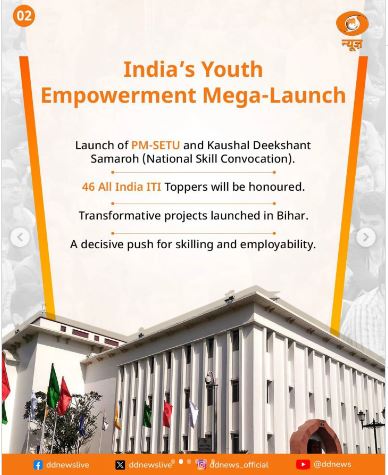
- Prime Minister Narendra Modi launched a series of youth-focused initiatives worth over ?62,000 crore, aimed at empowering India’s young population through education, skill development, and entrepreneurship.
- The announcements were made during the Kaushal DeekshantSamaroh held at Vigyan Bhawan, New Delhi, marking a significant step toward building a future-ready workforce aligned with global skill demands.
Pradhan Mantri Skilling and Employability Transformation through Upgraded ITIs (PM–SETU)
The centrepiece of the event was the launch of the PM–SETU scheme — a centrally sponsored initiative with an investment of ?60,000 crore. The scheme seeks to revitalize Industrial Training Institutes (ITIs) across India, transforming them into modern, industry-linked centers of skill excellence.
Key Features of PM–SETU
- Coverage: Transformation of 1,000 Government ITIs into modern, technology-driven institutes.
- Implementation Model:
- Based on a Hub-and-Spoke structure, comprising 200 hub ITIs connected to 800 spoke ITIs.
- Hub ITIs will host innovation centers, incubation units, production facilities, and training-of-trainers setups.
- Spoke ITIs will extend outreach, ensuring skill accessibility to smaller towns and semi-urban regions.
- Curriculum and Industry Linkage:
- Introduction of new demand-driven courses and modernization of existing ones in collaboration with industry partners.
- Establishment of Special Purpose Vehicles (SPVs) with anchor industries to ensure cluster-based training and employability outcomes.
- Academic Integration: Creation of pathways for short-term training, executive programs, and long-term diploma courses to align with higher education and employment opportunities.
- Centres of Excellence: Strengthening of five National Skill Training Institutes—
- Bhubaneswar (Odisha)
- Chennai (Tamil Nadu)
- Hyderabad (Telangana)
- Kanpur (Uttar Pradesh)
- Ludhiana (Punjab)
These will serve as global-level Centres of Excellence through partnerships with leading international institutions.
- Global Collaboration: The initiative is co-financed by the World Bank and the Asian Development Bank (ADB), with the first phase focusing on Patna and Darbhanga ITIs in Bihar.
Other Youth-Focused Announcements
- Vocational Skill Labs: Inauguration of 1,200 vocational skill labs across 400 Jawahar Navodaya Vidyalayas (JNVs) and 200 Eklavya Model Residential Schools spread across 34 States and Union Territories, to integrate skill education at the school level.
- Bihar’s Revamped MukhyamantriNishchay Swayam Sahayata Bhatta Yojana:
- Under the revamped scheme, five lakh graduate youth in Bihar will receive a monthly allowance of ?1,000 for two years, along with free skill training.
- The scheme aims to enhance youth employability and entrepreneurship readiness.
- Karpoori Thakur Skill University: A Skill University named after Bharat RatnaKarpoori Thakur will be established to honor his contribution to social empowerment and education.
- Recognition of Excellence: The Prime Minister also felicitated 46 All India Toppers from Industrial Training Institutes (ITIs) under the Ministry of Skill Development and Entrepreneurship (MSDE).