
Fiscal Health Index 2026
- 14 Mar 2026
In News:
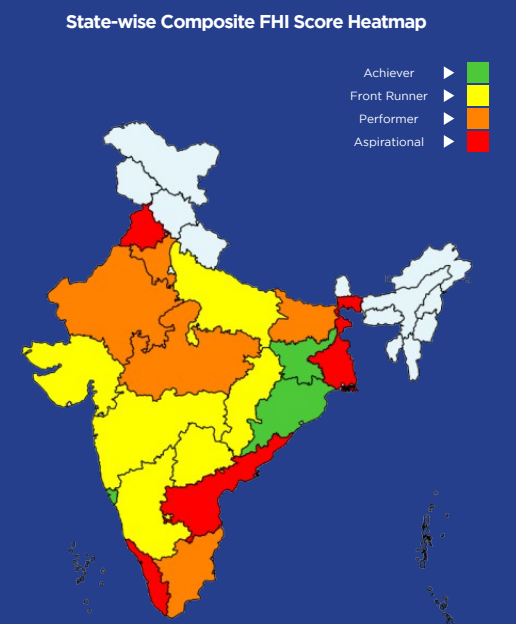
- The NITI Aayog has released the second edition of the Fiscal Health Index (FHI) 2026, which evaluates the fiscal performance and sustainability of Indian states for the financial year 2023–24.
- The index provides a comprehensive framework to assess the fiscal strength, vulnerabilities, and sustainability of state finances, moving beyond traditional indicators such as fiscal deficit to a broader evaluation of fiscal management.
- Given that state governments account for around one-third of India’s general government debt, their fiscal health plays a critical role in ensuring macroeconomic stability and sustainable economic growth.
What is the Fiscal Health Index?
- The Fiscal Health Index (FHI) is a comparative analytical framework developed by NITI Aayog to evaluate the financial performance of states using multiple fiscal indicators. It aims to promote transparent fiscal governance, data-driven policymaking, and peer benchmarking among states.
Key Pillars of the Index
The FHI evaluates states based on five core pillars:
- Quality of Expenditure: This indicator examines the composition of government spending, focusing on the proportion allocated to developmental and capital expenditure rather than committed or routine spending.
- Revenue Mobilisation: It measures the ability of states to generate own tax and non-tax revenues, reflecting fiscal self-reliance.
- Fiscal Prudence: This pillar evaluates how effectively states manage their fiscal deficits and adhere to the norms under the Fiscal Responsibility and Budget Management Act (FRBM).
- Debt Index: It assesses the size and burden of outstanding liabilities, indicating the level of indebtedness.
- Debt Sustainability: This dimension examines the long-term ability of states to service their debt obligations without creating fiscal stress.
State Rankings (FY 2023–24)
Top Performing States
- Odisha – Rank 1 (Score: 73.1)
- Goa – Rank 2 (Score: 54.7)
- Jharkhand – Rank 3 (Score: 50.5)
- Gujarat – Rank 4
- Maharashtra – Rank 5
Bottom Performing States
- Punjab – Rank 18
- Andhra Pradesh – Rank 17
- West Bengal – Rank 16
- Kerala – Rank 15
Among the North-Eastern and Himalayan states, Arunachal Pradesh emerged as the top performer, largely due to high-quality expenditure and relatively stable fiscal management.
Key Findings of the Report
- Expanded Coverage: The 2026 edition expanded its scope to include 10 North-Eastern and Himalayan states, recognising their unique geographic and structural fiscal constraints.
- Improved Capital Expenditure: Several states have increasingly prioritised capital expenditure and social sector spending, reflecting a shift toward growth-oriented investments.
- Persistent Fiscal Stress in Some States: Certain states continue to face structural fiscal challenges, including rising debt levels, weak revenue growth, and high fiscal deficits.
- Importance for National Macroeconomic Stability: With state finances forming a significant portion of public debt, improving fiscal management at the state level is essential for India’s overall fiscal stability.
Major Challenges Highlighted
- High Committed Expenditure: Large portions of state budgets are locked into salaries, pensions, and interest payments, leaving limited resources for development. For example, committed expenditure in Punjab accounted for about 80% of revenue receipts in 2023–24.
- Weak Own-Revenue Mobilisation: Several states depend heavily on central transfers rather than internal revenue generation. In Bihar, own revenue contributes less than one-third of total receipts, increasing fiscal vulnerability.
- Fiscal Deficit Pressures: Some states have breached the fiscal deficit limits prescribed under the FRBM framework. For instance, Andhra Pradesh’s fiscal deficit reached 4.35% of GSDP in 2023–24, exceeding the recommended threshold.
- Rising Interest Burden: High levels of debt lead to large interest payments. West Bengal spends over 20% of its revenue receipts on debt servicing, reducing fiscal flexibility.
- Geographic Constraints: States with challenging terrain face higher infrastructure and service delivery costs. For example, Himachal Pradesh experiences fiscal stress due to the high cost of maintaining infrastructure in mountainous regions along with rising pension liabilities.
Way Forward
To strengthen fiscal sustainability, the report suggests several reforms:
- Broadening the tax base and improving GST compliance to enhance state revenue capacity
- Rationalising subsidies and committed expenditure to create fiscal space for development
- Increasing the quality of capital expenditure to generate long-term economic growth
- Adopting medium-term fiscal frameworks to manage deficits and debt trajectories
- Enhancing transparency and data-driven governance, using tools such as the Fiscal Health Index for benchmarking