
Etalin Hydroelectric Project
- 20 Jun 2026
In News:
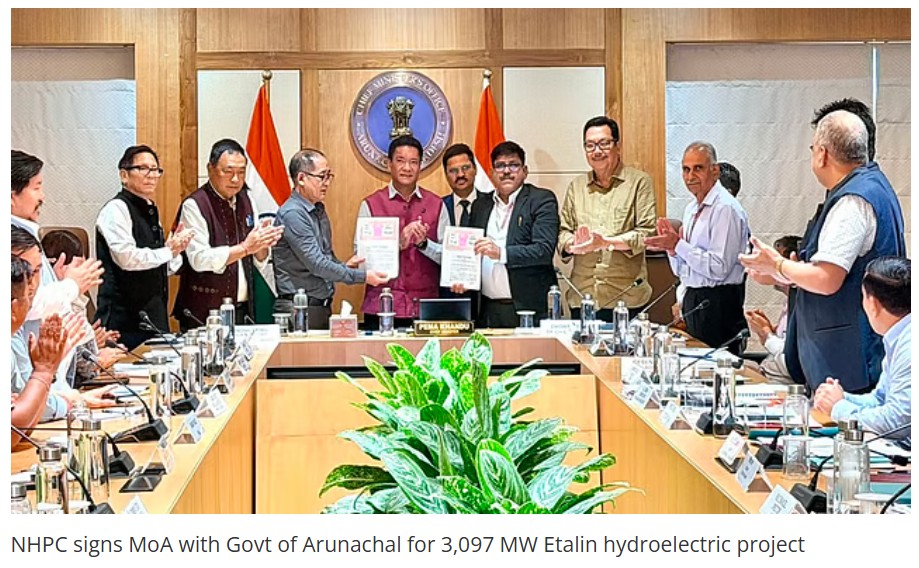
NHPC Limited has signed a Memorandum of Agreement (MoA) with the Government of Arunachal Pradesh for the development of the 3,097 MW Etalin Hydroelectric Project, one of India's largest proposed hydropower projects.
About the Etalin Hydroelectric Project
The Etalin Hydroelectric Project is a 3,097 MW hydropower project proposed in the Dibang Valley district of Arunachal Pradesh. It will be constructed on the Dri and Talo rivers, both tributaries of the Dibang River, and is among the largest hydropower projects in India in terms of installed capacity.
The project will be developed as two run-of-the-river (RoR) hydroelectric schemes, involving the construction of concrete gravity dams on the Dri and Talo rivers. Water from both reservoirs will be diverted to an underground powerhouse located near the confluence of the two rivers, close to Etalin village.
The project is expected to generate approximately 12,752 GWh (12.75 BU) of electricity annually, contributing significantly to India's renewable energy capacity and energy security.
Implementation Framework
The project is being implemented by NHPC Limited (formerly National Hydroelectric Power Corporation) under the Build, Own, Operate and Transfer (BOOT) model.
Under the agreement:
- NHPC will develop, own, and operate the project.
- The lease period will be 40 years from the Commercial Operation Date (COD).
- After completion of the lease period, the project will be transferred to the Government of Arunachal Pradesh.
Environmental and Social Significance
The project is located within the Dibang Valley, one of the richest biogeographical regions of the Himalayan biodiversity zone and part of a globally recognisedmega-biodiversity hotspot. The region supports rich flora and fauna and is ecologically sensitive.
The area is predominantly inhabited by the Idu Mishmi, a Particularly Vulnerable Tribal Group (PVTG) of Arunachal Pradesh, whose traditional livelihoods and cultural practices are closely linked to the surrounding forests and river ecosystems.
Given its ecological sensitivity, the project has attracted attention regarding biodiversity conservation, forest diversion, and sustainable development, highlighting the need to balance renewable energy generation with environmental protection and tribal rights.