
India’s First Indigenous 5 kN Rotating Detonation Engine (RDE)
- 24 Aug 2026
In News:
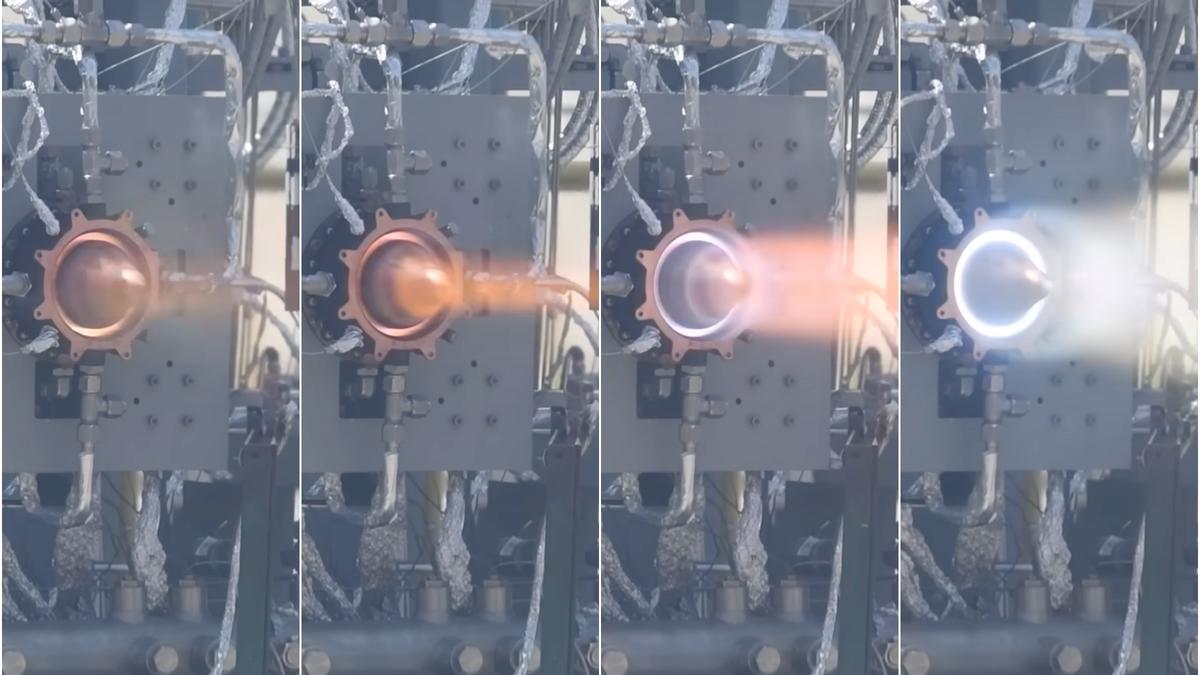
Indian defence start-up D-Propulse has successfully demonstrated India’s first indigenous 5 kN air-breathing Rotating Detonation Engine (RDE) at a DRDO facility in Hyderabad, achieving Technology Readiness Level-5 (TRL-5). The development marks a step towards strengthening India’s indigenous next-generation air-breathing propulsion capabilities.
What is an RDE?
- A Rotating Detonation Engine is an advanced propulsion technology that uses continuously travelling supersonic detonation waves. Unlike conventional combustors, which rely on subsonic deflagration at approximately constant pressure, detonation involves a supersonic shock wave that compresses the unburnt fuel-air mixture and releases energy more efficiently.
- An RDE uses an annular combustion chamber—a ring-shaped channel between two concentric cylinders. Fuel and oxidiser are continuously injected into this chamber, where a detonation wave travels around the annulus repeatedly, producing sustained thrust. In contrast, a Pulsed Detonation Engine (PDE) generates intermittent detonations along a straight tube.
Efficiency & Applications
- RDEs have the potential to provide 10–25% higher thermodynamic efficiency than conventional rocket engines. A 20% improvement could translate into roughly 17% lower fuel requirements, improving payload-to-fuel ratios and potentially reducing launch costs.
- Potential applications include hypersonic cruise missiles, high-speed aircraft, UAVs, ramjet-type propulsion systems, space launch vehicles and in-space propulsion.
- However, the technology remains at the R&D stage globally. RDEs face major engineering challenges, including temperatures above 2,000°C, pressures of 10–100 atmospheres, detonation velocities exceeding 1,500 m/s, precise microsecond-scale fuel injection and combustion stability. Advanced materials and high-speed computing are therefore essential.