
World Bank Country Income Classification 2027
- 09 Jul 2026
In News:
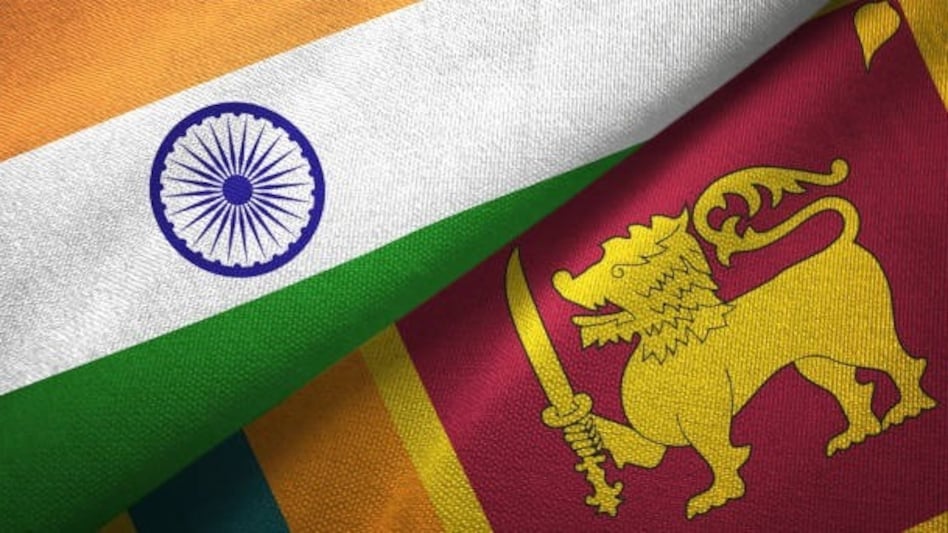
The World Bank Group Country Income Classifications for Fiscal Year 2027 (released in July 2026) retained India in the Lower-Middle-Income category, a position it has held since 2009. In contrast, Sri Lanka, Vietnam and the Philippines were upgraded to the Upper-Middle-Income category.
What is the World Bank Country Income Classification?
The World Bank classifies economies every year on 1 July into four income groups based on their Gross National Income (GNI) per capita of the previous calendar year. The classification serves as an operational and analytical tool for development financing and cross-country comparison rather than a measure of overall development.
To improve comparability, GNI per capita is calculated using the Atlas Method, which smoothens the effects of exchange-rate fluctuations and inflation by averaging exchange rates over time. The income thresholds are revised annually using the Special Drawing Rights (SDR) deflator to account for global inflation.
Income Classification (FY 2027)
- Low Income: USD 1,175 or less
- Lower-Middle Income: USD 1,176–4,635
- Upper-Middle Income: USD 4,636–14,375
- High Income: Above USD 14,375
India's GNI per capita stood at USD 2,760 (2025), keeping it within the Lower-Middle-Income category.
Key Highlights
The latest classification reflects continued improvements in the global income landscape. While nearly 30% of economies were classified as low income in 1987, the share has declined to 11% by 2026.
This year, Sri Lanka, Vietnam, the Philippines, Jordan and Micronesia moved from the Lower-Middle-Income to the Upper-Middle-Income category, while Togo graduated from Low Income to Lower-Middle Income.
Vietnam and the Philippines achieved the upgrade through sustained export-led industrial growth, while Sri Lanka recovered from its recent economic crisis through the revival of tourism and financial services. Jordan and Togo benefited largely from revised statistical methodologies and updated national accounts.
Why Does India Continue to Remain a Lower-Middle-Income Economy?
Despite being one of the world's fastest-growing major economies, India's per capita income remains relatively low because of its large population, which dilutes gains in aggregate national income.
Significant regional disparities also persist. High-income States such as Tamil Nadu, Maharashtra and Gujarat coexist with relatively poorer States like Bihar and Uttar Pradesh, lowering the national average.
Another structural challenge is the dominance of the informal sector, where nearly 85% of the workforce is employed. Low labour productivity, disguised unemployment in agriculture and limited formal employment constrain growth in average incomes.
India also entered the Lower-Middle-Income category only in 2009. Historically, moving into the next income bracket requires sustained high economic growth over several decades.
Employees' Provident Funds (EPF) Scheme, 2026
- 05 Jul 2026
In News:
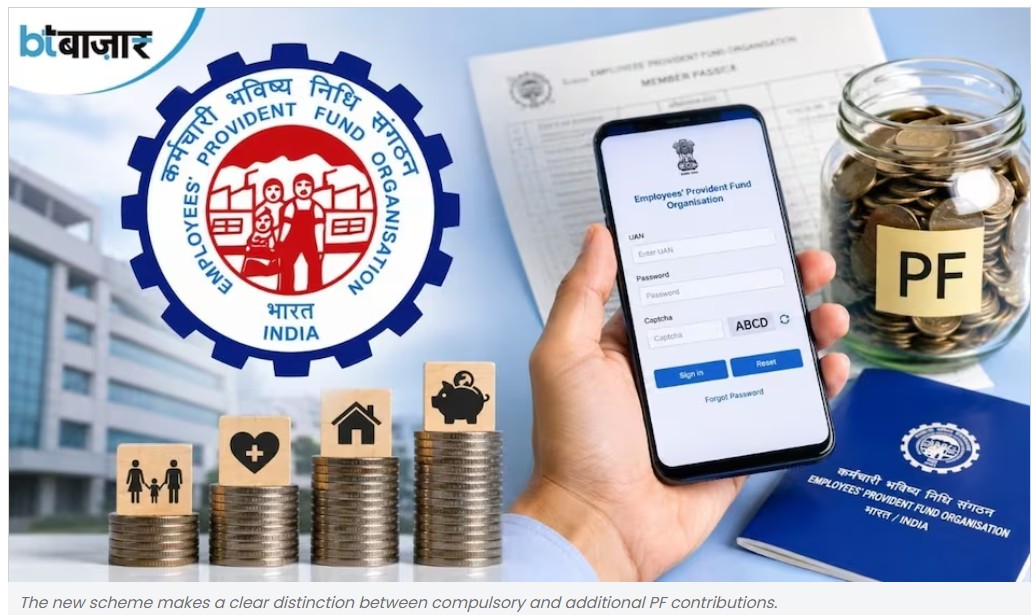
The Ministry of Labour and Employment has notified the Employees' Provident Funds (EPF) Scheme, 2026, replacing the EPF Scheme, 1952, under the Code on Social Security, 2020. The new framework seeks to modernise provident fund administration while ensuring continuity of retirement benefits for employees.
About EPF Scheme, 2026
The Employees' Provident Funds (EPF) Scheme, 2026 is India's new statutory retirement savings framework administered by the Employees' Provident Fund Organisation (EPFO) under the Ministry of Labour and Employment. It replaces the seven-decade-old EPF Scheme, 1952, while implementing the provisions of the Code on Social Security, 2020.
The primary objective of the scheme is to provide long-term financial security to employees through compulsory retirement savings, improve ease of compliance, and promote digital governance.
Key Features
The new scheme ensures seamless continuity for existing EPF subscribers. Current members automatically continue under the new framework without requiring fresh registration or transfer of accumulated balances.
The contribution structure largely remains unchanged. Both employer and employee continue to contribute 12% of wages (10% for notified establishments). However, the mandatory contribution is calculated only up to the statutory wage ceiling of ?15,000 per month, limiting compulsory contributions to ?1,800 each from the employer and employee.
Employees may voluntarily contribute beyond the statutory wage ceiling or above the prescribed contribution rate. Employers may also make matching voluntary contributions, which can subsequently be modified or discontinued without affecting the mandatory contribution.
Withdrawal Provisions
The scheme simplifies the earlier 13 withdrawal categories into three broad heads:
- Essential Needs – illness, education and marriage.
- Housing Needs – purchase or construction of a house, home loan repayment and renovation.
- Special Circumstances – specified emergencies.
To preserve retirement security, members must maintain a minimum balance equal to 25% of total contributions as a retirement corpus, while the remaining eligible balance can be withdrawn subject to prescribed conditions.
Some important withdrawal provisions include:
- Illness: Up to 100% of the eligible balance after 12 months of membership.
- Education: Permitted after 12 months, with a maximum of 10 withdrawals.
- Marriage: Up to 100% of the eligible balance, subject to a maximum of five withdrawals.
- Housing: Up to 75% of the accumulated balance after 12 months, with a maximum of five withdrawals.
Digital Governance and Compliance
A major feature of the new framework is the emphasis on digital service delivery. Aadhaar-linked Universal Account Number (UAN), PAN and bank account integration will facilitate faster claim settlement, portability and online services.
EPFO is also expanding digital services through UPI-based withdrawals and WhatsApp-based member services, making provident fund management more accessible.
Employers are required to submit Aadhaar, PAN, UAN, wage details and monthly statutory returns electronically, strengthening transparency and compliance.
Protection for Contract Workers
The scheme introduces the concept of a Principal Employer, making the principal employer ultimately responsible for provident fund contributions if contractors fail to deposit them. This provision strengthens social security coverage for contract workers and improves accountability.
International Workers
Existing provisions relating to international workers continue without change, ensuring uninterrupted provident fund coverage for employees already enrolled under international social security arrangements.
Significance
The EPF Scheme, 2026 modernises India's retirement savings framework by combining continuity of benefits with greater flexibility, digital governance and simplified procedures. It strengthens employee welfare, improves compliance, protects contract workers, and facilitates easier access to provident fund services while safeguarding long-term retirement savings. The scheme also marks an important step towards the comprehensive implementation of the Code on Social Security, 2020.
Special and Differential Treatment (SDT)
- 02 Oct 2025
In News:
China has announced that it will continue to be classified as a developing country within the World Trade Organization (WTO) but will no longer seek Special and Differential Treatment (S&DT) in future negotiations.
About Special and Differential Treatment (S&DT):
- S&DT grants developing and least-developed countries (LDCs) flexibilities in implementing WTO obligations, including longer deadlines, preferential market access, safeguard measures, and technical assistance.
- Introduced under GATT in the 1960s and formalized in WTO agreements (1995) and the Doha Development Agenda (2001).
- LDCs receive additional automatic benefits; other countries self-declare their status, subject to challenge by WTO members.
Significance of China’s Decision:
- China, historically a major beneficiary of S&DT, will forego such benefits while retaining its developing country status.
- The move signals support for multilateral trade and contributes to WTO reform, addressing concerns raised by the United States and others over selective access to S&DT.
- It highlights the tension between economic capabilities and self-declared developing status, especially among major economies.
Implications:
- Encourages balanced WTO negotiations and strengthens the global trading system.
- Marks a step towards aligning development considerations with global economic realities without relinquishing China’s role in the Global South.
STAR Missile
- 16 Sep 2025
In News:
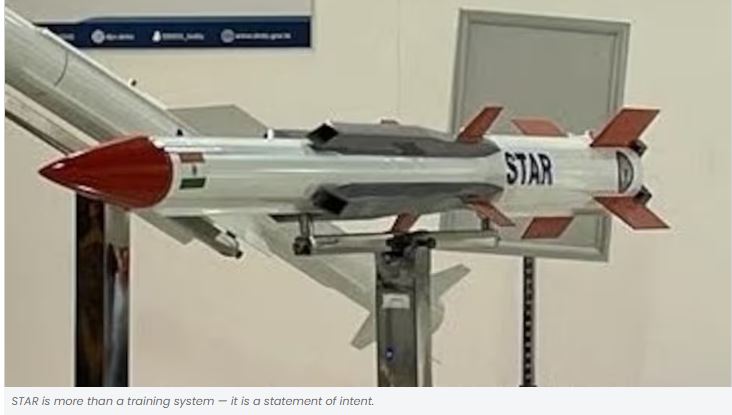
India has developed the Supersonic TARget (STAR) missile — an indigenous, reusable high-speed target system designed to reproduce modern cruise-missile and anti-ship threat profiles for realistic training and validation of sensors, weapons and doctrines. STAR replaces expensive imported target systems and fills a critical gap in live realistic training for the Navy, Air Force and Army.
What STAR does
STAR is not a combat weapon but a high-fidelity aggressor platform that simulates hostile supersonic missiles so air defence systems, shipborne weapons and interceptor pilots can practise time-critical engagements under realistic conditions. It can mimic sea-skimming runs, steep dives and evasive manoeuvres to test detection, tracking and interception chains end-to-end.
Key technical features
- Propulsion: Two-stage system — a solid booster for launch followed by a Liquid Fuel Ramjet (LFRJ) for sustained supersonic cruise. The ramjet experience is also being matured for future systems (e.g., Astra Mk-3 development).
- Speed: Mach 1.8–2.5 (roughly 612–850 m/s).
- Altitude & profiles: Operates from low sea-skimming heights (as low as ~12 feet above water) up to ~10 km, and can execute high-speed dives and complex manoeuvres.
- Range & flight time: Designed for missions between 55–175 km with flight durations of ~50–200 seconds, enabling diverse scenario replication.
- Variants:
- Air-launched STAR (carried by combat aircraft such as LCA Tejas) to emulate air-to-air or air-to-ground supersonic threats and anti-radar/anti-AWACS profiles.
- Ground-launched STAR (truck-mounted) for shore-based or remote launches without extensive infrastructure.
- Operational utility: High manoeuvrability, programmable trajectories and safe recovery/destruction options make it suitable for repeated use in trials.
Operational and strategic significance
- Realism in training: STAR provides time-critical, live target practice that simulations alone cannot offer — particularly valuable against low-altitude, high-speed cruise profiles which compress engagement timelines.
- Atmanirbhar Bharat: Fully indigenous development reduces dependency on foreign target systems, cuts recurring costs, and supports domestic missile-R&D ecosystems. STAR is reusable and cost-effective relative to imported alternatives.
- Force integration: Its modular design serves tri-service needs, helping calibrate ship radars, point-defence systems, interceptor missiles, and fighter tactics in joint exercises.
- R&D multiplier: The ramjet and guidance technologies validated on STAR feed into broader missile-development programs, strengthening long-term indigenous capabilities. Analysts also view STAR as a potential seed technology that could be adapted into tactical offensive roles in the future (e.g., anti-radar or precision suppression platforms), should doctrinal decisions and legal frameworks permit.
Development status and outlook
As of mid-2025, STAR progressed into advanced development and flight validation phases — integrating propulsion, guidance and control subsystems and conducting combat-style trials. Operational induction for routine service trials and training is anticipated as tests mature.
Gini Index
- 07 Jul 2025
In News:
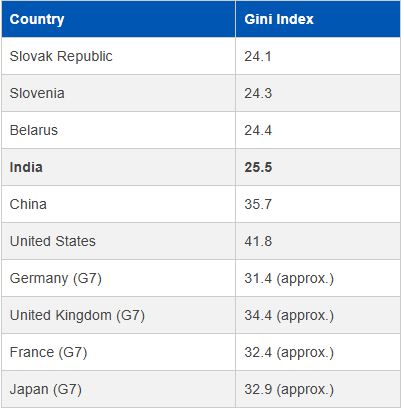
According to the World Bank’s Spring 2025 Poverty and Equity Brief, India has emerged as the fourth most equal society globally, with a Gini Index of 25.5—outperforming all G7 and G20 nations. Only the Slovak Republic (24.1), Slovenia (24.3), and Belarus (24.4) rank ahead.
This achievement marks a significant improvement from India’s Gini score of 28.8 in 2011 to 25.5 in 2022, reflecting a steady narrowing of income inequality and growing social equity.
Key Highlights:
Gini Index Comparison (2022-2023):
|
Country |
Gini Index |
|
Slovak Republic |
24.1 |
|
Slovenia |
24.3 |
|
Belarus |
24.4 |
|
India |
25.5 |
|
China |
35.7 |
|
United States |
41.8 |
|
Germany (G7) |
~31.4 |
|
United Kingdom (G7) |
~34.4 |
|
France (G7) |
~32.4 |
|
Japan (G7) |
~32.9 |
Poverty Reduction Achievements:
- 171 million people lifted out of extreme poverty (2011–2023).
- Population living under $2.15/day fell from 16.2% (2011–12) to 2.3% (2022–23).
- Under revised poverty line of $3.00/day, poverty fell to 5.3% in 2022–23.
Drivers of Income Equality:
a) Financial Inclusion:
- Jan Dhan Yojana: Over 55.69 crore bank accounts opened (as of June 2025).
- Enabled Direct Benefit Transfers (DBT), reducing leakages and ensuring targeted welfare.
b) Digital Infrastructure:
- Aadhaar: Over 142 crore issued (as of July 2025), enabling real-time, identity-based service delivery.
- DBT savings: Over ?3.48 lakh crore by March 2023.
c) Universal Healthcare Access:
- Ayushman Bharat: Over 41.34 crore health cards issued.
- Covers ?5 lakh per family/year; now extended to all citizens aged 70+ under Ayushman Vay Vandana.
- Over 32,000 empanelled hospitals ensure access to treatment.
d) Empowerment of Marginalized Communities:
- Stand-Up India: Loans worth ?62,807 crore disbursed to SC/ST and women entrepreneurs.
- PM Vishwakarma Yojana: Nearly 30 lakh artisans registered for credit and marketing support.
Significance for India and the World:
India’s low Gini score demonstrates that economic growth and social equity can be pursued together. The country’s targeted welfare architecture, digital governance tools, and inclusive schemes have created a replicable model for other developing nations.
As global inequality widens, India’s success offers a template for countries seeking to integrate economic reforms with social protection mechanisms to foster inclusive development.
Orange Economy
- 05 May 2025
In News:
At the World Audio Visual Entertainment Summit (WAVES) held in Mumbai, Prime Minister Narendra Modi highlighted the transformative potential of India's Orange Economy—a sector driven by creativity, content, and culture. With Indian films now screened in over 100 countries and a surge in OTT platform consumption, India is fast emerging as a global content leader.
What is the Orange Economy?
Also known as the Creative Economy, the Orange Economy encompasses industries rooted in individual creativity, talent, and intellectual property. Coined by Colombian economists Felipe Buitrago and Iván Duque, the term “orange” reflects the vibrancy of cultural identity and innovation.
Core Sectors:
- Advertising, architecture, and design
- Arts and crafts, fashion, and publishing
- Film, music, performing arts, and photography
- Animation, gaming, software, and digital media
- Television, radio, and electronic publishing
- Research and development (R&D)
Key Features of the Orange Economy
- Knowledge-driven and innovation-centric
- Promotes cultural diversity and economic inclusivity
- Combines economic, social, and cultural dimensions
- Strong links to technology, tourism, and intellectual property rights
Global and National Significance
- As per UNESCO, the Orange Economy contributes approximately 3% to global GDP and supports over 30 million jobs worldwide.
- The global animation industry alone is valued at $430 billion.
- In India, the creative sector is being nurtured through flagship initiatives like Skill India, Startup India, and platforms such as WAVES, aiming to empower young creators—from Guwahati musicians to Kochi podcasters.
Government Support and Vision
Emphasized that though the "screen may be shrinking, the scope is infinite," underlining the massive potential of digital platforms and content innovation. The government is actively working to build an enabling ecosystem for the creative economy, blending economic growth with cultural preservation.
US Says Egypt Border Crossing to Gaza to Reopen (Business Today)
- 16 Oct 2023
Why in the News?
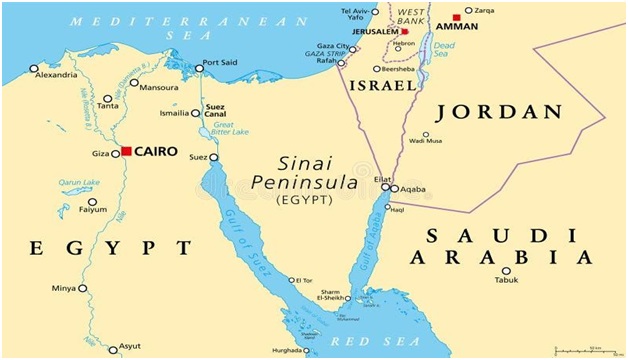
Hundreds of tons of aid from multiple countries have been stationed in Egypt's Sinai Peninsula, awaiting an agreement for secure transportation to Gaza for several days.
About the Sinai Peninsula:
- Geographical Location: The Sinai Peninsula is a triangular landmass located in northeastern Egypt, serving as a critical land bridge that connects the continents of Asia and Africa.
- Size and Sovereignty: Encompassing an expansive area of 23,500 square miles (61,000 square km), the Sinai Peninsula is recognized as a sovereign territory within the boundaries of Egypt.
- Geographical Boundaries: It is bordered to the north by the Mediterranean Sea and to the east by Israel and the Gaza Strip.
- The Suez Canal lies to the west, acting as a separation from the African part of Egypt.
- To the southwest, the Gulf of Suez and the Red Sea border the peninsula, while the Gulf of Aqaba marks its southeastern boundary.
- Egypt shares maritime borders in the Sinai with Jordan and Saudi Arabia.
- Historical Significance: In the late 19th century, including the Sinai Peninsula, Egypt became part of the British Empire until gaining independence in 1922.
- During the Six-Day War of June 1967, the peninsula was occupied by Israeli forces and returned to Egypt in 1982 as part of the peace treaty signed in 1979.
- Diverse Geography: The Sinai Peninsula is characterized by a diverse landscape, featuring mountain ranges, deserts, plateaus, and coastal regions.
- Population Composition: With a relatively sparse population, the Sinai is home to about 600,000 people, predominantly consisting of Arab Egyptians and Bedouins.
This explosion in space, will now form a new solar system! James Webb Telescope captures Cassiopeia A in its latest discovery (Business Today)
- 13 Dec 2023
Why is it in the News?
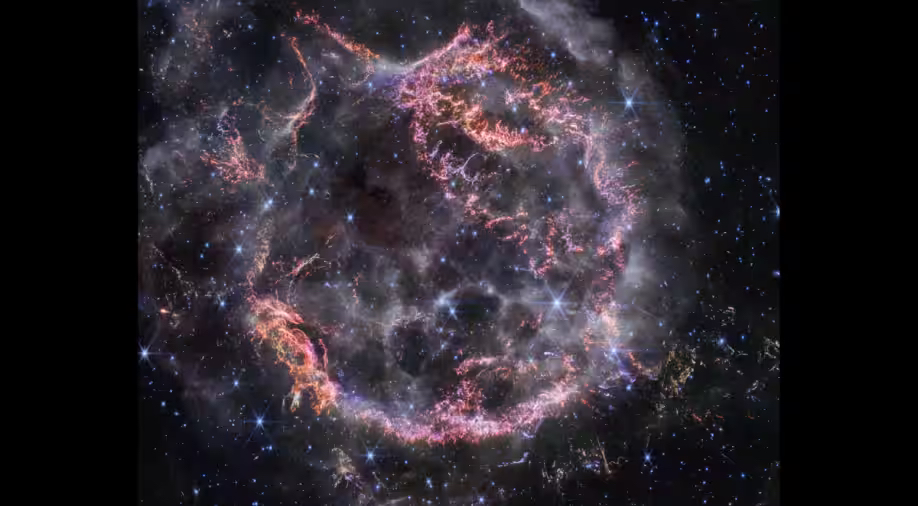
The James Webb Space Telescope by NASA has recently documented a striking image of a star that underwent a supernova explosion within the Cassiopeia A (Cas A) supernova remnant.
What is Cassiopeia A?
- Cassiopeia A is the aftermath of a colossal star's explosion approximately 340 years ago, standing as the most recently formed remnant of its kind in our galaxy.
- Renowned for its status as a prototypical type of supernova remnant, it has been the subject of extensive exploration by various ground- and space-based observatories.
- Encompassing around 10 light-years, this remnant resides 11,000 light-years away in the Cassiopeia constellation, offering valuable insights into the intricate dynamics of supernovae.
What is Supernova?
A supernova is a powerful and catastrophic stellar explosion that occurs during the final stages of a massive star's life cycle. This extraordinary event releases an immense amount of energy, temporarily outshining entire galaxies and producing luminosities that can briefly outshine an entire galaxy.
What happens during a supernova explosion?
- Massive stars: Supernovas typically occur in massive stars, at least 8 times the mass of our sun.
- These stars burn brightly and fiercely, fusing hydrogen into helium in their cores.
- Nuclear fusion: As the star ages, it runs out of hydrogen fuel in its core.
- The core starts to collapse inwards due to gravity, while the outer layers expand and cool.
- This increased pressure and temperature trigger the nuclear fusion of heavier elements, like carbon and oxygen, releasing immense energy.
- Bounce and shockwave: The core's collapse eventually leads to a sudden rebound, called the core bounce.
- This bounce creates a shockwave that rips through the star's outer layers, ejecting them outwards in a violent explosion.
Types of supernovae: There are two main types of supernovae:
- Core-collapse supernovae: The explosion blows away the star's outer layers, leaving behind a neutron star or, if the mass is even greater, a black hole.
- Type Ia supernovae: These occur in binary systems where a white dwarf, the remnant of a low-mass star, siphons material from its companion star.
- This builds up mass on the white dwarf until it reaches a critical point and undergoes thermonuclear runaway, leading to a massive explosion.
Significance of supernovae: Supernovae play a crucial role in the universe's evolution.
- Enrich the interstellar medium with heavy elements: The ejected material from supernovae is rich in elements heavier than hydrogen and helium, which are essential for the formation of new stars and planets.
- Trigger star formation: The shockwaves from supernovae can compress surrounding gas clouds, triggering the formation of new stars.
- Create black holes and neutron stars: The most massive stars leave behind black holes or neutron stars, incredibly dense objects with fascinating properties.