
Sickle Cell Disease (SCD) & National Sickle Cell Anaemia Elimination Mission (NSCEM)
- 24 Jun 2026
In News:
On International Sickle Cell Day (19 June) 2026, the President of India reaffirmed the country's commitment to eliminate Sickle Cell Disease (SCD) by 2047 under the National Sickle Cell Anaemia Elimination Mission (NSCEM).
International Sickle Cell Day
- International Sickle Cell Day is observed annually on 19 June to raise awareness about Sickle Cell Disease (SCD) and promote early diagnosis, treatment, prevention, and equitable healthcare access.
- The United Nations General Assembly (UNGA) designated 19 June as International Sickle Cell Day through a resolution adopted on 22 December 2008, recognizing SCD as a major global public health challenge and one of the world's most significant inherited genetic disorders.
- Theme (2026):"Closing the Survival Gap: Equity in Sickle Cell Disease."
What is Sickle Cell Disease (SCD)?
Sickle Cell Disease (SCD) is a hereditary genetic blood disorder caused by a mutation in the HBB (beta-globin) gene, resulting in the production of abnormal haemoglobin (Haemoglobin S). Instead of their normal biconcave shape, red blood cells become rigid, sticky, and sickle (crescent)-shaped, impairing blood flow and oxygen delivery.
The disease follows an autosomal recessive inheritance pattern, meaning an individual develops SCD only after inheriting two defective genes (one from each parent). Individuals carrying only one mutated gene possess the Sickle Cell Trait and are generally asymptomatic but can transmit the gene to their offspring.
Health Impact
Abnormally shaped red blood cells obstruct small blood vessels, leading to vaso-occlusive crises, severe pain episodes, chronic anaemia, organ damage, recurrent infections due to splenic dysfunction, and reduced life expectancy. Symptoms generally begin at 5–6 months of age as fetal haemoglobin declines.
Treatment
Management focuses on reducing complications through:
- Hydroxyurea therapy (increases fetal haemoglobin production).
- Pain management and adequate hydration.
- Blood transfusions for severe complications.
- Vaccination and antibiotics to prevent infections.
National Sickle Cell Anaemia Elimination Mission (NSCEM)
Launched in 2023, the National Sickle Cell Anaemia Elimination Mission aims to eliminate Sickle Cell Disease as a public health problem in India by 2047, with a special focus on tribal populations, where disease prevalence is highest.
The Mission is implemented jointly by the Ministry of Health & Family Welfare and the Ministry of Tribal Affairs under the National Health Mission (NHM) across 17 high-focus States.
Key Features
- Mission period: 2023–2026 (screening phase).
- Screening target: Approximately 7 crore individuals aged 0–40 years.
- Focus areas include:
- Universal screening and early diagnosis.
- Genetic counselling.
- Timely treatment and follow-up.
- Public awareness and prevention.
- Strengthening healthcare infrastructure.
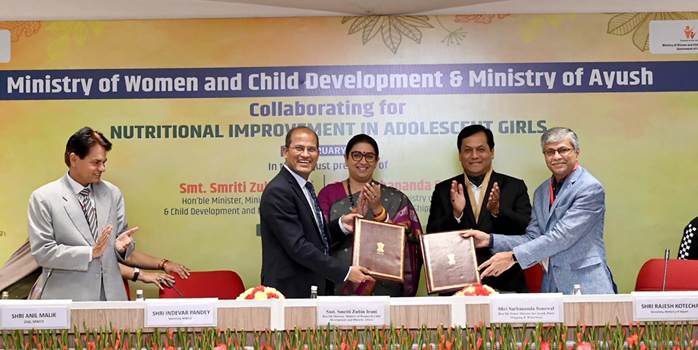
An initiative to improve nutrition in adolescent girls using Ayurveda under Mission Utkarsh
- 27 Feb 2024
Why is it in the News?
The project for anemia control under Mission Utkarsh will be a joint public health initiative by the Ministries of Ayush and Women and Child Development and will be launched in five aspirational districts first as a pilot project.
About Mission Utkarsh:
- Mission Utkarsh was launched in January 2022, a new initiative of “rapid improvement of selected Districts” to improve.
- Under this mission, 15 central ministries and departments are working to bring select key performance indicators in bottom districts to the state and national average.
- Over 94,000 adolescent girls between the age group of 14-18 years registered under Poshan Tracker at approximately 10,000 Anganwadi Centres will benefit in 12 12-month periods of the program.
- The coordinating agency for the project will be the Central Council for Research in Ayurvedic Sciences (CCRAS).
- Classical Ayurveda medicines (Drakshavaleha and Punarnavadi mandoor) for better nutrition to improve the health of the anemic adolescent girls will be provided for a period of 3 months.
- These five districts are Dhubri in Assam, Bastar in Chhattisgarh, Paschimi Singhbhum in Jharkhand, Gadchiroli in Maharashtra, and Dholpur in Rajasthan.
- Building research capacity through training, conferences, workshops, and seminars with the active participation of researchers of integrative healthcare would be enhanced.
What is Anaemia?
- According to WHO, anemia occurs when there is a lower-than-normal count of red blood cells or a reduced hemoglobin concentration within them, crucial for oxygen transport throughout the body.
Symptoms
- This condition leads to symptoms like fatigue, weakness, dizziness, and shortness of breath due to decreased oxygen-carrying capacity in the blood.
Causes:
- Iron deficiency is the most common nutritional cause, although deficiencies in folate, vitamins B12 and A can also contribute.
- Chronic diseases like kidney or liver disease, cancer, and genetic conditions such as sickle cell anemia further exacerbate anemia.
Significance:
- Anaemia has significant implications, particularly affecting vulnerable populations like pregnant women and children under five, impacting reproductive health and reducing work capacity, thus posing an economic burden.
Anaemia in India:
- India faces a substantial anemia burden, with recent surveys indicating alarming prevalence rates among women aged 15-49 and children aged six months to five years, highlighting the urgent need for public health interventions.