
World Day to Combat Desertification and Drought 2026
- 18 Jun 2026
In News:
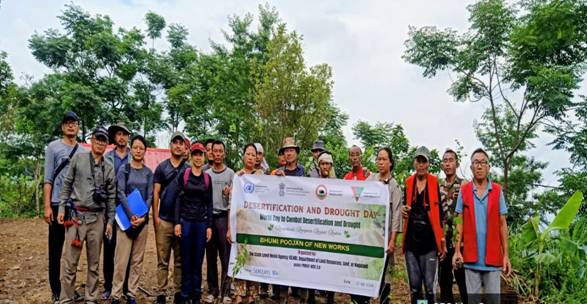
The World Day to Combat Desertification and Drought (17 June)was observed across the project areas of the Watershed Development Component of Pradhan Mantri Krishi Sinchayee Yojana (WDC-PMKSY 2.0) to promote sustainable land management, watershed conservation, and restoration of degraded landscapes.
World Day to Combat Desertification and Drought
- The United Nations General Assembly (UNGA) declared 17 June as the World Day to Combat Desertification and Drought in 1994 to commemorate the adoption of the United Nations Convention to Combat Desertification (UNCCD)—the only legally binding international agreement linking environment, sustainable land management, and development.
- The day seeks to raise awareness about land degradation, promote Land Degradation Neutrality (LDN), and encourage sustainable management of land resources. It emphasizes that desertification, driven by human activities and climate change, is preventable and reversible.
- Theme 2026:"Rangelands: Recognize. Respect. Restore."—aligned with the International Year of Rangelands and Pastoralists (IYRP) 2026, led by the FAO and UNCCD.
What are Rangelands?
Rangelands are extensive natural landscapes comprising grasslands, shrublands, deserts, and tundras, primarily used for livestock grazing.
- Cover 54% of the Earth's land surface.
- Contribute nearly 16% of global food production.
- Support the livelihoods of around 2 billion people, especially pastoralists and indigenous communities.
- In India, they cover about 1.21 million sq. km, with nearly 40% of the country's land used for grazing.
- India's grassland area declined from 18 million hectares (2005) to 12 million hectares (2015), while less than 5% of grasslands are under protected areas.
Besides supporting livestock, rangelands function as carbon sinks, conserve biodiversity, regulate water cycles, and prevent soil erosion.
Watershed Development Component of PMKSY 2.0 (WDC-PMKSY 2.0)
Originally launched as the Integrated Watershed Management Programme (IWMP) in 2009–10, it was integrated with Pradhan Mantri Krishi Sinchayee Yojana (PMKSY) in 2015–16. The present phase, WDC-PMKSY 2.0, covers the period 2021–2026.
Implemented by the Department of Land Resources (DoLR), Ministry of Rural Development, the scheme aims to restore 49.50 lakh hectares of degraded and rainfed land.
Its objectives include:
- Restoration of degraded landscapes and ecological balance.
- Enhancement of groundwater recharge and agricultural productivity.
- Promotion of diversified farming systems and livelihood opportunities.
- Springshed rejuvenation, especially in Himalayan regions.
- Use of GIS and Remote Sensing for scientific watershed planning.
Desertification in India
Desertification refers to land degradation in arid, semi-arid and dry sub-humid regions due to climatic variations and human activities; it does not imply the expansion of existing deserts.
According to the Desertification and Land Degradation Atlas of India (Space Applications Centre, ISRO), about 29.7% of India's Total Geographical Area (TGA) is undergoing land degradation.
Major causes include:
- Water erosion (largest contributor)
- Vegetation degradation
- Wind erosion
- Salinity and alkalinity caused by improper irrigation practices
Major Initiatives
Global: UNCCD, Bonn Challenge, Great Green Wall Initiative, G20 Global Land Initiative, and SDG Target 15.3 (Land Degradation Neutrality by 2030).
India: Commitment to restore 26 million hectares of degraded land by 2030 (UNCCD COP14), Aravalli Green Wall Project, Desert Development Programme (DDP), National Mission for a Green India (GIM), and WDC-PMKSY 2.0.