
eSARAS: Digital Marketplace for Women Self-Help Groups
- 08 Jul 2026
In News:
The eSARAS platform is emerging as a key initiative for promoting women-led rural entrepreneurship, preserving India's traditional crafts and strengthening digital commerce under the Deendayal Antyodaya Yojana–National Rural Livelihood Mission (DAY-NRLM).
What is eSARAS?
eSARAS is the official e-commerce platform developed by the Ministry of Rural Development under the Deendayal Antyodaya Yojana–National Rural Livelihood Mission (DAY-NRLM). It serves as a dedicated online marketplace for products manufactured by Women Self-Help Groups (SHGs) and their federations across India.
The platform connects rural producers directly with consumers, eliminating intermediaries and enabling wider market access for women-led enterprises.
Objectives
The platform aims to:
- Promote women-led rural entrepreneurship.
- Provide nationwide market access to SHG products.
- Increase income opportunities for rural women.
- Preserve India's traditional handicrafts and handloom products.
- Promote digital inclusion and financial empowerment.
- Strengthen sustainable rural livelihoods.
Key Features
eSARAS supports women entrepreneurs by providing end-to-end market linkage services.
Its major features include:
- Exclusive marketplace for Women SHGs and their federations.
- Direct business-to-consumer (B2C) marketing platform.
- Support for branding, packaging, processing, logistics and shipping.
- Digital platform accessible across India.
- Promotes authentic handmade and indigenous products.
The platform caters to a wide range of rural artisans, including:Weavers, Potters, Marble artisans, Pashmina producers, Women-led cooperatives, and Other traditional craft clusters
Product Categories
eSARAS offers a diverse range of products such as:
- Home décor and lifestyle products
- Apparel and fashion accessories
- Personal care products
- Food and processed food items
- Toys and children's products
- Traditional handicrafts and handloom products
Some notable products include:Chanderi sarees, Pashmina products, Marble handicrafts, Handmade rural crafts
Platform Evolution
|
Platform Evolution |
Detail |
|
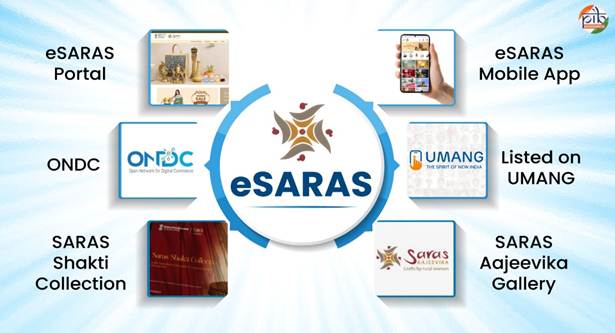
eSARAS Portal Launch |
e-Commerce portal https://www.esaras.in/ launched for better and more effective marketing of Saras products |
|
eSARAS Mobile App Launch |
Mobile app launched alongside the eSARAS Fulfilment Centre. It is used for processing, packaging and shipping of products. |
|
ONDC |
SHG products made available across 11 buyer apps (20 crore buyers on ONDC platform) with 800 handcrafted products listed |
|
UMANG |
eSARAS listed on UMANG; platform now serves 2,572 services with 796.69 crore transactions (June 2026) |
|
SARAS Shakti Collection |
Premium curated gift collection launched at Rashtriya Gramin Vikas Sammelan 2026 for institutional and corporate markets |
|
SARAS Aajeevika Gallery |
Permanent retail gallery established at Baba Kharak Singh Marg, New Delhi, showcasing curated SHG products. |
About DAY-NRLM
The Deendayal Antyodaya Yojana–National Rural Livelihood Mission (DAY-NRLM) is the flagship rural poverty alleviation programme of the Ministry of Rural Development.
It seeks to reduce rural poverty by organising poor households into Self-Help Groups (SHGs) and enabling them to access sustainable livelihood opportunities through self-employment, skill development and financial inclusion.
Objectives
- Mobilise poor rural households into SHGs.
- Promote women's financial inclusion.
- Facilitate access to institutional credit.
- Strengthen rural livelihoods through entrepreneurship.
- Enhance household income and reduce poverty.
- Build strong community-based institutions for long-term socio-economic development.
Cashless Treatment of Road Accident Victims Scheme, 2025
- 09 May 2025
In News:
The Government of India has recently introduced the Cashless Treatment of Road Accident Victims Scheme, 2025, aimed at providing immediate, hassle-free medical care to individuals injured in road accidents. This initiative reflects the government's commitment to strengthening the emergency healthcare response system and reducing fatalities due to delays in treatment.
Key Features of the Scheme:
- Universal Eligibility: Any person injured in a road accident involving a motor vehicle on a public road anywhere in India is eligible for cashless treatment.
- Financial Coverage: The scheme offers a maximum coverage of ?1.5 lakh per accident victim, valid for up to seven days from the date of the accident.
- Designated Hospital Network: Victims can avail full cashless treatment only at empanelled hospitals under the scheme. In non-designated hospitals, treatment will be restricted to initial stabilisation, as per official guidelines.
Implementation Mechanism:
- National Health Authority (NHA): The NHA is the central coordinating body for scheme implementation. It will work closely with state health agencies, police, and hospital networks.
- State-Level Execution: In each state and Union Territory, the State Road Safety Council serves as the nodal agency, responsible for:
- Coordinating the onboarding of designated hospitals.
- Managing treatment procedures and claim settlements.
- Facilitating real-time communication through a dedicated online portal.
- Monitoring Framework: A 17-member Steering Committee, chaired by the Secretary, Ministry of Road Transport and Highways, has been constituted to oversee and monitor implementation and address policy-level concerns.
Significance and Impact:
- Addresses Financial Barriers: By offering cashless access to emergency care, the scheme reduces the out-of-pocket burden on accident victims and their families.
- Improves Emergency Response: Ensures timely medical intervention, a critical factor in saving lives during the "golden hour" after a road accident.
- Promotes Inter-Agency Coordination: Brings together multiple stakeholders—healthcare, law enforcement, and road safety agencies—on a unified digital platform for better service delivery.
- Nationwide Coverage: Marks a paradigm shift in accident response policy, aiming to make quality trauma care accessible across both urban and rural India.