
Unlocking Growth in Tourism and Hospitality Sector
- 05 Jul 2026
In News:
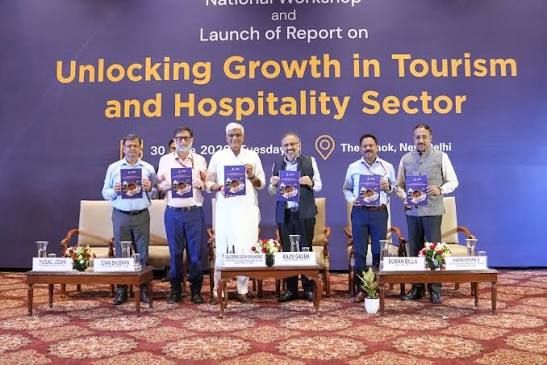
NITI Aayog, in collaboration with the Ministry of Tourism, has released the report "Unlocking Growth in Tourism and Hospitality Sector". The report recommends comprehensive regulatory, infrastructure and policy reforms to transform India from a volume-driven tourism market into a high-value, investment-led global tourism destination.
Current Status of India's Tourism Sector
Tourism has emerged as one of India's fastest-growing service sectors and a significant contributor to economic growth and employment.
Globally, the travel and tourism sector contributed nearly 10% of global GDP in 2024, supporting one in every ten jobs worldwide. By 2035, the sector is projected to contribute USD 16.5 trillion, growing at around 3.5% annually.
In India, the tourism sector contributed ?15.73 lakh crore (5.22% of GDP) during FY 2023-24 and supported nearly 84.6 million jobs, making it one of the country's largest employment generators. Domestic tourism remains the biggest strength, recording nearly 2.9 billion domestic tourist visits in 2024. However, Foreign Tourist Arrivals (FTAs) stood at only 9.95 million, giving India a global market share of less than 1.5%.
According to the World Economic Forum's Travel & Tourism Development Index (TTDI) 2024, India ranks 6th in Natural Resources and 9th in Cultural Resources, but only 39th overall, reflecting significant policy and infrastructure gaps.
Major Challenges
The report identifies both demand-side and supply-side constraints limiting India's tourism potential.
On the demand side, India's restrictive visa regime remains a major obstacle. India scores 38.14 on the UN Tourism Visa Openness Index, below both the global and Asia-Pacific averages. The report also highlights complex e-visa procedures, payment failures, fragmented traveller interfaces and weak destination marketing, which reduce repeat international visits.
Supply-side constraints are equally significant. Hotel projects typically require 36–48 months for completion compared to 12–18 months in many ASEAN countries. Developers often require 50–60 different approvals, increasing project costs and delaying investments. Restrictive building regulations, fragmented interstate transport rules, overlapping taxes, and prolonged environmental and Coastal Regulation Zone (CRZ) clearances further discourage investment.
Key Recommendations
The report recommends a comprehensive package of reforms to improve the Ease of Doing Business in tourism.
Regulatory Reforms
- Integrate approvals through the National Single Window System (NSWS).
- Introduce a single health trade licence and single liquor licence for hotels.
- Eliminate the requirement for police-issued Eating House Licences.
Visa and Travel Reforms
- Introduce a 90-day multiple-entry Visa-on-Arrival for selected countries.
- Simplify the e-Visa system through fewer application fields, improved payment gateways and a unified traveller profile.
- Extend the validity of the All India Tourist Permit (AITP) from 90 days to five years and remove overlapping state entry taxes.
Infrastructure Reforms
- Increase permissible Floor Area Ratio (FAR) and liberalise building byelaws.
- Raise the room limit for registered homestays from 6 to 9 rooms.
- Create dedicated State Expert Appraisal Committees (SEACs) for faster environmental clearances.
- Digitise High Tide Line (HTL) and Low Tide Line (LTL) maps to expedite CRZ approvals.
Government Initiatives
India has already launched several initiatives to promote tourism, including:
- Swadesh Darshan Scheme
- Swadesh Darshan 2.0
- PRASHAD Scheme
- Dekho Apna Desh
- Incredible India Campaign
- National Digital Tourism Mission (NDTM)
- NIDHI Portal
- Utsav Portal
- Ek Bharat Shreshtha Bharat
- Loan Guarantee Scheme for COVID Affected Tourism Service Sector (LGSCATSS)
Significance
Implementing these reforms can significantly enhance India's global competitiveness, attract greater private investment, generate employment, increase foreign exchange earnings and strengthen regional development. Improved connectivity, simplified regulations and faster approvals would particularly benefit hospitality, transport, handicrafts, MSMEs and rural tourism.
With its unmatched cultural heritage, biodiversity and natural resources, India possesses enormous untapped tourism potential that can become a major engine of inclusive economic growth.