
UNICORN (Unified Complex Radio Antenna) Mast

- 03 Jul 2026
In News:
At the 16th India–Japan Annual Summit held in New Delhi (July 2026), India and Japan announced their first-ever joint defence co-development project to manufacture the UNICORN (Unified Complex Radio Antenna) Mast for the Indian Navy. The project follows the Memorandum of Implementation (MoI) signed between the two countries in 2024 for the co-development of the system.
About UNICORN Mast
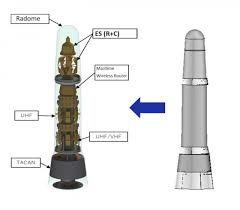
The UNICORN (Unified Complex Radio Antenna) Mast, also known as NORA-50, is a next-generation integrated communication and radar mast designed for modern naval warships. Developed by Japan, it combines multiple communication systems and radar antennas into a single integrated mast, replacing the conventional arrangement of several externally mounted antennas.
This integrated design significantly reduces the Radar Cross Section (RCS) of a warship, thereby improving its stealth capabilities, survivability, and operational effectiveness in modern maritime warfare. The system also provides secure, high-performance communication and supports network-centric naval operations in electronically contested environments.
Key Features
The UNICORN mast incorporates advanced stealth antenna technology and offers several operational advantages:
- Integrates multiple communication and radar antennas into a single mast.
- Reduces the Radar Cross Section (RCS), enhancing stealth.
- Improves secure voice and data communication.
- Minimises electromagnetic interference between communication systems.
- Enhances survivability and tactical evasion capabilities during naval operations.
- Supports advanced network-centric and digitally integrated warfare.
India–Japan Defence Collaboration
The project marks a major milestone in India–Japan defence cooperation, as it is the first joint defence manufacturing initiative between the two countries. Under the collaboration:
- Bharat Electronics Limited (BEL) will manufacture the UNICORN mast in India.
- Japanese partners will provide advanced design and technological expertise.
- India will undertake system integration, production, and installation on future Indian Navy warships.
The initiative also makes India the second Asian country, after the Philippines, to receive Japanese defence technology.
Significance for India
The project aligns closely with the 'Make in India' and Atmanirbhar Bharat initiatives by strengthening indigenous defence manufacturing and promoting technology transfer. The UNICORN mast is expected to gradually replace the Indian Navy's existing Advanced Composite Communication System (ACCS)-based external communication infrastructure with a more secure and stealth-oriented integrated system.
Strategically, the project enhances India's maritime domain awareness, strengthens naval operational capability, and deepens defence-industrial cooperation with Japan. It also reflects the growing strategic convergence between the two countries in promoting a free, open, inclusive, and rules-based Indo-Pacific, while contributing to regional maritime security and technological self-reliance.
Unified Complex Radio Antenna
- 17 Nov 2024
In News:
- India and Japan recently signed a Memorandum of Implementation (MoI) to co-develop the UNICORN (Unified Complex Radio Antenna) mast for deployment on Indian Navy ships. This pact marks a significant milestone as it is India's first military technology transfer agreement with Japan.
- The deal follows a 2015 agreement on the transfer of defense equipment and technology, further strengthening defense ties between the two countries.
- The UNICORN mast is a cutting-edge communication and radar system designed to enhance the stealth characteristics of naval vessels. This agreement is seen as an important step towards deepening India-Japan defense cooperation.
What is UNICORN?
The UNICORN mast is an advanced, integrated antenna system that combines several communication and radar components into a single conical structure or radome (a radar-absorbing dome). It is designed to reduce the radar cross-section (RCS) of ships, improving their stealth capabilities.
Key features of the UNICORN mast include:
- Integration of multiple antennas: It consolidates various antennas used for tactical data links, communications, and navigation systems (e.g., TACAN - Tactical Air Navigation System).
- Stealth enhancement: By reducing the number of exposed components and consolidating them into a single radome, the mast significantly lowers the ship’s radar signature, making it harder to detect.
- Improved performance: The mast design minimizes mutual interference between antennas, enhances maintainability, and increases lightning resistance.
- Space efficiency: It saves valuable below-deck space and reduces ship-building time by integrating multiple systems into one mast.
The UNICORN system is currently deployed on Mogami-class frigates of the Japan Maritime Self-Defence Force.
India-Japan Defense Cooperation
- 2015 Defense Technology Transfer Agreement: This pact established a framework for defense cooperation between India and Japan, paving the way for joint projects like the UNICORN mast.
- Bilateral Military Exercises:
- Veer Guardian 2023: A bilateral exercise conducted between the Japan Air Self Defence Force (JASDF) and the Indian Air Force (IAF), which deepened defense interoperability between the two nations.
- Tarang Shakti 2024: The first multilateral air exercise hosted by the Indian Air Force, with Japanese fighter aircraft participating.
- Andaman and Nicobar Islands Development: Japan has also provided financial aid for infrastructure development in India’s strategically located Andaman and Nicobar Islands, contributing to enhancing India’s maritime security in the region.