
US Attacks on Ships with Indian Crew
- 16 Jun 2026
In News:
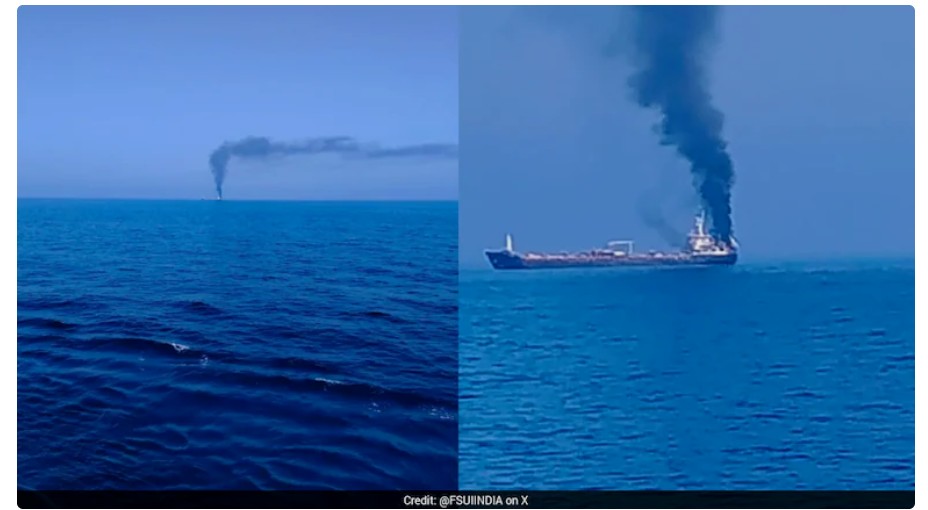
India has strongly condemned a series of military strikes by the US Central Command (CENTCOM) on commercial oil tankers carrying Indian seafarers in the Gulf of Oman and the Strait of Hormuz. Following the death of three Indian nationals in one of the attacks, India summoned the US Chargé d'Affaires to lodge a strong diplomatic protest and called for an immediate cessation of attacks on commercial shipping.
What Happened?
The attacks are linked to the US enforcement of a maritime blockade targeting vessels allegedly transporting Iranian oil in violation of US sanctions.
Three merchant vessels with Indian crew were attacked:
|
Vessel |
Details |
Outcome |
|
MT Marivex |
Oil tanker with 24 Indian seafarers targeted south of the Strait of Hormuz. |
Vessel caught fire; all crew members were rescued. |
|
MT Settebello |
Palau-flagged tanker allegedly carrying Iranian oil. |
Attack resulted in the death of three Indian seafarers and evacuation of the remaining crew. |
|
M/T Jalveer |
Guinea-Bissau-flagged tanker transporting oil through the Gulf of Oman. |
CENTCOM admitted firing two Hellfire missiles into the engine room after alleging non-compliance with its directions. All 20 Indian crew members were reported safe. |
International Maritime Law
The incidents have renewed debate over the legality of using force against commercial shipping.
- Freedom of Navigation (UNCLOS): The United Nations Convention on the Law of the Sea (UNCLOS) guarantees freedom of navigation and the right of innocent passage for commercial vessels through international waters and strategic straits such as the Strait of Hormuz, subject to international law.
- Sanctions vs. Use of Force: While countries may enforce sanctions through inspections, interception or other lawful measures, the use of lethal military force against neutral civilian merchant vessels raises complex issues under international maritime and humanitarian law.
- Diplomatic Demarche: Summoning a foreign diplomat is a formal diplomatic mechanism used to register strong protest while maintaining diplomatic engagement.
Implications for India
The incidents underscore India's growing vulnerability to geopolitical tensions in West Asia, where thousands of Indian seafarers serve aboard international merchant vessels.
- Creates diplomatic challenges in balancing the India–US strategic partnership with the protection of Indian nationals overseas.
- Heightens security risks for Indian seafarers operating in the Gulf of Oman and Strait of Hormuz.
- May discourage recruitment of seafarers, leading to workforce shortages and higher operating costs.
- Escalates war-risk insurance premiums, freight charges and global energy transportation costs, affecting India's energy security and import bill.
- Reinforces the need for secure Sea Lines of Communication (SLOCs) and freedom of navigation in the Indo-Pacific.
Way Forward
India is likely to continue pursuing diplomatic engagement, strengthening maritime safety mechanisms, and coordinating with regional partners to safeguard its seafarers and commercial interests. At the international level, ensuring respect for UNCLOS, protecting civilian shipping, and promoting dialogue remain essential for preserving stability in one of the world's most critical maritime corridors.