
The Dancing Girl of Mohenjo-daro
- 21 Jun 2026
In News:
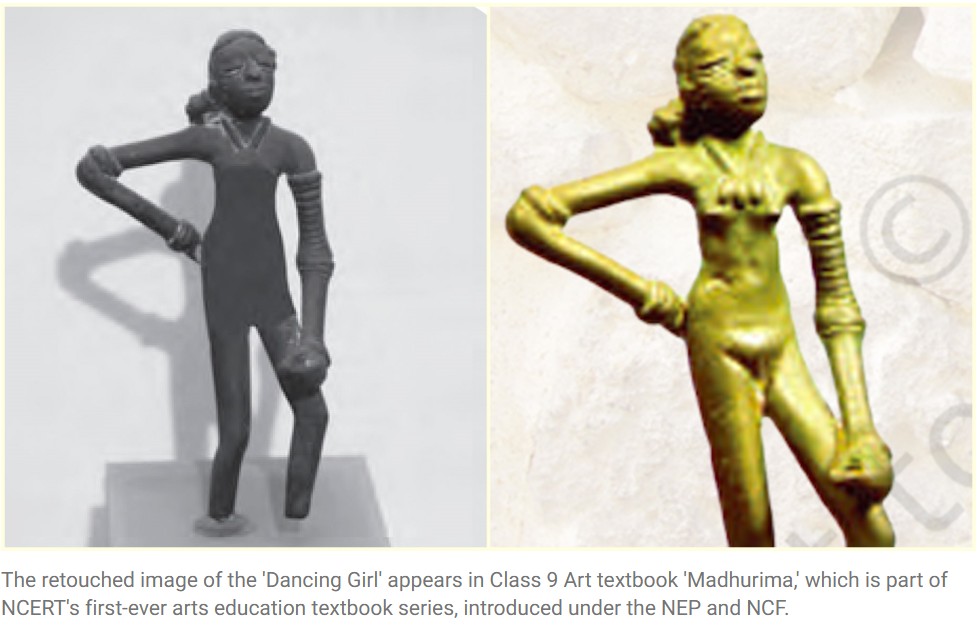
The National Council of Educational Research and Training (NCERT) announced that it will replace a retouched image of the iconic 'Dancing Girl' of Mohenjo-daro in its new Class 9 Art textbook, following criticism from historians and archaeologists regarding the alteration of a significant cultural artifact.
About the Dancing Girl of Mohenjo-daro
The Dancing Girl is one of the finest surviving examples of Indus Valley (Harappan) art and among the most celebrated archaeological discoveries from the Bronze Age. The bronze statuette, measuring about 10.5 cm (4 inches) in height, depicts a slender young female figure and is regarded as an enduring symbol of the artistic excellence and metallurgical skills of the Harappan Civilization.
The figurine was discovered in 1926 during excavations at Mohenjo-daro (present-day Sindh, Pakistan) by John Marshall, who named it the "Dancing Girl" because its posture resembled that of contemporary nautch dancers. It is generally dated to around 2500 BCE (approximately 2700–2100 BCE).
Today, the original artifact is preserved in the National Museum, New Delhi.
Key Features
The sculpture is notable for its remarkable realism and artistic sophistication.
Its distinctive features include:
- A natural contrapposto posture, with body weight resting mainly on one leg, giving the figure a dynamic and lifelike appearance.
- The right hand is placed on the hip, while the left arm hangs freely by the side.
- The left arm carries about 24 bangles, whereas the right arm bears only four bangles and a bracelet, reflecting asymmetrical ornamentation.
- A cowry-shell necklace adorns the neck.
- Hair is arranged in a coiled bun at the back of the head.
- The upward-tilted face conveys confidence and individuality.
Artistic and Historical Significance
The statuette is an outstanding example of the lost-wax (cire perdue) casting technique, demonstrating the advanced metallurgical knowledge of the Harappans. Crafted from a copper-tin bronze alloy, it reflects sophisticated understanding of alloy preparation and bronze casting.
Unlike the majority of Harappan human figurines, which were made of terracotta, the Dancing Girl is a free-standing bronze sculpture, making it unique within the corpus of Indus Valley art.
Although traditionally identified as a dancer, scholars have also interpreted the figure as representing a warrior, a young woman, or an individual of particular social or ethnic identity, indicating that its precise cultural significance remains open to interpretation.