
Taal Volcano Produces Brief Phreatomagmatic Eruption
- 03 Jul 2026
In News:
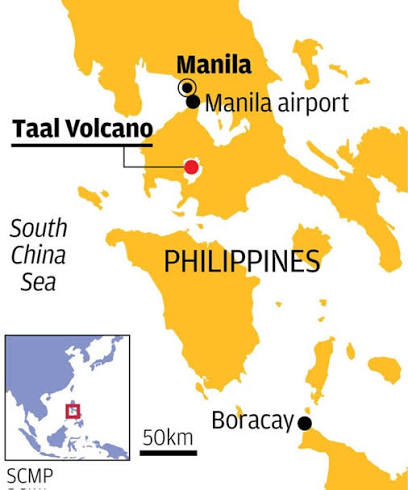
The Taal Volcano in the Philippines recently witnessed a four-minute phreatomagmatic eruption, producing a 450-metre-high ash-and-steam plume. The eruption was triggered by the interaction of rising magma with water and was accompanied by volcanic tremors and gas emissions, prompting authorities to maintain close surveillance.
About Taal Volcano
Taal Volcano is located in Batangas Province, about 70 km south of Manila, and is among the most active volcanoes in the Philippines. It forms part of the Pacific Ring of Fire, one of the world's most tectonically active regions, and has recorded at least 38 eruptions over the last 450 years.
It is classified as a complex volcano by the Philippine Institute of Volcanology and Seismology (PHIVOLCS) because it consists of multiple volcanic centres, craters, cones, and stratovolcanoes, rather than a single volcanic cone.
Geological Features
Taal's present landscape is the result of repeated volcanic activity over thousands of years.
- A large caldera was formed by massive eruptions between 140,000 and 5,380 BCE.
- The caldera is now occupied by Taal Lake, covering nearly 265 sq. km.
- At the centre of the lake lies Volcano Island (about 24 sq. km).
- The island contains the Main Crater, within which lies Crater Lake.
- Inside Crater Lake is Vulcan Point, a rare geological feature—a rocky islet inside a lake, which itself lies on an island within another lake.
What is a Stratovolcano?
A stratovolcano (composite volcano) is a steep-sided volcano formed by successive layers of lava flows, volcanic ash, pyroclastic material, and rock fragments.
Key characteristics include:
- Highly viscous magma.
- Predominantly explosive eruptions.
- Commonly associated with subduction zones.
Examples: Taal, Mount Fuji, Mount St. Helens, and Mount Vesuvius.
What is a Phreatomagmatic Eruption?
A phreatomagmatic eruption occurs when magma comes into direct contact with water, such as groundwater, crater lakes, seawater, or water-rich rocks.
The sudden conversion of water into steam generates powerful explosions, fragmenting both magma and surrounding rocks and ejecting ash, steam, volcanic gases, and pyroclastic materials.
Key features include:
- Highly explosive despite relatively small magma volumes.
- Dense ash plumes and base surges.
- Associated with volcanic lightning, ballistic projectiles, and ashfall.
- Common in volcanoes containing crater lakes or abundant groundwater.
Types of Volcanic Eruptions
|
Type |
Primary Cause |
Main Products |
|
Magmatic |
Gas pressure within magma |
Lava, ash, volcanic gases |
|
Phreatic |
Heating of groundwater without fresh magma |
Steam and rock fragments |
|
Phreatomagmatic |
Direct interaction of magma with water |
Steam, ash, fragmented magma and pyroclastic materials |
Pacific Ring of Fire
The Pacific Ring of Fire is a horseshoe-shaped tectonic belt surrounding the Pacific Ocean.
- Contains nearly 75% of the world's active volcanoes.
- Accounts for about 90% of global earthquakes.
- Formed mainly due to plate subduction along convergent plate boundaries.
Countries located along the Ring of Fire include Japan, the Philippines, Indonesia, New Zealand, Chile, Peru, Mexico, and the western coast of the United States.
Why is Taal Volcano Highly Hazardous?
Taal is considered one of the world's most dangerous volcanoes because of its frequent explosive eruptions, crater lake, and dense human settlements surrounding Taal Lake.
Major hazards include:
- Ashfall.
- Pyroclastic density currents.
- Volcanic gases.
- Ballistic projectiles.
- Earthquakes and ground deformation.
- Lahars during heavy rainfall.