
Sub-Orbital Launch Vehicle for Experiment (SOLVE)
- 07 Jul 2026
In News:
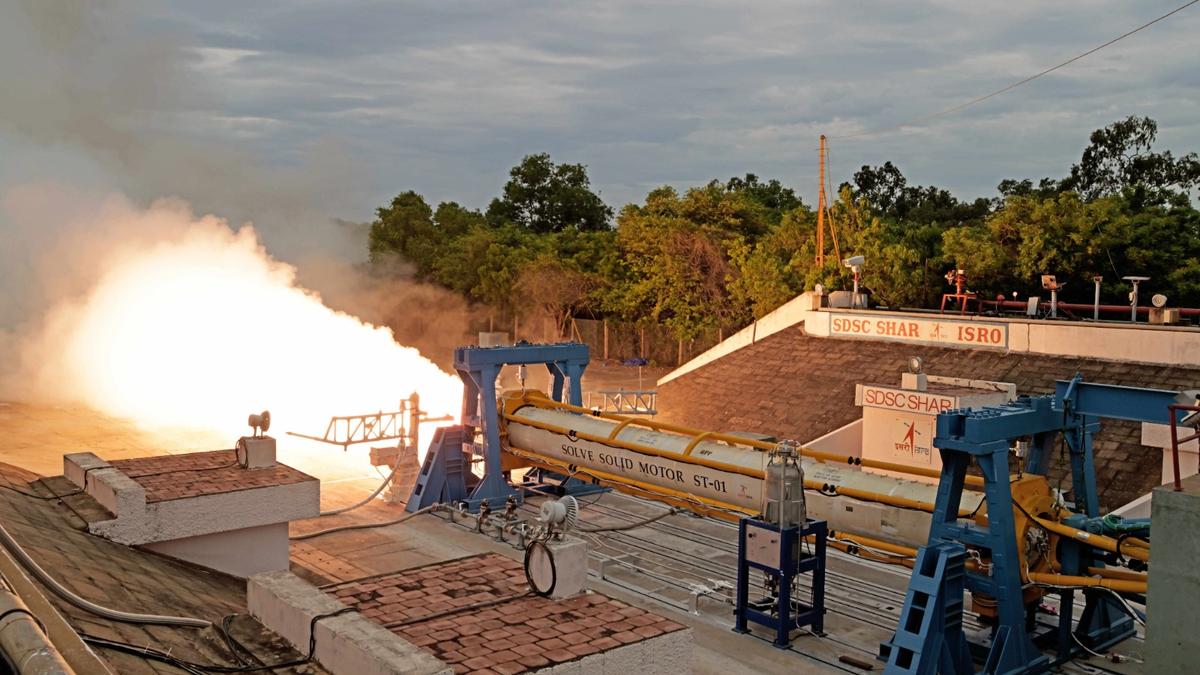
The Indian Space Research Organisation (ISRO) has successfully conducted the first ground test of the Sub-Orbital Launch Vehicle for Experiment (SOLVE) solid motor at the Static Test Facility, Satish Dhawan Space Centre (SDSC), Sriharikota. The successful test marks a significant milestone in validating critical technologies for India's Gaganyaan Human Spaceflight Mission.
What is SOLVE?
The Sub-Orbital Launch Vehicle for Experiment (SOLVE) is a specialised test platform developed by ISRO to validate the deceleration and recovery systems of the Gaganyaan Crew Module under realistic flight conditions before undertaking human spaceflight.
Unlike an orbital launch vehicle, SOLVE performs sub-orbital missions, reaching lower altitudes without entering Earth's orbit. These missions are intended to test critical systems that ensure the safe return of astronauts.
Key Features
- Developed specifically for Gaganyaan qualification tests.
- Carries the Crew Module to an altitude of 10–17 km before separation.
- Designed to validate the Integrated Parachute Deceleration System.
- Uses a solid propulsion stage derived from the PSLV Strap-on Motor, with modifications to meet human spaceflight requirements.
- Incorporates:
- Slow burn-rate solid propellant for controlled performance.
- Straight nozzle configuration.
- Secondary Injection Thrust Vector Control (SITVC) for improved flight stability and control.
How the Test Mission Works
During a SOLVE mission:
- The launch vehicle carries the Crew Module to an altitude of 10–17 km.
- The Crew Module separates from the vehicle.
- A carefully sequenced parachute deployment system is activated.
- A total of 10 parachutes deploy in different stages to progressively reduce the module's speed.
- The Crew Module finally performs a safe splashdown in the sea, simulating the recovery phase of the Gaganyaan mission.
These tests help verify the reliability of the deceleration system under different flight conditions before astronauts are flown.
About the Gaganyaan Mission
Gaganyaan is India's first indigenous human spaceflight programme, aimed at demonstrating the country's capability to safely send humans into space and return them to Earth.
Objectives
- Demonstrate India's indigenous capability to undertake human spaceflight.
- Send a crew of three astronauts into Low Earth Orbit (LEO) at an altitude of approximately 400 km.
- Keep the crew in orbit for about three days before ensuring their safe return through splashdown and recovery.
- Promote scientific research by conducting microgravity experiments.
- Lay the foundation for a long-term Indian human space exploration programme, including future space stations and deep-space missions.